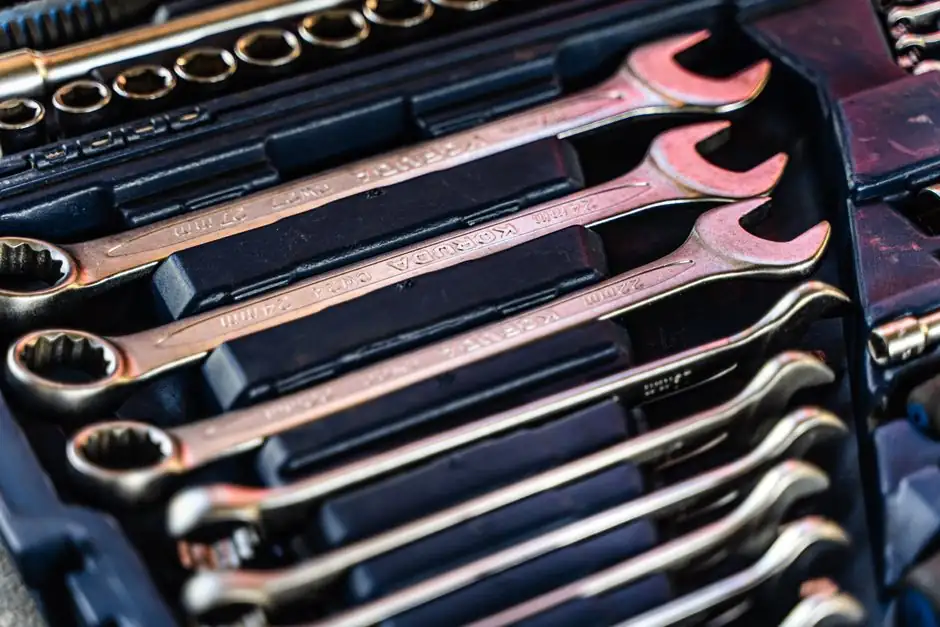
3/8" and 1/2" drive air impact wrenches dominate landscaping fastening, with the FW-8300 and FW-8400 series shipping 10-piece master cases at 15.48 kg and 16.48 kg total mass respectively, sized to fit a 1.48 cubic-foot master carton [S2].
Landscaping crews hit three fastener regimes: timber-deck lag bolts (low torque, high count), mower and chipper blade bolts (mid torque, shear-sensitive), and auger/stump-grinder drive hardware (high torque, infrequent). The air impact wrench drive square must be matched to the socket fleet, not the other way around.
Drive Square Selection: 3/8", 1/2", 3/4"
Drive square determines the maximum torque the tool can transmit before the anvil twists, and 1/2" remains the default for general landscaping because it covers most deck, fence, and equipment-blade fasteners in a single body [S1]. For light under-deck screw work and irrigation valve assembly, the air ratchet wrench family offers 3/8" drives in a straight inline body, sized to enter the 50-80 mm cavities common under raised timber decking [S4].
Industrial 1" drive air impact wrenches exist for heavy nut-busting, and the Central Pneumatics #94109 ships as a 1" pneumatic impact with a matched socket set for high-load service, with a used market reference of US $199.99 [S3]. Landscaping rarely needs 1"; 3/4" is the realistic ceiling for auger drives and stump cutter tooth holders.
Torque Tier Mapping to Landscaping Fasteners
Most landscape lag bolts (3/8" to 1/2" hot-dip galvanised) seat between 60-90 ft-lb, well inside the working range of a 3/8" impact wrench rated around 90-150 ft-lb nut-busting output. Mower blade bolts (typically 9/16", grade 8) sit at 70-110 ft-lb and must be re-torqued in reverse to avoid stretching the shoulder bolt. [S1]
For stump grinder teeth and auger flight bolts, step up to a 1/2" or 3/4" drive tool delivering 300-600 ft-lb working torque, paired with impact-rated sockets (chrome-moly, black phosphate, not chrome-vanadium). The impact drill comparison matters here only at the hole-prep stage; for fastener drive-out, the impact wrench owns the job.
Air Consumption and Compressor Sizing on Site

Air impact wrenches in the 1/2" landscaping class typically demand 4-6 CFM at 90 psi, meaning a portable gas-driven compressor rated at 9-12 CFM continuous keeps two wrenches running without starv-cycles. Three-quarter-inch tools push to 8-10 CFM at working pressure, so a tow-behind 17-25 CFM compressor is the practical minimum. [S1]
Inline lubrication is mandatory; most landscaping crews skip the lubricator because trailer compressors feed wet air, which shortens hammer-jig life. Drop a 1/2" NPT inline lubricator set to 1-2 drops per minute at the manifold. Filter regulators belong upstream of the lubricator, not after, to keep water out of the oil reservoir.
Hose, Fittings, and Reel Setup for Crew Mobility
3/8" ID hose is the minimum for 1/2" impact wrenches under continuous load; 1/2" ID keeps pressure drop under 5 psi at 50 ft run. Landscaping layouts rarely exceed 100 ft from compressor to operator, so a 3/8" x 50 ft hybrid hose on a rewind reel covers most residential and light commercial sites. [S3]
Quick-connect fittings should be 1/4" industrial (MIL-spec) on the tool side and 3/8" on the hose-end to match flow. Push-to-lock couplers save time when a crew is swapping between air impact wrench and air ratchet wrench bodies across deck and equipment work.
Failure Modes Specific to Landscape Service
Dust ingestion is the dominant killer: soil fines and grass clip silica enter through the exhaust and abrade the hammer mechanism. Daily exhaust-port blowing-out and weekly flushing with pneumatic tool oil extends service life 2-3x on landscaping fleets versus uncared-for shop tools. [S1]
Drop damage on rocky ground bends the drive anvil and cracks the hammer case; the giveaway is a wobble at idle before any torque loss. Do not run a bent-anvil tool: the off-axis hammer blows destroy the air motor front bearing within hours.
Standards and Sourcing Reference
Pneumatic hand tools in this category are catalogued under Taiwan CENS pneumatic hand tools (impact wrenches and air sockets), with OEM examples including the FW-8300 (3/8") and FW-8400 (1/2") at 15.48 kg and 16.48 kg per 10-piece case and 1.48 cu-ft carton volume [S2]. Industrial 1" drive air impact wrenches such as the Central Pneumatics #94109 ship with matched socket sets and are sourced in the secondary market around US $199.99 [S3].
For broader landscaping fastening work, the air impact wrench picks for masonry fastening reference covers similar torque tiers but on concrete anchors, and the air impact wrench selection for demolition piece covers the high-end drive-size and failure logic that the 3/4" landscaping tool inherits. Watch for 2026 Q4 OEM announcements on brushless-motor cordless alternatives in the same torque class; air still owns the duty cycle on landscaping fleets, but the gap is narrowing.