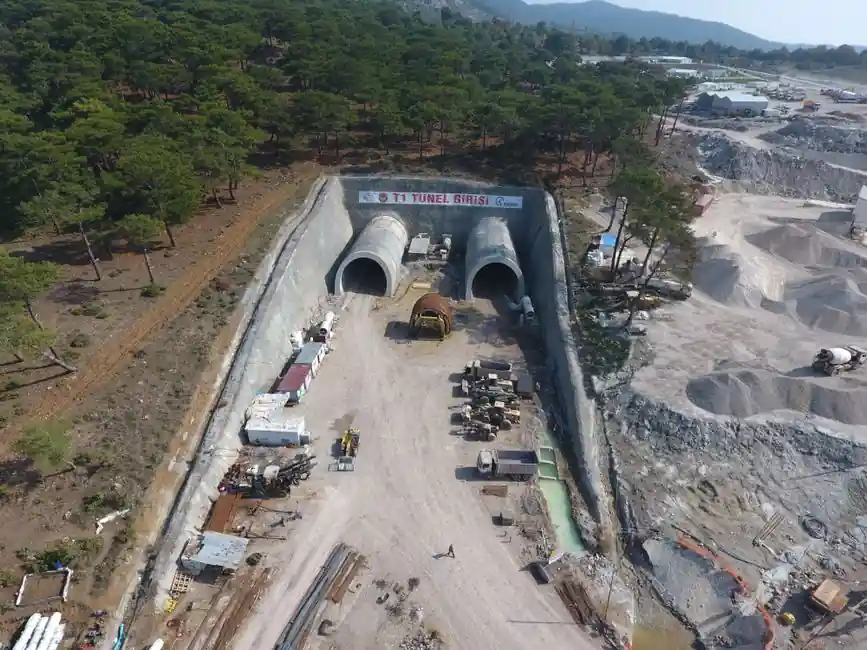
1" drive air impact wrench models delivering 1950 ft-lb (2644 N·m) of maximum torque at 7,500 rpm free speed are the reference class for hard-rock tunnel heading bolting, per the WS-2108 specification sheet on CENS [S10].
Tunnel-heading crews run three to five pneumatic wrenches per face for rock-bolt and rib-connection tightening, so the torque class, drive anvil size, exhaust orientation, and air-consumption rate must be matched to the largest fastener in the BOM before the compressor is sized.
Drive Size and Torque Envelope by Fastener Class
Rock-bolt diameters in modern tunnel support systems range from M24 to M36, and the required breakaway torque at the nut face scales with bolt diameter and grout condition: a typical M27 bolt in cured resin or cement grout needs roughly 800-1100 N·m to bring up, while M30-M36 ground-support bolts regularly demand 1500-2500 N·m during initial tightening [S10].
The 1" drive class is the practical floor for tunnel heading work, with 1950 ft-lb (2644 N·m) peak torque and 1-1/8" (30 mm) standard bolt capacity on the WS-2108 [S10]; 3/4" heavy models cover lighter M24 segment-bolt work but under-deliver on M30 ground-anchor nuts [S3]. 1/2" drive wrenches at 10-piece export cartons of 22.0/25.28 kg and 1.48 cuft volume [S1] are reserved for rib-connection hardware, mesh-clip torquing, and form-tie work inside the heading where weight matters more than peak torque.
Mechanism, Free Speed, and Air Demand
Twinned-hammer impact mechanisms remain the standard for sustained high-torque output, and the 7,500 rpm free speed published for the 1" WS-2108 [S10] gives the impact rate (typically 900-1500 BPM on this class) needed to seat a large ground-support bolt without stalling under load.
Air consumption for the 1" class sits in the 6.2-8.5 CFM (175-240 L/min) range at 90 psi (6.2 bar) working pressure with a 3/8" PT or NPT inlet [S10], which means a single heading compressor rated in the 185-375 CFM bracket can feed four to six 1" wrenches simultaneously. Compressed-air quality at the heading must be dried to a pressure-dew point of 3-5°C below ambient for tunnel muck and shotcrete dust service, otherwise the hammer mechanism ingests fines and the anvil busing wears inside a single shift.
Exhaust Path, Vibration, and Heading Air Quality
Tunnel-heading wrenches should have rear- or side-exhaust ports routed away from the operator's breathing zone and the shotcrete nozzle, because diesel particulate and RCS (respirable crystalline silica) are the dominant long-term health hazards underground; an un-directed front exhaust turns the tool into a dust re-suspension source. [S2]
For utility-tap work, electrical-panel mounting, and shotcrete-rib fastening where dust load is lower, the air impact wrench picks for masonry fastening guide covers lighter 1/2" and 3/8" classes that a heading mechanic might keep as a secondary tool. Vibration-transmitted hand-arm injury is a real risk on 1" wrenches at sustained 8-10 m/s² triaxial values, so job-rotation schedules, anti-vibration gloves rated to ISO 10819, and tool tethering to a load-rated lanyard are the standard controls on a mechanised heading.
What an Air Impact Wrench Will and Will Not Do in a Tunnel
For ground-support and rock-bolt tightening on the heading, a 1" drive pneumatic wrench rated 1900-2700 N·m peak with twin-hammer action, 3/8" air inlet, and rear exhaust is the correct tool; it handles M27-M36 bolts at production rates of 25-40 bolts per hour per wrench in competent rock [S10].
It is the wrong tool where the application is interior MEP fit-out, suspended-ceiling hanger torquing, or electrical-tray fastening, where a 1/2" or 3/8" drive is faster, lighter, and less fatiguing, as mapped in the air impact wrench selection for interior finishing reference. The pneumatic wrench also does not replace a calibrated hand torque wrench tester for QA on final rock-bolt tension, because impact wrenches do not control clamp load to within the ±10% tolerance most tunnel-support specifications require for recordable torque audit.
Comparison: 1/2" vs 3/4" vs 1" Drive Classes
On a four-criterion decision matrix, 1/2" drive wrenches at 10-piece export packs of 22.0/25.28 kg total mass [S1] deliver 280-680 N·m typical peak torque at the lowest air cost (3-4 CFM), making them the weight-optimised pick for rib-and-mesh work; 3/4" heavy models scale torque to 1100-1700 N·m with a 1/2" air inlet and 4-6 CFM demand [S3], the right band for M24 segment bolts and concrete anchor sleeves; 1" drive wrenches top the range at 1950 ft-lb (2644 N·m) peak and 7,500 rpm free speed with 6.2-8.5 CFM demand and 30 mm standard bolt capacity [S10], the only class that consistently breaks M30-M36 ground-support nuts free on the first run.
Air-supply infrastructure cost scales with CFM, not with wrench count, so a heading running four 1" wrenches needs a compressor in the 185-375 CFM bracket, while the same four-wrench crew on 3/4" tools can drop to a 150-250 CFM unit.
Air-Supply, Lubrication, and Standards Anchors
Working pressure of 90 psi (6.2 bar) is the industry reference for the 1" class [S10], and the air inlet must match the manifold standard (3/8" PT or NPT) to avoid adapter restrictions that drop impact energy 10-15% under load.
Inline lubrication with a 2-3 drop-per-minute oiler (ISO VG32 turbine oil) or pre-lubricated hose is the standard practice to keep the hammer mechanism within the 600-800 hour service interval; dry-heading air without lubrication can cut hammer life by more than half. For tunnels classified as gassy (methane) orcoal-heading-adjacent, the wrench must be certified to ATEX category M2 or IECEx equivalent for Group I M1/M2 equipment; pneumatic tools are intrinsically safer than corded electric in such headings because there is no electrical sparking source at the tool body. Hose-burst safety whip-checks and a 1/2" minimum ID supply hose are mandatory to keep pressure drop over the 30-50 m hose reel below 10% at peak demand.
Failure Modes and Service Intervals

The dominant in-service failures on 1" heading wrenches are anvil-bushing wear (visible as head drift or socket wobble after 300-500 hours), hammer-pin fatigue (audible as a loss of impact "kick" between 600-800 hours), and trigger-valve stiction from water-contaminated supply air. [S1]
Heading mechanics should log cycle hours on each wrench and pull the tool for anvil service at 250 hours of heading time, because a worn anvil on an M36 bolt turn typically rounds the nut corner before the operator feels the loss of torque. For demolition-adjacent heading work where the wrench doubles as a bolt-buster, the air impact wrench selection for demolition reference covers the higher-vibration duty cycle and earlier service intervals. The pneumatic air pick and chipping hammer remain the correct tool for concrete spalling and heading cleanup; do not substitute an impact wrench for sustained chipping duty because the hammer mechanism is tuned for rotary impact, not reciprocating percussion.
For a working heading in August 2026, the verifiable procurement track is: confirm the largest bolt in the current support pattern, select the 1" drive class if M30 or larger is routine [S10], size the compressor to 6.2-8.5 CFM per wrench [S10], and verify ATEX/IECEx Group I certification before placing the order for any gassy-coal or methane-classified heading.
