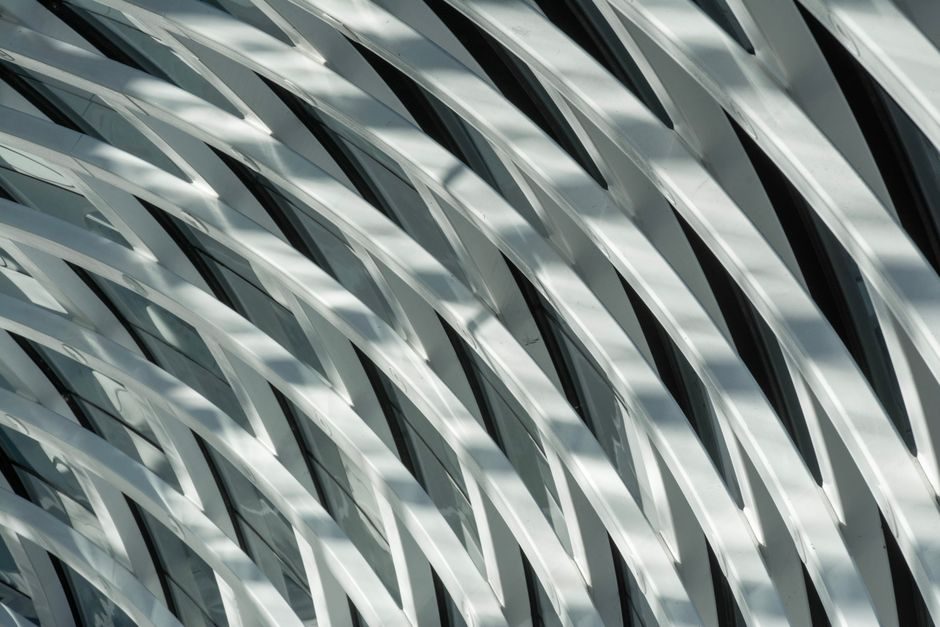
Standard single-skin aluminum veneer panels (2.0-3.0 mm, PVDF or PE coil-coated) shipped FOB from Foshan and Guangzhou factories cluster at US$40-100/sqm at a 20 sqm minimum order, with carved, curved, and perforated fabrications reaching US$50-160/sqm on the same line [S1].
The range below is what verified China-manufacturer storefronts are publishing on 2026-07-03, drawn from Foshan Zhuzao, Guangdong Bahe, Guangzhou Xinghe, Brilliance China, Guangzhou Bolon and Foshan Xinlvxiang [S1][S2][S3][S4][S6][S7]. Solid aluminum veneer panels — single sheet, no plastic core — sit at the high end; aluminum composite panels (two 0.5 mm skins over LDPE/FR core) are the cheap tier; aluminum honeycomb panel variants are the rigid mid-tier with the best strength-to-weight ratio.
FOB Price Bands by Product Type (2026-07-03 listings)
Three core SKUs dominate storefront catalogs and they price on a clear ladder. Carved/curtain-wall single-skin veneer: US$50-100/sqm FOB at 20 sqm MOQ [S1]. Custom triangle/perforated curtain-wall screen: US$30-160/sqm FOB at 20 sqm MOQ — perforation geometry and open-area ratio drive the spread [S1]. 3D-punching facade veneer: starting from US$40/sqm on the same terms [S1].
ACP (3-4 mm PE or FR core, 0.21-0.50 mm skin) typically lands 20-40% under equivalent single-skin veneer because the LDPE/FR core replaces expensive aluminum mass. Standard 1220×2440 mm 4 mm PE-core ACP panels are commonly quoted in the US$3-8/sqm range on B2B wholesale portals when 4 mm PE-core stock is sold in pallet quantities [S8]. Fire-rated FR-core A2/B1 grades add roughly US$2-4/sqm versus PE-core stock. Honeycomb panels (10-25 mm total, 0.7-1.0 mm skins over 3003/5052 honeycomb core) typically price US$25-60/sqm FOB at 50+ sqm MOQ, with PVDF-coated exterior-grade stock commanding the upper half [S7].
Material, Thickness and Coating Cost Drivers
Coil-coated alloy choice is the first cost lever. 1100-H14 and 3003-H14 are the workhorse alloys for architectural veneer; 3003 commands a 5-8% premium over 1100 because of higher Mn content and better formability for curved panels. 5052 is reserved for high-strength or marine-grade specifications and adds another 10-15% above 3003 [S7].
Thickness scales cost roughly linearly. PVDF (Kynar 500/Hylar 500-grade) finishes carry a 15-25% premium over polyester (PE) for the same panel, reflecting the fluoropolymer resin cost and the higher 230-250 °C cure window [S1][S2].
Surface fabrication stacks cost on top of base panel. Perforation, carving, 3D-punching and CNC-bent curves all require programming, fixturing, and scrap — the 50-160 USD/sqm carved/curtain-wall tier published by Foshan Zhuzao reflects this conversion overhead [S1]. For comparison, our aluminum veneer vs building stone spec cut shows stone full-bed cladding typically lands 2-4× higher on installed cost when you include the wet-fix masonry labor line.
What $40 vs $100 vs $160/sqm Actually Buys
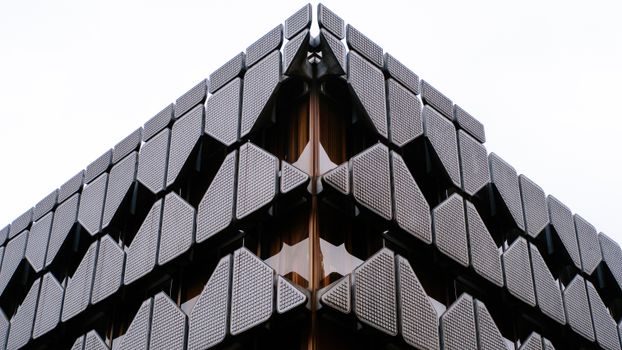
At US$30-45/sqm you are looking at stock 4 mm PE-core ACP or 2.0 mm single-skin PE-finish panels in standard RAL colors, no perforation, no carving, 20 sqm MOQ. Suited to interior feature walls, canopies, and small commercial soffits where fire rating is not the primary spec driver [S1][S8].
At US$50-80/sqm you enter the workhorse architectural band: 2.5-3.0 mm 3003-H24 PVDF 2-coat-2-bake, custom RAL, factory-bent returns, simple straight perforation. This is the band where the bulk of PRC-spec commercial curtain-wall and aluminum window-door integration projects land [S1][S2][S6].
At US$100-160/sqm you are paying for double-curvature, complex perforation, carved/etched patterns, anodized post-coating or 3-coat-3-bake PVDF with 30-year warranty systems. Lead time stretches from the 15-workday off-season norm to 30-45 days, and tooling charges of US$300-1,500 per die are common for the perforation and carving masters [S1][S4].
Lead Time, MOQ and Incoterm Reality from Foshan and Guangzhou
Standard off-season lead time across the surveyed Foshan/Guangzhou manufacturers is 15 workdays for stock-finish PE/PVDF panels in standard thicknesses; peak-season stretch is "within one month" with PVDF coil-coat lines running near capacity in Q3 [S4]. MOQ for fabricated panels sits at 20 sqm on the public storefront listings, but custom color matching (non-stock RAL, wood-grain transfer, stone-print sublimation) typically requires 200-500 sqm to recover the paint-line changeover cost [S1][S4].
Incoterms published are FOB and CIF on most Made-in-China storefronts, with payment by T/T or LC at sight [S1][S4]. Sea freight from Guangzhou or Foshan to North-Europe main ports in 2026 has ranged US$2,800-4,200 per 40 ft HC depending on bunker surcharges, and a 40 ft HC takes roughly 1,500-1,800 sqm of 2.5 mm veneer or 2,800-3,200 sqm of 4 mm ACP — so the freight line item is real at roughly US$1.50-2.50/sqm landed European port for a full container of veneer.
Standards, Fire Rating and Certification Levers
The two specs that move price most on a buy order are fire-rating class and coating warranty. China GB 8624-2012 grades panels A1/A2 (non-combustible), B1 (difficult-to-ignite), B2 (ordinary), and B3 (easily-ignitable); for high-rise curtain wall over 24 m and for most European-spec projects, GB 8624 B1 / EN 13501-1 B-s1,d0 or better is the typical minimum, which forces an FR (mineral-filled) core or a 3 mm+ solid aluminum alloy skin [S8].
Coating warranties: PE finishes are typically warranted 5-8 years exterior; PVDF 2-coat-2-bake 15-20 years; PVDF 3-coat-3-bake with clear topcoat 25-30 years. AAMA 2603 (PE) and AAMA 2605 (PVDF high-performance) are the equivalent US architectural references. The 5-10 year warranty jump from PE to PVDF is roughly the 15-25% premium quoted in section 2 of this guide [S2][S6].
Verification Steps Before Placing a PO
Four checks separate a clean PO from a dispute. First, request the mill test certificate (MTC) for the 1100/3003/5052 alloy and confirm temper (H14/H24/H44) matches spec — a 1100-H14 substitution for 3003-H24 will fail on curved returns. Second, demand a current third-party PVDF resin certificate (Kynar 500 or Hylar 500) — not all "PVDF" finishes contain 70% fluoropolymer resin. Third, confirm coating thickness by micrometer: PVDF 2-coat-2-bake typically lands 25-35 µm primer + 20-30 µm topcoat, total ≥ 30 µm. Fourth, sample-test flatwise tensile and 90° peel for ACP (≥ 7 N·mm/mm is the typical FR-core spec). [S1]