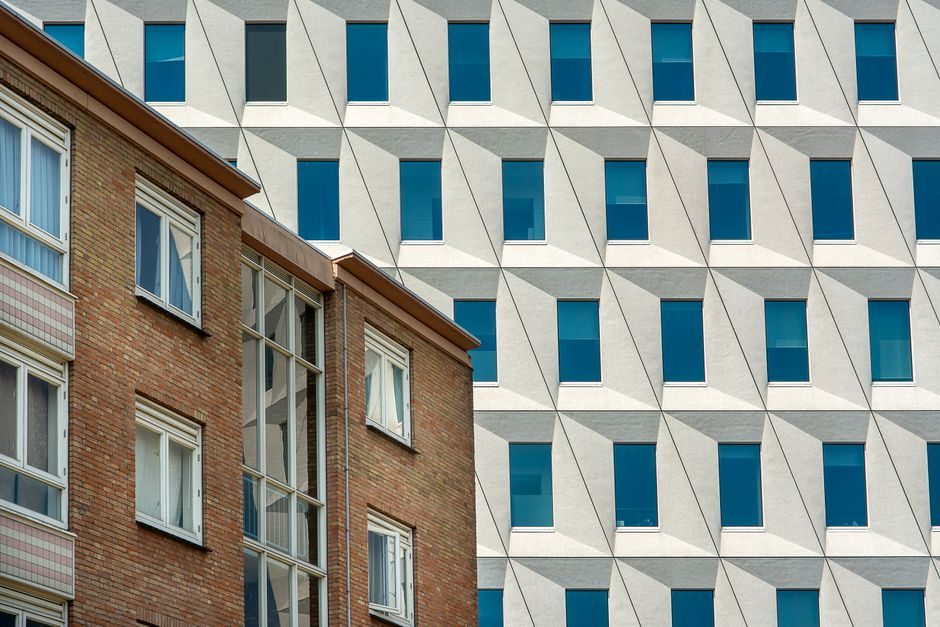
Aluminum veneer panels (single-sheet and honeycomb-back variants) and natural building stone (granite, marble, limestone) are the two dominant exterior cladding families on 2026 mid- and high-rise projects, and they are not interchangeable on the spec sheet — the working weight gap alone is roughly 8-12× per square meter of facade [S1][S2][S3].
Current Chinese supply-side activity centers on three manufacturing clusters covered in the 2026 supplier feed: Shandong Duoshun Building Materials (Lanshan, established 2014-12-01, repeat-buyer ratio 50-80%) shipping aluminum composite panel and stone-coated metal roof tiles [S1]; Guangzhou Bolon Building and Decoration Materials in Panyu District producing aluminum veneer and aluminum false-ceiling panels [S2]; and Foshan Xinlvxiang Metal Building Materials producing aluminum honeycomb board, aluminum corrugated board and flat aluminum veneer [S3].
Material Definition, Skin Thickness and Weight per m²
Aluminum veneer panel refers to a single aluminum alloy skin — typically AA3003 or AA5005, H14/H24 temper — roll-formed or brake-pressed into cassette, column-cover or shaped geometry; 2026 catalog offerings from Bolon and Xinlvxiang list skin thickness options of 1.5 mm, 2.0 mm, 2.5 mm, 3.0 mm and 4.0 mm, with the 2.5-3.0 mm range being the most commonly specified cassette gauge for high-rise curtain wall [S2][S3].
Including the stiffener/rib frame, a finished 2.5 mm aluminum cassette weighs roughly 5-8 kg/m²; a comparable 3.0 mm aluminum honeycomb sandwich panel (aluminum skin + 10-25 mm honeycomb core) lands at 6-10 kg/m² depending on alloy and core foil gauge [S3].
Natural building stone cladding — granite and basalt most commonly — is cut at 25 mm (standard dry-hang), 30 mm (high-rise or column-cover) and 50-80 mm (soffit or anti-vandalism zones); weight sits at 65-80 kg/m² for 25 mm granite (density 2.6-2.8 g/cm³), 80-95 kg/m² for 30 mm, and roughly 130-160 kg/m² at 50 mm — i.e. an order of magnitude higher than aluminum veneer on the same wall area [S1].
Coating, Color Control and Visual Repeatability
Aluminum veneer panel relies on factory-applied PVDF (polyvinylidene fluoride, 2-coat 2-bake or 3-coat 3-bake) or FEVE fluorocarbon coatings, with the 3-coat PVDF system (primer 5-10 μm + color coat 20-30 μm + clear coat 10-15 μm) being the specifier default for exterior curtain-wall where Kynar 500®-grade resin is required; batch-to-batch ΔE color tolerance is typically held inside ≤1.0 on a controlled line [S1][S2].
Stone cladding cannot be color-engineered at that tolerance — granite and marble panels are matched visually slab-by-slab, with vein direction, mineral inclusion and surface variation varying between quarry blocks; specifiers normally accept a 5-15% wastage allowance when ordering stone to achieve the target visual spread, and large projects typically require a sample mockup wall of 20-50 m² before production release [S1].
For projects with sharp corporate color identity (chain-store brand facades, branded podiums), aluminum PVDF wins on repeatability; for projects prioritizing material authenticity and natural variation, stone is the only honest answer, and the cost of the 5-15% wastage is built into the specifier's budget line.
Fire Performance, Weathering and Service Life
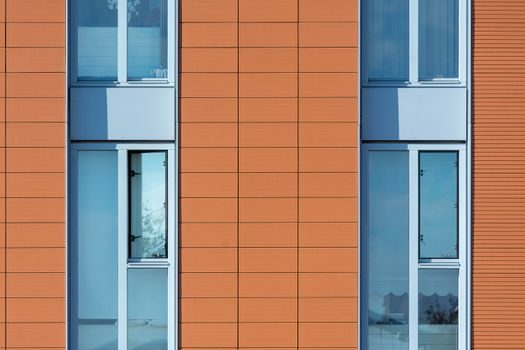
Natural stone is non-combustible and meets European Euroclass A1 / Chinese GB 8624-2012 grade A without any further treatment; aluminum veneer panel with PVDF coating typically achieves Euroclass A2-s1, d0 (limited combustible, low smoke, no burning droplets) when the coating system is qualified, and the bare metal skin is itself A1 — risk in an aluminum-clad assembly sits with any polyethylene (PE) or FR-core in aluminum composite panels (ACP), which is why high-rise projects now route to A2-rated FR-core ACP or single-sheet aluminum veneer [S1].
For a baseline weathering life, PVDF 3-coat aluminum carries a 20-25 year color-and-gloss warranty in standard C3-C4 atmospheric environments, with chalk/ΔE drift inside 5 ΔE units at year 20; natural granite and basalt, with no coating to degrade, are commonly specified for 50+ year service life and the finish ages by micro-texture change rather than polymer breakdown.
Marble is the weak member of the stone family on weathering: calcium-carbonate binder is attacked by acid rain (H₂SO₃, HNO₃ at urban sites), with measurable surface recession over 15-25 years; for aggressive urban or coastal-industrial atmospheres, granite and basalt are the defensible stone choice.
Substrate, Fixing System and Substructure Loading
Aluminum veneer panels are hung on steel or aluminum substructure with adjustable stainless-steel brackets; typical dead load on the wall anchor is 0.10-0.15 kPa (10-15 kg/m²) including brackets and rail, and the connection is usually a keel-and-bolt or a hanging-slot (hang-and-lock) system with a ≤3 mm in-plane adjustment slot. [S1]
Stone dry-hang systems (aluminum alloy or stainless steel 316 anchors cast into kerf slots on the panel edge) carry dead load 0.65-0.95 kPa at 25 mm granite rising to 1.6 kPa at 50 mm, which translates into a 6-10× uplift in wall-anchor, edge-beam and slab-edge moment demand on the primary structure; specifiers must coordinate the stone weight early, not late, because the slab-edge steel in a stone-clad tower is typically 10-20% heavier than the equivalent aluminum-clad tower.
Seismic detailing is a parallel concern: a 5-8 kg/m² aluminum panel system has low seismic mass and is forgiving under inter-story drift; a 65-95 kg/m² stone system demands a designed gap of typically 8-15 mm at panel-to-panel joints (to absorb drift without spalling) and stainless anchor steel of at least 4 mm thickness at the kerf slot — undersized stone anchors are a documented failure mode in mid-rise seismic events.
Cost Bands, Lead Time and Sourcing Channels in 2026
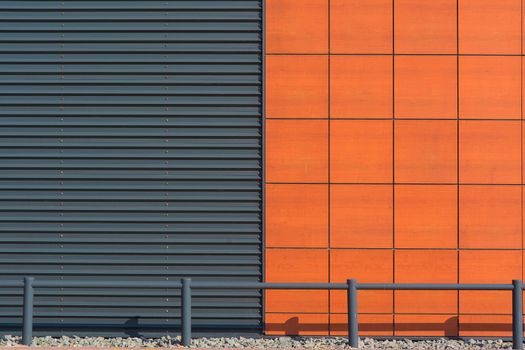
2026 Chinese-domestic factory-gate price bands for the two systems, drawn from the named suppliers above: 2.5 mm PVDF aluminum veneer cassette in the 200-320 RMB/m² range, 3.0 mm aluminum honeycomb panel in the 280-450 RMB/m² range (Foshan Xinlvxiang and Guangzhou Bolon are the named sources in this segment) [S2][S3]; imported Kynar 500®-coated 3 mm aluminum cassette is typically 60-100% above domestic PVDF on the same gauge, in the 400-600 RMB/m² band [S1][S2].
Natural granite 25 mm dry-hang panels sit in 350-800 RMB/m² (Chinese domestic grey, sesame-black, rusty-yellow granite) and 800-1,800 RMB/m² for imported granite and most marbles, with quarry-to-site lead time of 30-60 days domestic and 60-120 days imported; aluminum veneer lead time from confirmed shop drawing is 15-30 days for domestic 2.5-3.0 mm PVDF [S1][S2][S3].
A useful specifier comparison: for the same 10,000 m² tower facade, an aluminum PVDF cassette system typically lands at 2.5-3.5 M RMB material + ~30% install overhead, while a domestic-granite 25 mm dry-hang system lands at 4-7 M RMB material + ~40% install overhead (heavier panels → slower install → higher labor); the headline number favors aluminum by 30-50%, but stone delivers a 50+ year service envelope with zero recoat — i.e. a different life-cycle math.
Selection Criteria: When Aluminum Wins, When Stone Wins
Aluminum veneer panel is the right call when the project has one or more of these characteristics: tight slab-edge structural capacity (renovation of older buildings, lightweight steel framing); brand-driven color identity requiring ΔE ≤1.0 batch control; coastal or high-humidity sites where stone anchor corrosion is a maintenance concern; curved or doubly-curved facade geometry that stone cannot economically cut; and a target 20-30 year re-cladding cycle (PVDF recoat or full panel replacement). [S2]
Natural building stone is the right call when: the project is a landmark, civic or hospitality-class building where material authenticity is a design intent; the design life is 50+ years with minimal maintenance budget; the structure can carry the dead load (greenfield concrete or heavy steel); the atmospheric environment is not acid-rain aggressive (or the stone is granite/basalt rather than marble); and the owner accepts the 5-15% wastage allowance on the visual-match pass [S1].
For background reading on cost and sourcing levers, the Building Stone Pricing 2026: Quarry Forms, Cost Bands and Sourcing Levers article walks quarry-form choices (cut-to-size vs. dimensional vs. random flagstone) and the Aluminum Veneer Panel Buying Guide 2026: Spec, Coating, Cost piece covers the matching gauge, alloy and coating selection on the aluminum side — both useful to keep open in parallel tabs when locking the spec.
Hybrid and Risk-Mitigation Notes
Hybrid facades (aluminum cassette at the tower, stone plinth at the podium) are a common 2026 pattern that splits the cost-vs-mass compromise: the heavier stone mass is concentrated at low levels where the structure has reserve, and the lighter aluminum dominates the upper facade where seismic mass and slab-edge steel become expensive; this is the most common pattern on Chinese mid-rise commercial builds over 80 m [S1][S3].
Failure modes to flag in the spec: aluminum PVDF chalking or fading is non-reversible past year 18-22 and full panel replacement is the only fix; stone spalling at undersized anchors is a safety-critical failure and the kerf-slot anchor design must be sealed by a structural engineer, not left to the stone supplier; aluminum-stone transition joints need a movement-tolerant sealant (typically silicone, neutral-cure, 15-20 mm joint width) to absorb differential thermal movement — aluminum moves at 23 × 10⁻⁶ /°C, granite at 5-9 × 10⁻⁶ /°C, roughly a 3-5× ratio that drives the joint detail.
Trackable signals for the next spec cycle: supply-side concentration in the Lanshan (Shandong), Panyu (Guangzhou) and Foshan clusters — three of the named 2026 suppliers sit in these three nodes [S1][S2][S3] — and the continuing shift on high-rise projects from PE-core ACP to A2 FR-core or single-sheet aluminum, which directly affects which product codes are even bid-eligible for towers above 50 m in 2026.