
Aluminum veneer panels divide into five production families in current 2026 Chinese building-material catalogues: standard single panel, carved/3D relief, hyperbolic/curved, aluminum honeycomb composite, and aluminum-plastic composite (ACP), each differentiated by substrate thickness, surface coating, and forming process [S1][S2][S3][S4].
Single-panel production dominates Foshan and Guangzhou supply, with Foshan Zhuzao listing carved, perforated, U-shaped, open-grid, and wood-grain variants under one factory roof, while ENOXBELL catalogues fluorocarbon, hyperbolic, and honeycomb lines as separate SKUs [S1][S2].
Single-Panel Family: Thickness, Alloy, and Coating Logic
Single aluminum panels are typically produced from 1xxx/3xxx-series aluminum alloy sheet, with 2.0–3.0 mm the most common exterior cladding gauge and 1.5 mm reserved for interior ceilings per ENOXBELL's product zone [S2].
Fluorocarbon (PVDF) coating is the dominant exterior finish for aluminum veneer panel single sheets, while polyester powder coating and wood-grain transfer printing handle interior and decorative sub-lines [S1][S2][S6]. Foshan Zhuzao's product tree lists "wood grain aluminum curtain wall" and "glass aluminum curtain wall" as separate sub-categories under the single-panel family [S1].
Punched/screen and open-grid ceiling panels are single sheets after CNC perforation, used where ventilation or acoustic transparency is required; Guangzhou Bolon lists "aluminum false ceiling" and "punched aluminum ceiling" as primary SKUs alongside flat veneer [S1][S3].
Carved and 3D Relief Panels: Forming Process and Material Penalty
Carved (engraved) panels are produced by CNC routing or laser cutting of a thicker single sheet — typically 2.5–3.0 mm base — then folding/welding into a hollow relief module, with ENOXBELL listing "carved aluminum panels" as a flagship decorative SKU [S2].
The forming process limits minimum bend radius to roughly 1.5× sheet thickness before cracking appears at the fold.
Carved modules are typically back-stiffened with internal aluminum alloy ribs and mounted on a steel or aluminum sub-frame, with ENOXBELL and Foshan Zhuzao both shipping carved panels as assembled cassette units rather than flat stock [S1][S2].
Hyperbolic, Curved, and Arc Panels
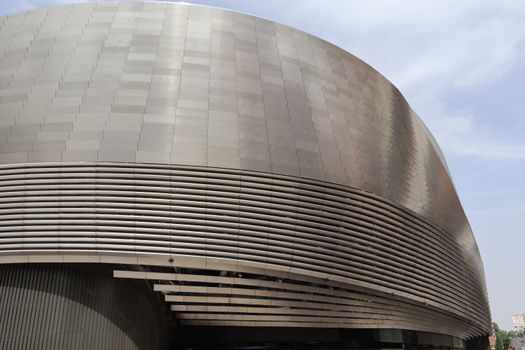
Hyperbolic and arc single panels are shaped by stretch forming, three-roll bending, or hot-bending of 2.0–3.0 mm sheet; ENOXBELL markets "hyperbolic-shaped aluminum panels" and "curved aluminum single panel" as a distinct product zone alongside flat sheet [S2].
Minimum cold-bend radius for 3003-H14 sheet at 2.0 mm thickness is approximately 3 mm inner radius without annealing, and tighter radii require induction heating or hot-forming, which adds 20–40% to panel cost and 5–10 working days to lead time relative to flat stock [S2].
Curved panels are commonly paired with aluminum honeycomb panel backing when project specs demand impact resistance or large-format single-piece facades without oil-canning; ENOXBELL ships both "curved aluminum single panel" and "curved honeycomb panel" as separate engineered products [S2].
Honeycomb Composite Family: Skin, Core, and Bonding
Aluminum honeycomb panels use 0.7–1.0 mm aluminum face skins bonded to a 3003 or 5052 honeycomb core (cell size typically 6–19 mm, foil thickness 0.04–0.08 mm) with two-part polyurethane or epoxy adhesive, producing a sandwich with 20–30× the stiffness of the skin alone at equal weight [S2][S4].
Alustrong's product list distinguishes "aluminum composite panel," "aluminum honeycomb panel," and "aluminum plate" as three independent categories, with honeycomb panels reaching 6 m × 1.5 m single-piece sizes commonly used for ship bulkheads, elevator cabs, and large curtain-wall modules [S4].
Premium honeycomb sub-lines substitute titanium-zinc, stainless steel, or copper face sheets for the aluminum skin, with ENOXBELL offering titanium-zinc, stainless steel, and copper honeycomb panels as separate catalogue entries for architectural-grade façades where galvanic compatibility with adjacent aluminum window door framing must be engineered [S2].
Aluminum-Plastic Composite (ACP) vs Aluminum Veneer
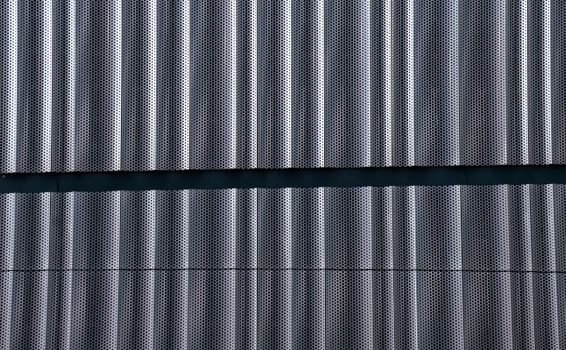
ACP consists of two 0.5 mm aluminum skins bonded to a polyethylene (PE) or fire-retardant (FR) mineral core, total thickness 3–6 mm, and is sold as a continuous coil-fed product rather than a single sheet — Alustrong and ENOXBELL both list it as a separate family from single-panel veneer [S2][S4].
For projects requiring A2-s1,d0 or B-s1,d0 fire classification, FR-core ACP with ≥70% mineral filler content is specified over standard PE-core; for impact and large-span requirements, honeycomb is preferred over ACP because the rigid core resists oil-canning on wide spans.
ACP cannot match single-panel or honeycomb for curved surfaces below roughly 800 mm radius without pre-routing the back skin, whereas single-panel aluminum veneer panel can be roll-bent to tighter radii — a real selection gate on column-cladding and dome work [S2][S4].
Selection Map: Five Families Against Four Decision Criteria
Across the five families, single panel wins on cost-per-m² for flat façades, carved wins on decorative depth, hyperbolic/curved is the only option for non-planar geometry, honeycomb wins on stiffness-to-weight for large spans, and ACP wins on coil-fed throughput and on-site bending for low-rise cladding. [S2]
For high-rise curtain walls above 30 m, the China building-material supply chain broadly pairs single-panel cassette systems (2.5–3.0 mm) with honeycomb spandrel panels in the same finish, while residential interior ceilings trend toward 0.6–1.0 mm powder-coated single sheets or open-grid modules [S1][S3].
One open question worth tracking: how rapidly bio-based and recycled-content aluminum alloy feedstocks penetrate the Foshan supply cluster through 2026–2027, since the major Chinese catalogues (Zhuzao, ENOXBELL, Bolon, Alustrong) still default to primary smelter stock on their public spec sheets [S1][S2][S3][S4].
See also our earlier report, Plastic Pallet Installation: Four Gates and Three Variant Types.