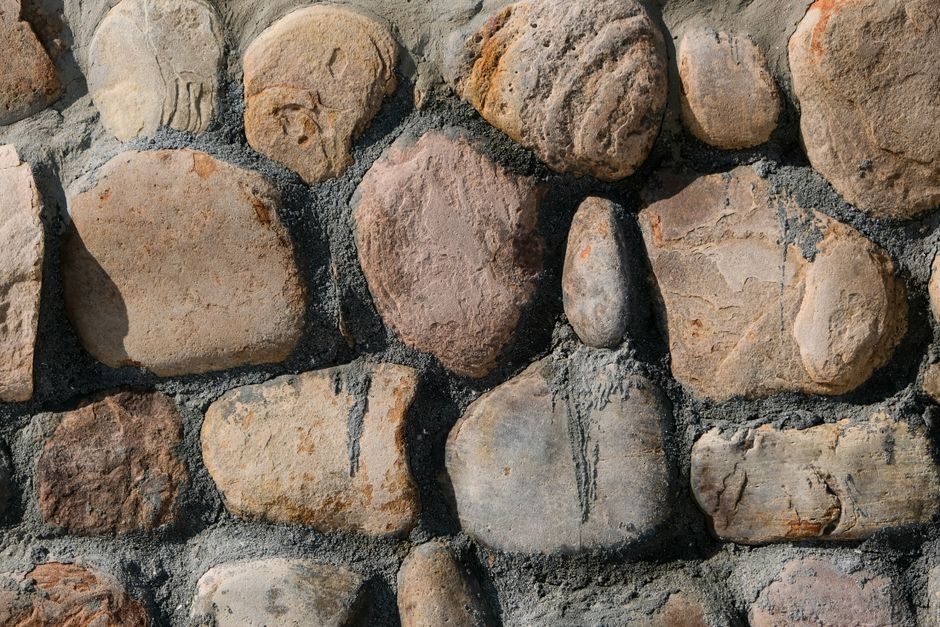
The 2026 Stone of the Year designation from the Natural Stone Institute went to Virginia Black Granite, signalling continued spec attention to dark igneous material for cladding and paving [S2].
Building stone as a category is geologically anchored to three rock families — igneous, sedimentary, metamorphic — and each family carries a distinct envelope of compressive strength, water absorption, density, and abrasion that drives the ASTM test gates a spec engineer applies before release.
Three Geological Families and the Standards That Bind Them
ASTM C97 governs absorption and bulk specific gravity, ASTM C170 caps compressive strength on 2-inch cubes or 2.25-inch cylinders, and ASTM C241 controls abrasion resistance via the Taber Abraser — these three test methods are the working gate for almost every dimension-stone submittal a process engineer reviews [S2].
Igneous stones (granite, basalt, diorite, gabbro) typically deliver the highest compressive strength envelope and the lowest water absorption; sedimentary stones (limestone, sandstone, travertine) sit in the mid-range with higher absorption; metamorphic stones split — marble trends softer and more absorbent, while quartzite rivals granite on strength and abrasion [S2].
Working Spec Bands by Stone Family
Limestone typically lands at 4,000–18,000 psi compressive strength and 0.5–12% absorption depending on density grade, which is why low-density limestone is locked to cladding and landscape work, not structural load paths; sandstone shows 4,000–20,000 psi with 0.5–25% absorption driven by cement type and porosity, so freeze-thaw grade selection is non-negotiable in cold climates [S2].
Marble, a recrystallised limestone, typically compresses at 7,000–20,000 psi and absorbs 0.2–0.6% — strong but acid-sensitive, which excludes it from kitchen countertop and exterior urban-pollution duty; quartzite (not to be confused with engineered quartz) reaches 20,000–40,000 psi with absorption under 0.6%, placing it at the top of the metamorphic band [S2].
Selection Criteria: Five Gates Before Release
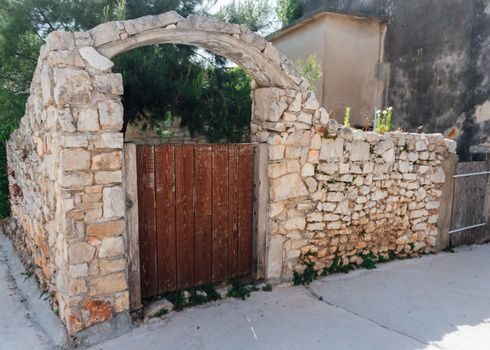
Five decision gates line up cleanly across all three families: ASTM C97 absorption, ASTM C170 compressive strength, ASTM C241 abrasion index, ASTM C880 flexural strength (important for thin-cut cladding panels), and ASTM C666 freeze-thaw resistance for any exterior temperate-or-colder service [S2].
The same gate stack sorts cladding-grade from structural-grade material, separates interior from exterior service, and rules out marginal stones for pool decks, plaza paving, or coastal facade work — a one-page comparison can be built from these five test values plus density and finish type (polished, honed, flamed, bush-hammered) [S2].
Reclaimed Stone, Reclaimed-Yard Economics
Reclaimed building stone is a parallel supply channel — independent UK yards such as Aztec Stone and Reclamations in County Durham stock a wide variety of new and reclaimed stone varying in size, shape, colour, and origin, with no minimum order and bespoke cutting from in-house masons for copings, cills, corbels, and pillar caps [S1].
Aztec Stone has been trading in the North East since 2007 on more than 40 years of family-run experience, sourcing reclamation items via an extensive contact list when stock is short — useful when a heritage spec calls for visual match against existing masonry [S1].
Industrial-Scale Manufacturing and the China Export Map
At the industrial end, Xiamen Zhenfeng Stone Co., Ltd. — a Fujian-based manufacturer and trading company registered on Made-in-China.com in 2009 — lists building stone, slab, tiles, countertops, stone furniture, granite, marble, carving, and tombstones under its main product range, illustrating the consolidated slate of cut-stone export SKUs that ship from Chinese production hubs [S3].
Fujian province and the broader Xiamen export cluster are the dominant source for cut-to-size granite, marble, and quartzite slabs and tiles, and the same cluster supplies the carved-architectural and monument segments that feed European and North American distribution [S3].
Where Natural Stone Sits Against Manufactured Alternatives
Natural stone competes head-to-head with engineered quartz, sintered stone (neolith-grade), and large-format porcelain — the trade-off is recycled-content and embodied-carbon profile versus factory-controlled colour, slab size, and consistent thickness [S2].
For an adjacent ceramic comparison, the ceramic tile types working map lays out the parallel classification system. For a deeper cost-stack view on metal-clad alternatives, see the metal curtain wall 40-year TCO map.
Failure Modes and Limits Spec Engineers Watch
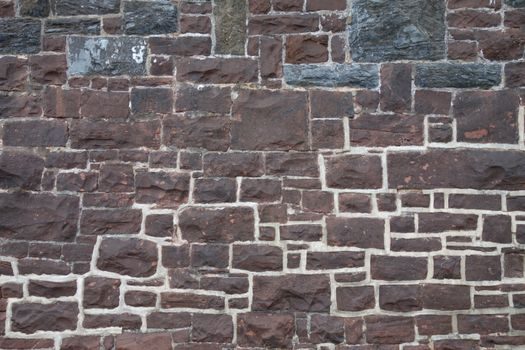
Three failure modes show up repeatedly in service: freeze-thaw spalling on marginal sandstone or low-density limestone, acid etching of marble and limestone in urban or kitchen environments, and surface staining on highly absorbent stone left unsealed — each ties back to a specific ASTM gate that should have been applied at submittal. [S1]
Thin-cut cladding failures trace to flexural strength (ASTM C880) rather than compressive strength, which is why the same stone passes a cube test and still cracks on a 30 mm façade panel; abrasion failures on flooring tie to ASTM C241, not C170, which is why a high-compressive stone can still wear badly in a high-traffic lobby [S2].
Track as a next node: the 2026 Natural Stone Institute Stone of the Year cycle and any updates to ASTM C97/C170 tolerance language released in the second half of 2026 [S2].
For component-level specifications, see building stone, pressure transmitter, and flow meter.