
Plastic pallet installation is governed by four pre-deployment gates — floor flatness, racking compatibility, declared load class, and forklift/pallet-truck interface — with three production variants (nestable, rackable, stackable) defined under the ISO 8611 test method for pallets [S3][S5].
The scope covers HDPE and PP injection-moulded or blow-moulded platforms ranging from Europallet 1200×800 mm to industrial 1210×1000 mm footprints, with static loads typically from 4,000 kg upward and dynamic forklift-loop ratings from 1,000 to 1,500 kg for general-purpose models [S3][S4].
Variant Selection: Nestable vs Rackable vs Stackable
Nestable plastic pallets nest empty at roughly 30–40 mm deck height increments, cutting return-freight cube by a factor of 4–6 versus fixed-deck wood, and are specified for closed-loop grocery, dairy, and parcel-handling flows where reverse logistics dominate cost [S3].
Rackable plastic pallets are engineered for open-beam and push-back racking with edge-rack test loads typically 1,000–1,500 kg, and are deployed in cold-storage and coil-handling environments where wood splinters and moisture absorption create contamination risk [S3].
Stackable plastic pallets — supplied as three-runner skids or full-perimeter bases — accept stacked loaded pallets up to 4–5 high, and are NOT rated for unsupported racking spans; misuse on edge rack is a documented failure mode that warps decks and racks [S3].
Gate 1: Floor and Racking Interface Flatness
Floor flatness must meet ACI 117 FF 50 / FL 35 minimum for forklift travel; racking bay flatness for rackable pallets should hold ≤ 2 mm deviation over the bearer length, otherwise fork impact during racking will crack the deck-to-block weld line within 20–40 cycles [S3].
Bearers on rackable pallets are typically 100 mm wide for standard 1200×800 mm Euro-format footprints; mating to beams narrower than 76 mm requires a dedicated rackable SKU, not a field-converted nestable unit, because the bottom deck is structurally tuned to the bearer span [S3].
Gate 2: Load Class and ISO 8611 Verification
Specifiers must read the ISO 8611 test report — not the marketing sheet — and verify three numbers: static load (racked, no impact), dynamic load (forklift loop, 28-day test), and rack load (edge or block racking, deflection ≤ 1.5% of span). Mismatched classes cause creep failure at 80–120% of the rated dynamic load over 6–18 months [S3][S5].
For a 1208 Europallet-format HDPE rackable pallet, typical 2025–2026 published ratings run 1,000–1,250 kg dynamic / 4,000–5,000 kg static, with rack-edge ratings of 600–800 kg; the same part number in a stackable configuration drops rack-edge rating to zero because no bottom deck stiffener is present [S3].
Gate 3: Forklift and Pallet-Truck Interface
Entry height for hand pallet jacks must be ≤ 95 mm from floor to bottom of entry opening; standard four-way HDPE pallets specify 100 mm fork pockets and a 245 mm center stringer, while nine-block nestable units use 165 mm center blocks incompatible with automatic guided vehicle (AGV) forks set for 230 mm stringer width [S3].
Powered pallet trucks and electric stackers must be checked for pallet-jack wheel diameter — wheels below 80 mm will ride up on nine-block nestable deck openings during entry, and the fix is either a 180 mm-wheel truck or a bottom-sheet rackable pallet, not a pallet stacker retrofit [S3].
Gate 4: Material, Process, and Service Environment
HDPE (high-density polyethylene) is the dominant 2026 production resin for general-purpose and cold-storage pallets, offering impact performance down to roughly −40 °C; PP (polypropylene) carries higher stiffness but is brittle below 0 °C, making PP unsuitable for frozen-food racking despite the cost overlap [S1][S2].
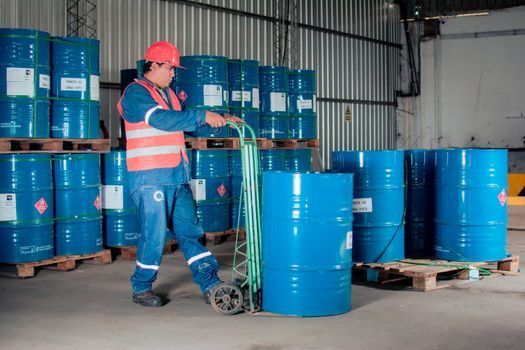
Blow-moulded pallets — produced on large hollow-form machines from manufacturers including Suzhou Tongda and Weifang Xinhengda — are characterised by a seamless double-wall construction with a typical tare of 13–18 kg for the 1208 footprint, and are specified for heavy chemical and export drum loads where injection-moulded decks would cold-creep [S4].
For food-contact and retail-ready flows, foldable PP pallet boxes such as the Tosca Bin 96 — 748×548×800 mm, 328 L capacity, polypropylene corrugated walls — replace corrugated shippers at the truck-to-shelf transition and accept 4-high stack loading when the optional rising floor is engaged [S2].
Acceptance Test and Field Sign-Off
Acceptance after plastic pallet deployment requires three measured checks: (1) a 5-pallet forklift-loop trial with a load equal to the dynamic rating, verifying no visible deck cracking after 20 cycles; (2) a racking deflection test at 1.0× rack-edge rating holding ≤ 1.5% span deflection; (3) a fork-entry height verification with a caliper at all four pockets, holding ± 2 mm of the SKU drawing [S3].
Reject criteria: any audible "ticking" on cycle 3 of the loop trial indicates internal weld-line cracking, and the entire pallet lot should be quarantined rather than field-repaired, because plastic pallet welds cannot be re-fused to original mechanical properties. For warehouse integration with pallet rack systems, the pallet supplier's ISO 8611 report must be filed against the rack UDL (uniform distributed load) chart before first load.
Trackable signals for the next installation window: published updates to the ISO 8611 revision ballot on rack-deflection limits (engineering community, accessible via ISO TC 51), and 2026 OEM datasheet refreshes from Cabka, Arcawa, and Tosca confirming cold-storage −40 °C HDPE grades — both are the levers that will reset 2027 pallet-replacement programmes in closed-loop grocery and pharmaceutical distribution [S1][S2][S3].