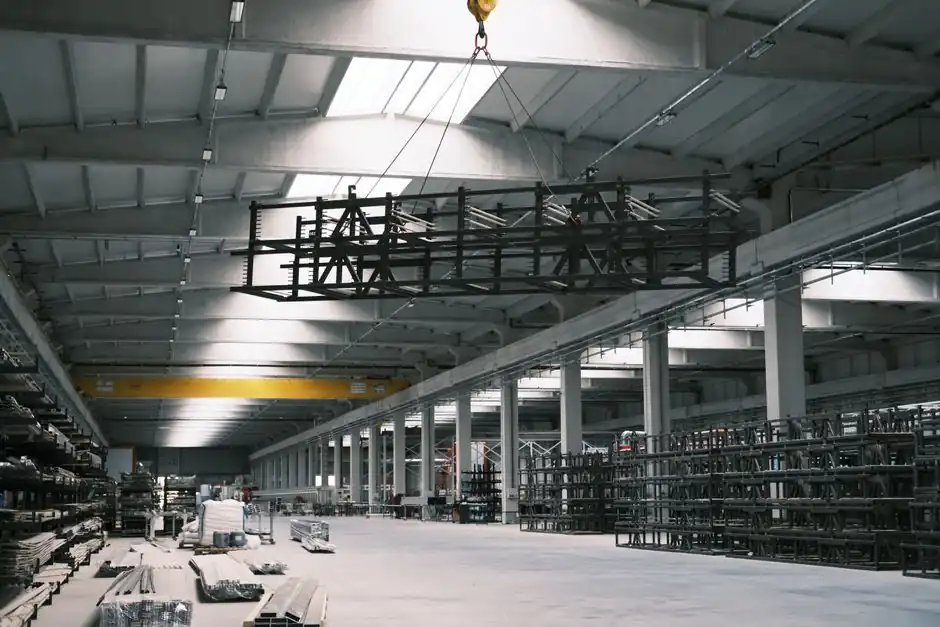
Vertical lift modules need a minimum 3.5 m clear ceiling, and the tallest units push past 15 m for extra tray capacity [S1]. An autonomous mobile robot docking at a VLM bay inherits only the leftover working height between the access window's lintel and the floor, not the building's full ceiling height.
The conflict is mechanical, not software: the VLM's extractor carriage and shutter live inside the bay's headroom, and the AMR's lift or top module must drive under that envelope with margin for mast tilt, sensor swing, and the payload itself. Get any of those three clearances wrong and the AMR physically cannot enter the bay, regardless of fleet software.
VLM headroom envelope and what eats the gap
A VLM bay is not a clear tube. The extractor, the lifting belt or chain, the shutter mechanism, and the picking window's lintel all consume vertical space at the access face. Modula's standard bay heights are 27.36 in, 35.23 in, and 50.98 in (roughly 0.69 m, 0.89 m, and 1.30 m), measured from the delivery surface upward to the underside of the lintel, not to the building's structural ceiling [S2]. The structural ceiling, by contrast, must clear 3.5 m minimum to accommodate the tallest tray the VLM will ever present at the window [S1].
For the AMR, only the bay height matters. A unit-load mobile robot that needs to slide a pallet or tote onto the VLM's delivery surface is constrained to that 0.69 to 1.30 m window. The unit-load AMR class, by spec, lifts payloads up to 2,000 kg using two or more actuators for balance [S3], and the taller those actuators the more working height they consume at the bay face.
AMR top module geometry: lift, topper, mast
AMR top modules fall into three groups, each with a different ceiling demand. Picker-only or roller-top toppers add 200 to 400 mm to the robot's static height; roller conveyors and transfer decks add 300 to 600 mm; and powered lift modules can add 760 mm or more when fully extended, with a 4-second minimum cycle [S5]. Compact lift platforms such as the BlueBotics mini sit at just 30 cm tall, leaving the most headroom for a low-bay VLM [S6].
Payload capacity and mast height scale together on the heavier end. Standard AMR lift models are rated 40 to 2,000 kg, and the heaviest units use a 14 m lift mast for very-narrow-aisle pallet work [S4][S9]. A 14 m mast is irrelevant at the VLM bay face, but the retracted mast height still has to fit under the bay lintel during approach, dock, and undock. Most AMR OEMs publish a "machine height with mast retracted" figure, and that number, not the maximum lift, is the one to compare against the VLM's bay height.
Calculating the usable working height at the bay

The usable working height is a subtraction: VLM bay height minus AMR static height minus safety margin. Using Modula's 50.98 in (1.30 m) tall bay as the worst case, and a mid-range AMR with lift module at 0.6 m static, the leftover for a tote or pallet on the AMR's deck is 1.30 minus 0.60 minus a 0.05 m clearance, roughly 0.65 m of vertical room for the load [S2][S5].
Going the other way, against Modula's 27.36 in (0.69 m) minimum bay, the same 0.6 m AMR with lift has only 0.09 m of clearance, effectively zero. The math forces a smaller robot (such as the BlueBotics mini's 30 cm tall lift platform [S6]) or a taller VLM bay, not a taller building. For an ASRS system retrofit, raising the bay height is a modular swap; raising a finished warehouse ceiling is not.
Comparison: three integration profiles against one VLM
Pairing a single Modula VLM (with 27.36 in, 35.23 in, and 50.98 in bay options [S2]) against three realistic AMR profiles shows the constraint. A compact picker topper at 0.35 m static fits the smallest bay with 0.34 m of load clearance and the largest with 0.95 m. A roller-deck AMR at 0.55 m static fits the smallest bay with only 0.14 m to spare, marginal for a loaded tote, and the largest with 0.75 m. A heavy lift AMR at 0.80 m static fails the smallest bay outright and leaves just 0.50 m at the largest, borderline for a 1,000 kg+ payload [S2][S5][S6].
The decision matrix collapses to two inputs: AMR static height with top module fitted, and VLM bay height at the access face. Throughput is irrelevant until the geometry works, and Modula's range of 10 ft 10 in to 68 ft 11 in (3.30 to 21.01 m) overall machine height gives plenty of room to pick a bay height that fits the fleet, but only if the building's 3.5 m minimum ceiling is already met [S1][S2].
Who this is for, and who should walk away
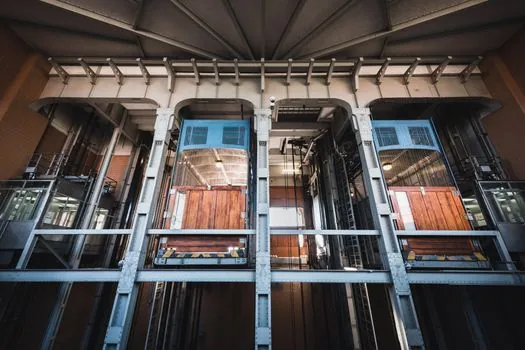
This integration profile fits greenfield sites where the AMR vendor, the VLM vendor, and the architect spec the bay height and AMR top module in the same room. It also fits brownfield retrofits where the building already has 4 m or more of clear ceiling, since the VLM's structural envelope fits and the bay-height selection has room to absorb an AMR of almost any practical size [S1].
It does not fit existing warehouses with ceilings under 3.5 m, sites that demand the very smallest 27.36 in (0.69 m) bay for footprint reasons and want heavy 1,500 to 2,000 kg lift AMRs to service them, or facilities planning to standardize on K-MATIC-class 14 m lift mast AMRs that are designed for very narrow aisle pallet rack, not low-bay VLM access [S1][S2][S9]. In those cases the bottleneck is structural, and a different storage class (a vertical lift module with no AMR interface, or a conveyor-fed ASRS) is the cheaper path.
Limits, failure modes, and safety standards
The biggest silent failure is mast tilt on approach. Most AMR lift masts are rated for vertical only; a 2 to 3 degree tilt at the bay face, caused by floor flatness or dock-plate deflection, can reduce usable headroom by 30 to 50 mm, enough to fail the smallest VLM bay geometry. The second is dynamic payload sway, especially with the 2,000 kg unit-load class that uses two or more actuators for balance [S3], where a swinging load at the top of the lift stroke can clip a low bay lintel.
Safety standards for AMR top modules are still being defined across regions, and integrators should expect mobile-robot top-module safety questions to dominate vendor selection in the near term [S8]. The hard rule is to spec the AMR with its top module fitted, mast retracted, payload at maximum, and a documented safety margin to the VLM bay lintel before any floor is poured or any bay is ordered. For related layout decisions on bay placement, the internal-versus-external access bay spec, explored in this comparison of internal vs external VLM access bays, sets the next constraint downstream of the ceiling-clearance check.