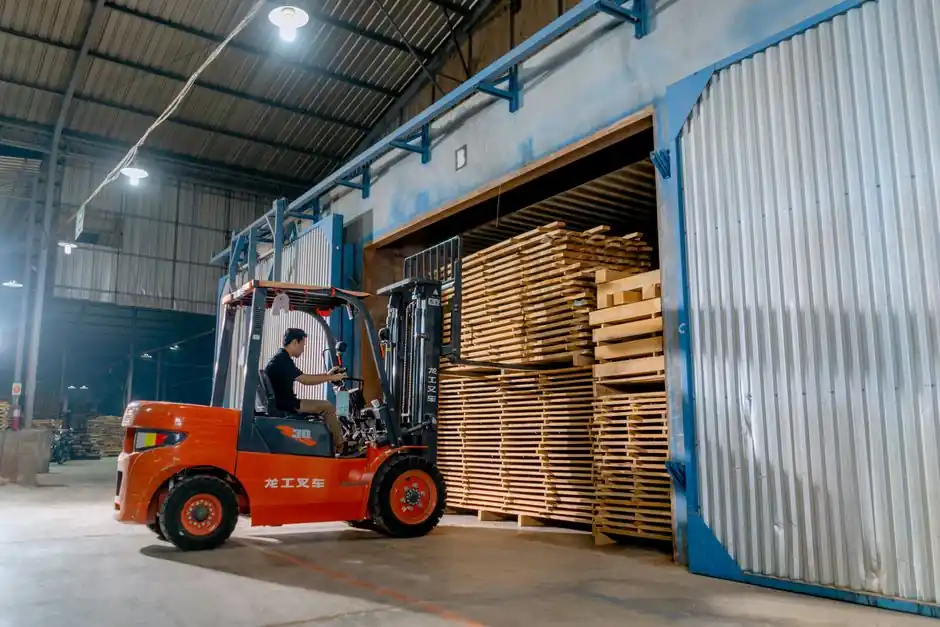
AMR deployments in multi-shift plants typically deliver ROI in 18-30 months, while tugger AMR applications can hit payback in 12-15 months, and forklift operations carry compounding cost with no defined ROI endpoint [S1][S3].
The choice between an AMR robot, a forklift (manual or automated), and a tugger train is governed by load profile, lift height, route stability, and mixed-traffic density, not by unit price alone [S2][S4].
What "ROI" Actually Means for Each Option
AMR ROI is a closed-loop number: vendor studies put multi-shift AMR fleet payback at 18-30 months, and tugger AMR applications at 12-15 months, with savings driven by labour displacement and injury reduction [S1][S3].
Forklift ROI is open-ended. Acquisition, fuel or charging, maintenance, operator wages, insurance, and incident costs accumulate year over year; there is no terminal point where the forklift "pays off" and becomes free, because the cost base resets each fiscal year [S1].
Tugger train ROI sits between the two. A tugger AMR pulling multiple carts on a fixed milk-run converts a single vehicle's operating cost into many payload moves per shift, with ROI often realised in 12-15 months for payloads in the 2,000-3,000 kg band [S3].
Selection Criteria That Decide the Match
Five criteria separate the three options cleanly: load weight per move, lift height requirement, route variability, traffic mix, and reconfiguration frequency [S2][S4].
For horizontal transport of crates, totes, boxes, and light/medium pallets below roughly 1,000 kg with no rack interface, the AMR robot is the lowest-friction choice, particularly when routes change seasonally or production lines are rebalanced [S2][S4].
For palletised loads that must be placed on or retrieved from racks, including block stacking, an automated forklift remains the only viable option in the comparison, because AMR lift modules are typically height-limited compared with purpose-built forklift masts [S2].
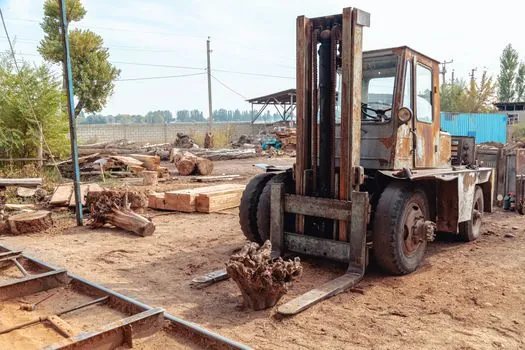
For fixed milk-run loops moving 2,000-3,000 kg of parts, kits, or subassemblies between known stations, a tugger AMR train wins on cost-per-payload, with the caveat that the route must stay predictable enough for the rough-terrain-forklift-style manoeuvres to be unnecessary [S3].
Comparing the Three Options on Decision Criteria
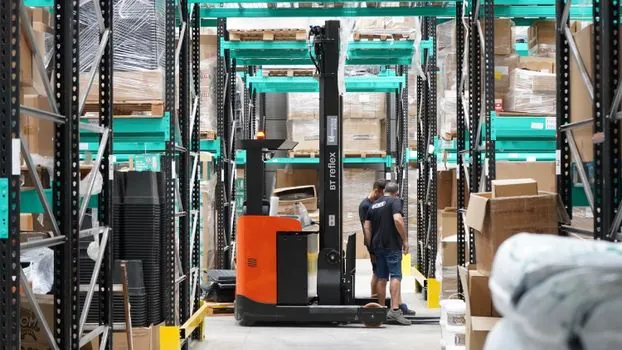
On flexibility, AMRs score highest: SLAM-based navigation reroutes around obstacles and re-maps when aisles shift, while AGVs and fixed tugger loops need re-engineering for any layout change [S4][S5].
On per-unit price, automated forklifts are the most expensive capital item, and AMRs sit between forklifts and manual tugger trains; however, AMRs typically carry higher unit cost but yield faster ROI precisely when layouts change often, which inverts the unit-price logic [S6].
On load handling, the autonomous forklift can pick a pallet from the floor, lift it, and place it on a rack in a single motion, while an AMR usually needs a transfer station or a lift-top module to exchange the load, and a tugger train simply tows a chain of carriers [S2][S3].
On throughput per shift, tugger trains multiplying a single prime mover's work cycle across several carts can outperform a single AMR on identical routes, but only if the route is fixed and traffic is controlled [S3][S5].
Use Cases That Map Cleanly to Each Technology
AMR fits picking-to-packing, line-side delivery of totes, inter-station transfer of subassemblies, and waste/empty-container loops where routes are dynamic and payloads sit below roughly 1,000 kg [S2][S4].
Automated forklift fits end-of-line palletising to rack, block stacking, dock-to-stock, and high-bay retrieval where lift height and pallet integrity dominate the requirement [S2][S6].
Tugger train fits automotive, solar, and heavy manufacturing milk-runs with payloads per cart in the 2,000-3,000 kg range, a fixed or slowly evolving route, and a need to free forklift drivers for higher-value tasks [S3].
For facilities where material flow uses multi-user aisles with workers, forklifts, and tuggers sharing space, the AMR robot is the safer autonomous choice, because its onboard sensors and path planning can run alongside other traffic without throughput penalties [S4].
Limitations, Failure Modes, and Where Each Option Fails
AMRs fail economically when the route is genuinely fixed for years, the payload exceeds the platform's rating, or the environment lacks the Wi-Fi coverage and floor flatness SLAM requires; in those cases, the higher per-unit cost cannot be amortised [S1][S4].
Automated forklifts fail operationally in narrow-aisle mixed-traffic zones, where their footprint, mast profile, and slower reaction profile make them liabilities next to pedestrians; the construction machinery and equipment class safety norms for tip-over and falling-load exposure also carry over to autonomous operation and must be engineered in [S2].
Tugger trains fail when the route is too dynamic, the cart train exceeds the AMR's towing limit, or coupling/uncoupling reliability drops below the duty-cycle requirement; partial-load trains also reduce the per-payload ROI advantage and can extend payback beyond 18 months [S3].
Across all three, integration with the warehouse management system, ERP, and MES layers is the hidden cost driver. For a deeper look at how that wiring typically breaks, the AMR Fleet Manager to MES and WMS integration guide walks through the architecture pitfalls buyers hit in year one.
Fleet Sizing, Charging, and Total-Cost Variables
Unit price is the smallest line in a five-year TCO model. Energy, batteries, opportunity charging versus swap decisions, software subscriptions, and fleet-manager licensing all compound, and they interact with duty cycle and shift pattern [S6][S7].
For plants running two or three shifts, the labour-displacement value of one AMR is roughly 1.5-2.0 full-time-equivalent operators per vehicle per shift, which is the single largest contributor to closing the 12-30 month payback window [S1][S7].
How many vehicles a given plant actually needs, and what utilisation ceiling keeps the ROI math honest, is covered in the 2026 AMR fleet-size calculation method; that method also resolves the duty-cycle versus opportunity-charging interaction.
Battery strategy is the second-order lever. The opportunity charging vs battery swap decision article lays out the throughput, capex, and floor-space trade-offs that typically swing AMR TCO by 10-20% over five years.
Standards, Safety, and Sourcing Anchors
AMR safety in mixed-traffic environments rests on 3D LiDAR volumetrics, AI-driven SLAM, and sensor fusion across LiDAR, camera, and IMU inputs, which together detect obstacles at floor level, sensor height, and overhead shelf edges that 2D LiDAR would miss [S1].
Manual forklift safety is governed by operator training, site rules, vehicle selection, and engineering controls against tipping, pedestrian collision, falling loads, limited visibility, and loading-ramp exposure, all of which carry over when the same vehicle class is automated [S2].
For facilities evaluating a hybrid AMR plus automated-forklift deployment, the lighting equipment and electric lamps class and aisle-illumination design directly affect 3D-LiDAR and camera performance, and should be specified before the vehicle RFP is issued.
Where you source from matters: China is the primary manufacturing base for both AMRs and automated forklifts, and the most current spec data, payload ratings, and safety certifications are typically published on the Chinese OEM portals before they appear in Western reseller catalogues; read those pages for the actual numbers, then translate the fact into English spec language for your RFP.
The next signal to watch is vendor disclosure of two figures: AMR unit cost trending toward the manual tugger-tractor price point, and automated forklift lift-height ceilings exceeding 6 m. Either crossing will redraw the selection matrix above within the next 12-18 months.