
AMR fleet management software (FMS) is the coordinating layer that receives transport orders from a MES or WMS, assigns each task to a robot based on proximity, battery state, and traffic, and reports execution back as a stream of state messages. It is the only piece of software in a multi-vendor AMR deployment that touches every system above and every robot below [S1][S3].
The same FMS must broker between enterprise planning (ERP), execution (MES), and storage (WMS) on one side and a heterogeneous fleet on the other. When that broker layer is weak, AMRs move materials without awareness of production priority, inventory state, or shift handoff [S8].
Where the FMS sits and what it owns
The fleet manager owns task assignment, traffic, charging cycles, and exception handling across every robot in the fleet. A single AMR navigates independently; a fleet does not, which is why the coordinating layer is non-optional once the robot count passes roughly five units [S1].
Three integration boundaries are the FMS responsibility: MES/WMS to FMS (task in, status out), FMS to AMR (orders and state), and FMS to facility PLCs and peripherals (conveyors, elevators, doors, gates, charging stations) [S2][S4]. Vendor positioning on the third boundary, specifically whether the FMS talks OPC UA directly to existing PLCs or requires extra endpoint sensors, is one of the largest sources of deployment cost in real plants [S4].
For a broader view of how the mobile robot itself fits into the wider industrial automation equipment landscape, treat the FMS as a process-control node, not a logistics add-on: it needs the same uptime, observability, and change-control discipline as a PLC rack.
VDA 5050 v2.0 as the interoperability baseline
VDA 5050 v2.0 defines a JSON message format for orders, state, and error communication between an AMR and a fleet management system, and any compliant robot can receive orders from any compliant fleet controller regardless of manufacturer [S1]. North American sites use the MassRobotics AMR Interoperability standard as the regional equivalent [S1].
The failure mode this standard addresses is real: a plant running mobile conveyor AMRs from one vendor alongside pallet-moving AMRs from another sees coordination gaps at every shared intersection unless the FMS speaks the same protocol as the robots. Confirming VDA 5050 version compatibility between robot firmware and FMS software before purchase is the single highest-leverage procurement check; mismatched versions are expensive to resolve after hardware is on site [S1]. KUKA.AMR, for example, integrates third-party vehicles specifically via the VDA 5050 interface, not through vendor-proprietary bridges [S2].
For plants that need to aggregate state across a wider plant, the same FMS commonly feeds dashboards and historians that also cover adjacent flow metering and pressure transmitter instrumentation, so the JSON schema choice on the AMR side propagates into the historian taxonomy.
MES versus WMS integration: what each actually demands
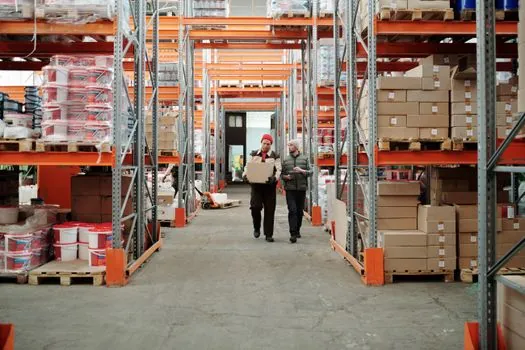
WMS integration is primarily transactional: pick waves, replenishment tasks, and shipping waves generate transport orders that must be synchronized to the FMS in real time so that the right pallet reaches the right dock at the right time. The WMS cares about order completion acknowledgement, not about which robot carried it [S3][S6].
MES integration is more stateful. The MES assigns transport and material handling tasks based on production schedules, inventory levels, and work-in-progress status, and dispatches the resulting transport orders to the appropriate vehicle in the fleet [S3]. The MES also enforces traffic-control policies (speed limits, restricted zones, e-stop procedures) and captures every movement as a record for analytics and continuous improvement [S3].
The practical asymmetry: WMS integration can ride on standard order/acknowledge APIs, while MES integration typically requires pre-built connectors or substantial custom code. Vendors that expose publicly documented example code for typical mission scenarios compress commissioning from weeks to days [S4]. OTTO Fleet Manager, for instance, centrally connects AMRs with MES, ERP, and WMS platforms while communicating with existing PLCs through OPC UA [S7]. MiR Fleet, similarly, advertises centralized control and seamless integration with ERP, WMS, and MES [S5].
Task assignment and the optimization model
The FMS assigns tasks using an optimization model that balances robot proximity, current battery state, ongoing task priority, and route traffic simultaneously [S1]. A model that sends the nearest robot regardless of battery state produces a fleet that runs low on charge mid-shift; a model that over-prioritizes battery state sends robots across the facility for unnecessary charging cycles [S1].
The model is not plug-and-play: it requires tuning for each facility based on actual shift patterns, charging station count, and task volume distribution. KUKA.AMR's process planning and optimization is positioned as AI-based, with real-time replanning against traffic and dynamic obstacles and no programming required for the standard process library [S2].
A useful decision tree for a process engineer sizing a new fleet: (1) single-vendor robot + small fleet (under ~10 units) plus homogeneous tasks typically works with vendor-default task assignment; (2) mixed-vendor fleet (over ~10 units) or mixed payload types (carts, pallets, conveyors) requires VDA 5050 v2.0 and a tunable optimizer; (3) brownfield plants with legacy PLCs and conveyors should require OPC UA bridging in the FMS rather than add-on endpoint sensors, because sensor count scales linearly with deployment size and dominates commissioning time [S1][S4].
Real failure modes and where projects stall
Integration projects stall at three predictable points. First, protocol mismatch: VDA 5050 v1 versus v2 between robot firmware and FMS produces silent message drops that show up as robots ignoring orders, not as connection errors [S1]. Second, sensor bloat: when the FMS cannot talk directly to existing PLCs, vendors add extra sensors at every endpoint, and each sensor adds commissioning time that compounds with fleet size [S4].
Third, gap between supplier and integrator capability. Suppliers deliver hardware, fleet management, and basic APIs, but are not equipped to connect AGVs and AMRs to WMS, MES, ERP, and broader automation systems on their own; the buyer often has to fund custom integration work, which is why pre-built API libraries materially change deployment economics [S4][S9]. MiR Fleet and KUKA.AMR both position pre-built ERP/WMS/MES connectors as the differentiator versus raw fleet managers that expose only basic APIs [S2][S5].
For plants running a hybrid AMR and AGV fleet, the integration cost is dominated by the third-party software layer rather than the robots, and that is also where lock-in lives: switching the FMS is harder than switching the hardware because the integration code lives in the FMS, not the robots.
Standards, sourcing, and selection checklist
Three sourcing checks are non-negotiable for any AMR project that has to talk to a MES or WMS. (a) Confirm VDA 5050 version compatibility in writing between the robot firmware and the FMS; require a test report, not a brochure claim [S1]. (b) Require OPC UA bridging to existing PLCs, and reject the workaround of extra endpoint sensors for any deployment over ~20 endpoints [S4]. (c) Require publicly documented example code for at least the canonical scenarios (pick, drop, conveyor handoff, charging) so the integration team has a test bed [S4].
A short comparison of the main integration options against four decision criteria: proprietary vendor FMS (low integration cost, single-vendor lock-in, limited MES state model, no mixed fleet), VDA 5050-compliant FMS (medium integration cost, mixed-fleet ready, requires protocol test, faster to scale), WMS-direct integration without FMS (lowest first cost, no traffic coordination, fails above ~3 robots), and MES-as-FMS custom build (highest control, longest commissioning, viable only for very large single-vendor fleets) [S1][S2][S3][S4].
For plants that already run their FMS alongside broader process control, the most useful next step is a paired benchmark: run a 24-hour shadow mode where the FMS records what it would have done and compare against the WMS/MES task stream, rather than going live on the first integration cut. Trackable signals to monitor through 2026 Q4: published VDA 5050 v2.x conformance certificates from major robot vendors, and OPC UA companion specifications for AMR fleets, which together determine whether mixed-vendor rollouts become routine or stay bespoke.
Related analysis: Metal scraper and double seal options on linear guide blocks: selection, fit, and limits.