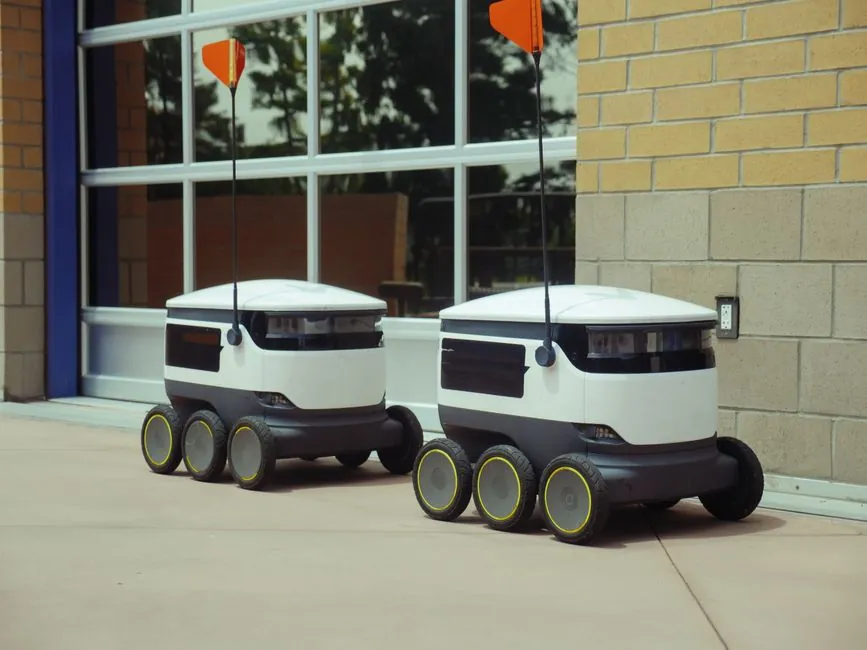
For 2026-compliant AMRs, the safety-rated 2D laser scanner is governed by a three-standard stack, ANSI/RIA R15.08 for autonomous-vehicle safety, ISO 3691-4 for driverless industrial truck integration, and UL 3100 for the battery and electrical envelope, with each scanner integrated into a control loop that is typically engineered to PLd Cat 3 or SIL2 [S4][S1].
Field geometry on current units is consistent: 270°-300° aperture, configurable warning and protective zones, and an eye-safe emitter rated Class 1M per IEC 60825-1, with redundant units front and rear to cover 360° around the chassis [S1][S6][S2].
Why mobile platforms need a safety-rated 2D LiDAR, not just a navigation scanner
Safety-rated 2D LiDAR measures time-of-flight and converts the returns into field geometry, which lets the scanner trigger a hard stop without relying on ambient light, surface reflectivity, or pre-mapped landmarks [S1]. The device does not depend on ambient light and is unaffected by dust or partial obstruction, and a 270°-300° aperture with configurable warning/protective zones is the typical architecture for AGV and AMR payloads [S1]. Bumpers, mats, and warning lights only fire after contact or rely on operator attention, while the scanner trips in milliseconds through the safety PLC [S1].
For navigation, fleets such as OMRON's HD-1500 run a separate path-planning LiDAR alongside the safety scanners, and the datasheet explicitly distinguishes the navigation laser from a Supplementary Laser Scanner Kit used for safety-zone coverage [S2]. Mixing navigation and safety in one sensor is rejected by R15.08: safety must be an independent, certified function that holds when the navigation loop misbehaves [S4].
Applicable standards and what each one actually constrains
ANSI/RIA R15.08 is the North American AMR safety standard, written around the fact that AMRs plan and deviate autonomously, so any obstacle-bypass maneuver must not create a new hazard for nearby personnel or equipment [S4]. It assumes dynamic navigation and forces the safety function to validate every re-plan, not just motion on a fixed guidepath [S4].
ISO 3691-4 covers driverless industrial trucks in the workplace and specifies clearance channels around the vehicle, active personnel detection, and the verification process for each safety function [S4]. UL 3100 sits underneath as the electrical-safety floor, defining battery management, charging interface, and power-distribution test criteria to bound thermal-runaway and electrical-fire risk [S4].
At the device level, safety laser scanners on AMRs defer to IEC 61496 for electro-sensitive protective equipment, with newer references also allowing IEC 60825-1 for the laser emission class and 21 CFR 1040.10 / 1040.11 for the U.S. FDA radiation-safety basis [S3][S2].
Functional-safety performance target inside the control loop
PLd Cat 3 and SIL2 are the typical targets embedded into AMR safety loops, which means the safety controller, the scanner channels, and the emergency-stop wiring must all be dual-channel with cross-fault detection [S4]. A single-channel design cannot meet PLd, because the standard requires that a single fault does not lead to loss of the safety function and is detected [S4].
Two engineering signals are useful here. First, the OMRON HD-1500 datasheet exposes a "pair of safety-rated alternate safety zone inputs" that toggle the protective zone based on vehicle state, which is the standard way to switch between, for example, a tight indoor zone and a wider transit-aisle zone [S2]. Second, a standard recommendation across vendor material is to engineer the protective-zone radius from load, speed, and measured braking distance rather than from a fixed lookup table, because an under-sized zone at higher payload mass is the most common cause of stop-distance failures on commissioning day [S4][S1].
Selection criteria, compared on a 2026 buyer's axes
For 2026 procurement, four axes separate the field: aperture, zone-count and switchover, performance level evidence, and form factor. Aperture: most AGV/AMR safety scanners ship at 270°-300° and the chassis mounts two units back-to-back to recover the missing sector, since no single 2D scanner can see 360° in one device [S1][S6]. Zone-count: HD-1500-style platforms support multiple alternate safety-zone inputs so a fleet manager can switch zones by I/O without re-flashing the scanner, which is the dominant 2026 pattern [S2][S1].
Performance level: PLd Cat 3 / SIL2 claims must come with a vendor certificate and a published MTTFd or PFHd figure, not a generic "safety-rated" label [S4]. Form factor: scanners such as the IDEC SE2L and SICK's small-footprint units fit the 101 x 101 x 80 mm class, enabling mounting on low-clearance carts where a taller head would clip racking [S8][S5]. Hokuyo's application note is explicit that, on a typical AGV, range and field of view together determine how early the vehicle can detect an obstacle at speed [S1].
Typical 2026 deployment topology on a real AMR

Front and rear scanners are placed to get 360° safety coverage around the robot, with each scanner mapped to its own dual-channel input on the safety controller and its own protective-zone definition [S6]. A second 2D scanner often watches the sides and a third covers reverse, and on heavy-payload platforms such as the HD-1500 the supplementary scanners are added as a kit with extension cables in 1 m and 2 m lengths to keep the wiring harness serviceable [S6][S2].
The scanner talks to the safety PLC over discrete safe inputs or a safety fieldbus; the navigation LiDAR, in parallel, talks to the fleet manager on a non-safe bus. The two systems are physically and logically separated so that a navigation-software bug cannot suppress a safety stop [S4][S2].
Limits, failure modes, and what the standards do not cover
2D safety LiDAR cannot see over a tall pallet load, and a scanner mounted at 200 mm above the floor will not detect a person standing behind a 1.2 m rack column on a perpendicular aisle, which is a known blind-sector problem that is usually handled by adding side scanners or perimeter sensing [S1]. The standards call this out: ISO 3691-4 requires clearance channels and active personnel detection, but the sizing of those channels is a function of the specific scanner's protective-zone radius and the vehicle's measured stopping distance, not a fixed number in the standard [S4].
Surface reflectivity still matters: a glossy black anodized column at grazing incidence can fall below the scanner's minimum reflectance threshold, so vendor manuals carry a "minimum reflectivity" clause that is often missed at procurement [S1]. A safety-rated scanner also has a defined mission time, typically 20 years for the safety function, after which the unit must be replaced, and PLd claims do not survive if the MTTFd is treated as a marketing number [S4][S3].
Who this stack is for, and who it is not for
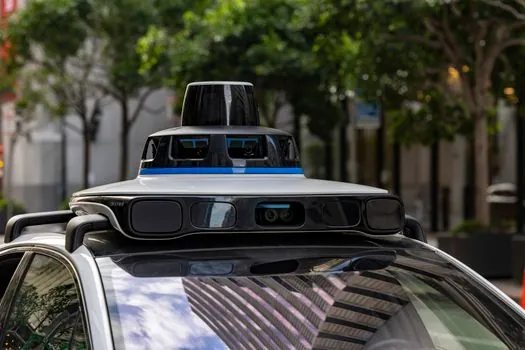
It is for integrators and in-house engineering teams building or buying AMRs that operate around people, including pallet-moving AMRs in distribution centers, line-side delivery units in automotive plants, and hospital/cart logistics robots that share corridors with staff [S4][S1][S6]. It is not for fenced AGVs that never enter a mixed-traffic zone, where a lower-cost non-safety-rated scanner plus hard guarding may be enough, nor for outdoor autonomous trucks that fall under different vehicle and mining standards [S4].
Practical 2026 signals worth tracking: updates to ANSI/RIA R15.08 for dynamic-zone and fleet-orchestration clauses, expansion of UL 3100 into higher-energy lithium chemistries, and harmonization of IEC 61496-1/-3 revisions with ISO 3691-4, each of which will tighten what counts as a compliant safety scanner on an AMR [S4][S3]. Compliance cost is concentrated in the safety controller and certification path rather than in the scanner itself, which is why vendors with pre-certified safety controllers, such as the SE2L integration with FANUC cobot cells, are gaining share in mixed-traffic cells [S5].
Component reference pages worth checking: agv robot, fire rated door, and mobile crane.
For related coverage, see Automatic vs Manual Induction on Cross-Belt Sorters: Spec-Driven Selection.