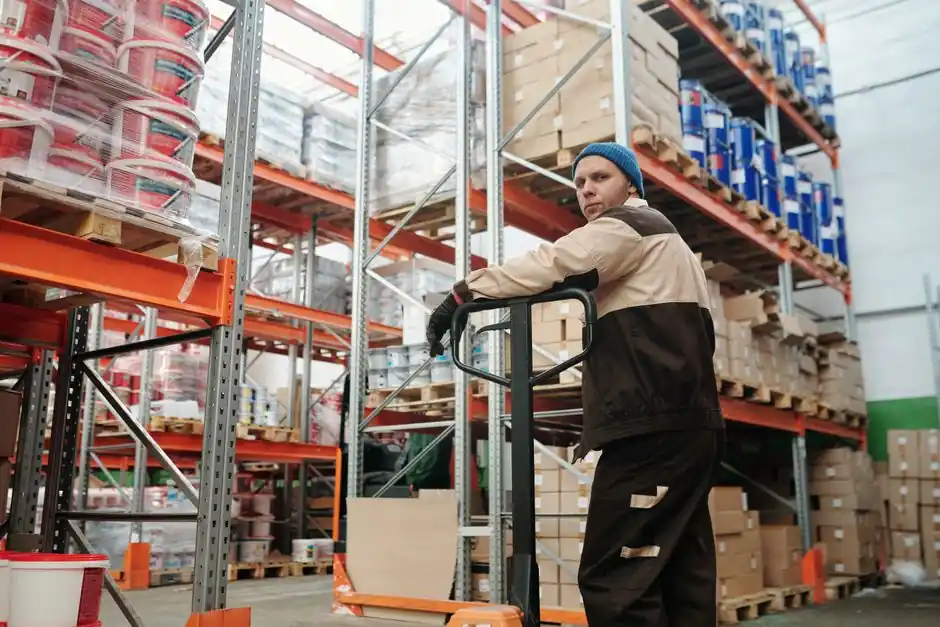
Hand pallet truck, pump truck, and manual pallet jack refer to the identical piece of equipment: a hand-pumped hydraulic device that slides forks under a pallet, raises it roughly 190-200 mm off the floor, and lets a walking operator push or pull the load [S3][S4].
Capacity for the manual version commonly lands in the 2,000-5,500 lb range, with heavy-duty industrial models reaching 6,600 lb, while the powered counterpart spans 3,000-6,000 lb and adds motorized drive and lift [S1][S4]. For background on the powered sibling class, see the electric pallet truck reference page.
Terminology: Why the Three Names Coexist
Multiple manufacturer and dealer sources state directly that the three labels are interchangeable for the manual tool, with the choice driven by regional vocabulary rather than any mechanical difference [S1][S2][S4][S6]. Toyota's own product FAQ confirms that a pump truck is "another common name for a hand pallet jack, referring to the pumping action required to operate the hydraulic lifting mechanism" [S2].
The label "pallet pump" appears as a third synonym in the Wikipedia entry, which also notes that "pump truck" redirects to the pallet-jack page rather than to firefighting apparatus, confirming the material-handling context for the term in industry usage [S3]. Huper's 2 March 2026 guide lists the canonical chain as hand pallet truck = manual pallet jack = pump truck, with no operational distinction among them [S4]. T-Lifting's 14 May 2025 reference adds "manual forklift" as a fourth colloquial label for the same device, and Zilla Industrial's 24 February 2026 buyer's guide uses "manual pallet truck" interchangeably with "hand pallet jack" [S6][S8].
For a wider view of how this category sits inside general manual material-handling tooling, the hand tools encyclopedia page covers the broader family context.
How the Manual Jack Actually Works
Operation rests on a hand-pumped hydraulic cylinder actuated through a tiller-style steering handle; pumping the handle forces hydraulic fluid into the lift cylinder, raising the forks, while a small release lever bleeds fluid back to lower the load [S3][S5].
Front load wheels sit inside the fork tips on pushrods connected to lift linkages, so the forks rise vertically as the hydraulic ram extends, lifting the pallet only enough to clear the floor for travel [S3]. Equipment Depot's 19 September 2023 comparison notes an alternate foot-pump design exists in place of the handle pump, but the lifting physics remain the same [S5].
There is no motor, no battery, and no controller in the manual configuration, which is why Huper's guide emphasizes that pump quality and fork-weld quality are the dominant determinants of service life, not electronics that do not exist on the unit [S4].
Manual vs Electric: Where the Real Difference Lives

Mobile Pallet Table's 2 March 2026 comparison makes the dividing line explicit: "While a Pump Truck and a Manual Pallet Jack are essentially the same piece of equipment, an Electric Pallet Mover operates very differently" [S1]. The electric class adds motorized drive, electric lift, electric lower, and often lithium-ion battery packs, dropping operator effort but adding capital cost and a charging infrastructure requirement [S1][S5].
A side-by-side criteria comparison for the two classes on the dimensions procurement teams actually weigh:
Power source: manual = 100 percent human; electric = battery-driven DC motor with throttle on the tiller [S1][S5]. Operator effort: manual requires pushing/pulling the full pallet mass; electric handles propulsion so the operator only steers [S1][S5]. Capacity envelope: manual typically 2,000-5,500 lb with heavy-duty at 6,600 lb; electric commonly 3,000-6,000 lb and handles longer travel runs beyond 40 ft more comfortably [S1][S4][S5]. Use-distance sweet spot: manual favors short hauls under roughly 40 ft; electric wins for longer cross-warehouse moves and trailer unloading [S5]. Upfront cost and maintenance burden: manual is lower on both axes; electric adds battery, charger, and motor service costs but cuts fatigue-related injury exposure [S5].
Superlift's 16 February 2026 guide on the powered side reinforces that "motorized pallet jack" and "power pallet truck" are themselves the same device under different labels, which means the manual tool's three-name pattern repeats in the electric category, just with motor equipment [S7].
Capacity, Lift Height, and Where the Manual Tool Stops
Standard hand pallet truck capacity clusters around 2,500 kg (5,500 lb) for general logistics, with light-duty retail units around 2,000 kg and heavy-duty industrial units at 3,000 kg (6,600 lb) per Huper's 2 March 2026 spec table [S4].
Lift height on a manual unit is fixed by the hydraulic ram stroke at roughly 190-200 mm, just enough to clear the floor for rolling transport, so any application requiring stacking, order picking to height, or pallet-to-rack loading belongs in the stacker, reach truck, or forklift category rather than a hand pallet truck [S3][S4].
For jobs where forks must clear the floor and the operator walks the load short distances, the manual jack is typically the lowest-total-cost option, with minimal maintenance beyond hydraulic seals, lubrication points, and occasional wheel replacement [S4][S5]. Wikipedia notes manual pallet jacks have existed since at least 1918, following the introduction of wooden pallets, and the fundamental hand-pumped hydraulic design has changed little since [S3].
Selection Criteria: When to Pick Manual, When to Step Up

Manual pallet jack fits when the work is ground-level horizontal transport over short distances, loads stay at or below 5,500 lb for typical units, aisles are tight, budgets are constrained, and the operating environment exposes electric equipment to dust, moisture, or temperature swings that stress batteries and controllers [S4][S5].
Electric pallet mover fits when travel distances stretch beyond roughly 40 ft, when loads push the 6,000 lb mark consistently, when operator fatigue and repetitive-injury exposure are tracked metrics, and when the facility can support battery charging routines and the higher capital outlay [S1][S5]. Equipment Depot's guidance is direct: "moving heavier pallets is strenuous on the operator and can lead to fatigue or injury" under manual operation, which is the core trigger for moving up to the powered class [S5].
As a sibling reference inside the manual-handling toolkit, the manual pallet jack encyclopedia entry captures the design lineage and typical operating envelope for the equipment class covered here.
Regional and Industry Usage Notes
"Pump truck" dominates British and Commonwealth warehouse vocabulary because the pumping action of the hydraulic handle is the most visible operating feature; "pallet jack" is the dominant North American label, with "hand pallet truck" used widely in European Union procurement documents and manufacturer catalogs [S2][S3][S6]. The functional identity is unchanged across regions, which is why safety, parts, and operator-training literature treats the three terms as a single equipment class [S1][S2][S4][S6].
Wikipedia's disambiguation note for the "pump truck" redirect exists specifically to keep searchers from landing on fire-engine content, a useful confirmation that within material handling the term is unambiguous and refers solely to the manual pallet-moving tool [S3].
Watch-Items and Failure Modes to Track

Hydraulic seal failure is the most common wear-out path on a manual jack, typically presenting as a slow drop under load or a handle that no longer holds its pumped position; rebuilding the pump cylinder is cheaper than replacement and is the standard field repair [S4]. Fork bending from overloading beyond nameplate capacity, or from striking dock plates and racking, is the second failure pattern, and it is a structural rather than hydraulic issue that typically forces retirement of the unit [S4].
On the electric class, the analogous watch-items are battery degradation cycles, throttle-controller faults, and dead-man-switch reliability, all of which are absent from the manual tool and which justify the higher maintenance budget line for powered units [S1][S5][S7]. For operators already standardized on the manual tool, the upgrade decision usually hinges on documented injury or throughput data, not on equipment-name confusion, since the three labels all point to the same machine [S1][S4][S5].
For adjacent material-handling equipment specifications and selection maps, the truck-mounted concrete pump encyclopedia entry covers a separate but similarly label-heavy equipment class, useful as a cross-reference for how regional naming conventions propagate across industrial product lines.
Trackable next signals: any 2026 updates to ANSI/ITSDF B56.5 safety standards for low-lift manual and powered pallet trucks, and continued lithium-ion cost declines that compress the electric-class price premium against the manual baseline.
See also our earlier report, ANSI/ITSDF B56.5-2024: Spec Rules for U.S. AGV Compliance.