
Teardrop pallet rack beams from most modern manufacturers hook into uprights from other teardrop manufacturers sharing the same 2-inch on-center hole pattern, which is the practical definition of "universal teardrop" compatibility [S6][S8]. Compatibility, however, is not symmetric: a new-style teardrop beam fits both new-style and old-style teardrop uprights, while an old-style round-pin beam will not seat in a new-style square-shouldered upright slot [S1][S5].
The teardrop hole is the inverted, tapered opening punched through roll-formed steel uprights, with beam rivets entering at the round top and sliding down into the tapered bottom to create friction-fit engagement [S4]. Because the geometry is standardized rather than the manufacturer, replacement and add-on beams do not have to come from the original rack vendor, which is exactly why so much used teardrop inventory moves through the secondary market [S4][S6].
What "Interchangeable" Actually Means in Teardrop
Two beams are mechanically interchangeable only when three conditions are met simultaneously: matching teardrop style (old vs new), matching face length within tolerance, and rated capacity that suits the lighter of the paired components [S4]. Sources document a 96-inch (nominal) beam arriving on the loading dock at 96.25 in. or 96.5 in. from a different maker, a quarter-to-half-inch variance that the eye cannot catch but the upright column certainly can [S4].
Stacking beams of slightly different face lengths in the same bay transfers eccentric load to the upright and reduces the assembly's structural integrity, which is why integrators flag this as a mixing failure mode even when the hooks drop in cleanly [S4]. For engineers weighing pallet rack frame reuse on a brownfield expansion, the same length and same style are non-negotiable across any single beam level [S4][S8].
Old-Style Teardrop vs New-Style Teardrop
Old-style teardrop uses a round-shouldered pin/button that locks into a slot with a circular entry, while new-style teardrop uses a tapered teardrop-shaped opening on the upright that mates with a matching teardrop-shaped beam-end connector [S1][S5]. The compatibility matrix is one-directional: new-style beams drop into both new-style and old-style uprights; old-style round-button beams do not seat in new-style upright slots [S1].
This is the most common source of "the beam won't fit" calls in the field, because buyers assume the inverse and end up with hardware that physically cannot engage the punched hole geometry [S1][S5]. Material handling dealers label this distinction on every invoice for a reason, and a storage rack retrofit should always begin with a positive ID of which style is already on the floor before any beam is ordered [S2][S5].
Mixing Manufacturers: Where It Works and Where It Fails

Mixing manufacturers works cleanly when the teardrop style matches, the face length is identical, and the engineer treats the lighter-rated component as the governing capacity for the bay [S4][S8]. It fails in three predictable ways: a 0.25 in. to 0.5 in. face-length mismatch that racks the frame, a capacity downgrade that is invisible until the next rack inspection flags it, and a safety-clip or locking-pin geometry that is brand-specific even when the hook interface is universal [S4][S7].
Engineering judgment, rather than the catalog, governs the result, and field experience confirms that beams from one maker's teardrop line typically engage another maker's teardrop uprights on a 2-inch hole spacing with no hardware beyond a rubber mallet [S6][S10]. Used-rack integrators routinely standardize a single teardrop brand across a facility specifically to retire that ambiguity, and a pallet stacker operating in narrow aisles will compound any twist introduced by mismatched beam lengths [S2][S3].
Safety Clips, Locking Pins, and R-Mark Capacity
Beam-to-upright engagement on a teardrop system is a friction fit that depends on the tapered slot, not a positive mechanical lock, which is why every OEM ships beams with a safety clip, locking pin, or J-Lock-style secondary retainer [S1][S4]. Field reports describe beams that appeared seated but unbolted popped loose under forklift impact, dropping a pallet from roughly 10 ft before operators could recover the load [S2]. The fix is a through-bolt or factory locking pin on every beam-to-upright interface, not just on the heavier levels.
Capacity rating is the second hidden variable when mixing brands: a "30,000 lb" beam from maker A and a "30,000 lb" beam from maker B are not the same beam if the R-Mark, the load-class symbol, and the published test report differ [S4]. Engineers specifying a mixed-brand bay should pin the bay capacity to the lighter R-Mark rating and document it on the rack-load poster, a discipline that mirrors the manual pallet jack load-plate conventions and is enforced under ANSI MH16.1 / RMI specification discipline in U.S. warehouses [S4][S7].
Inspection Signals That Catch a Bad Mix
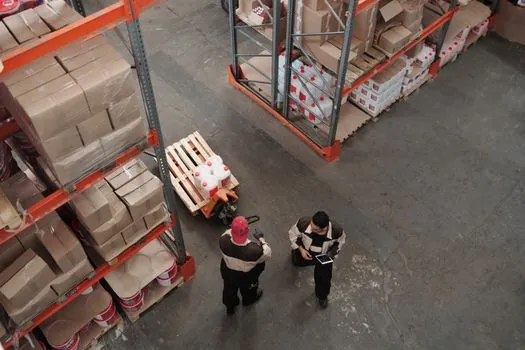
Three inspection signals reliably catch a mixed-brand problem before it becomes a failure: a step (more than 1/8 in.) between adjacent beam faces on the same level, a twist in the upright column measured at the beam seat, and any beam whose locking pin or safety clip will not seat because the geometry of the retainer, not the hook, is brand-specific [S4][S7]. A plastic pallet sitting on a slightly twisted beam face will telegraph that twist as fork-truck set-down misalignment, which is a useful leading indicator during normal operations [S7].
Engineers managing mixed-vendor teardrop installations should also confirm the column is rated for the combined beam-level load, not just the single-beam load, because used-rack integrators often reassemble frames and beams that were never tested as a system [S4]. When in doubt, source all new teardrop beams from a single manufacturer for any single rack row, treat the upright as a pallet rack assembly, and re-pin every beam with a factory locking pin or field-installed through-bolt at installation [S1][S7].
Decision Rules for a Cross-Brand Beam Retrofit
The retrofit decision rules fit on a single page: confirm the upright is teardrop (not slotted, not keystone, not Interlake old-style round), confirm the teardrop style (old vs new), confirm the 2-in. on-center hole spacing, match beam face length within 1/8 in., and match or downgrade to the lower published beam capacity [S4][S6][S8]. When any one of those five checks fails, the answer is no, regardless of how the hook looks on the bench.
Trackable signals to watch over the next quarter: vendor consolidation toward a single R-Mark supplier for new bay construction, growth of factory-locking-pin teardrop beams as the default ship state, and more third-party interchange lists (such as the rack identifier cataloged at 39 styles) becoming the standard cross-reference at the loading dock [S4][S7]. Operators standardizing on a single teardrop brand across an existing DC will continue to retire the cross-brand mix risk faster than any inspection regime can catch it [S2][S3].
See also our earlier report, ANSI/ITSDF B56.5-2024: Spec Rules for U.S. AGV Compliance.