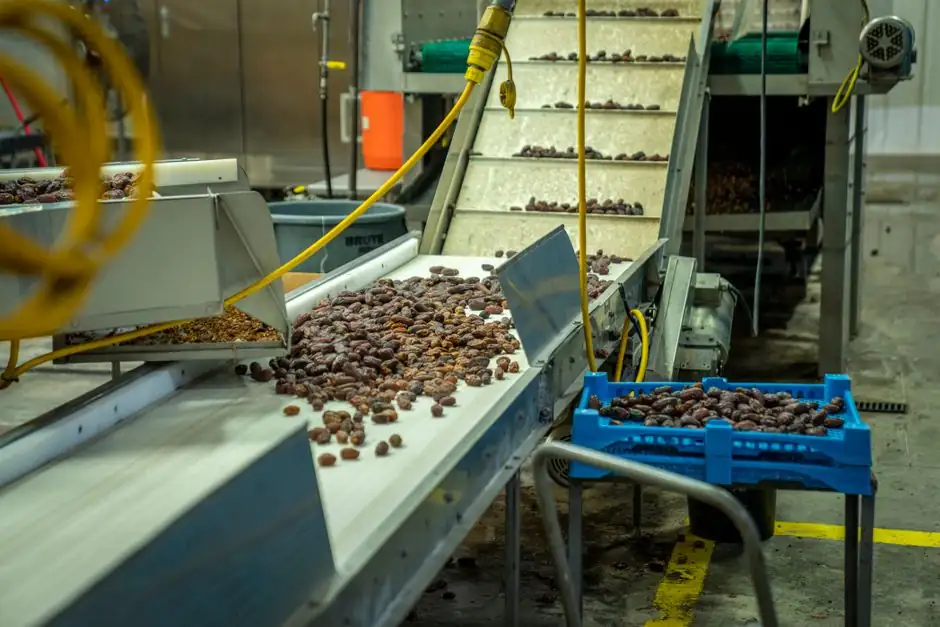
For operations where order profiles shift between B2B pallet runs, e-commerce each-picks, and seasonal returns, the AMR-vs-conveyor decision turns on three measurable axes: route variability, sustained parcels-per-hour, and reconfiguration lead time.
Industry guidance published in 2024-2025 frames AMRs as the right fit for dynamic work environments and variable workloads, while traditional conveyor sortation remains preferred for static layouts with permanent transport paths [S3]. A robotic sortation cell using AMRs with reclining trays and on-board barcode readers can sort packages directly to outgoing chutes, replacing a fixed loop with a fleet of mobile diverters [S6][S4].
What the two systems actually do on the floor
A conveyor sorting line is a fixed mechanical loop: belts, cross-belt sorter, tilt-tray, or shoe-sorter sections welded to a building's geometry. Parcels are inducted, scanned, and physically diverted at hard-wired chute positions. The line's throughput is bounded by induction rate, scan-and-divert latency (typically 1-2 seconds per parcel on a cross-belt), and the number of physical destination chutes that fit in the building footprint. [S4]
An AMR-based sortation system uses a fleet of mobile robots that read the floor with LiDAR and cameras, identify their assigned chute via digital map, and physically carry the parcel to it [S9]. Each robot is a discrete carrier rather than a node in a continuous loop, which decouples throughput from linear path length and from the number of physical diverters installed. AMRs work from a digital map and re-route around dynamic obstacles without floor tape or magnetic strips [S3][S5].
Where AMRs beat conveyor sortation
Variable order profiles break conveyor economics first at the chute-assignment layer: every new destination requires mechanical addition, controls rewiring, and a change-order window. AMRs handle the same change by editing the digital map and reassigning robots through fleet software, which KNAPP, Matthews, and SRS-i all cite as the primary flexibility advantage [S3][S2][S7].
AMRs also remove the structural-build requirement. The 2025 IMTS overview notes AMRs require no fixed tracks and can be redeployed across facilities or zones almost immediately, which makes them attractive for leased space, M&A integration, and pilot deployments [S5]. Where conveyor sortation implies a six-to-fourteen-month civils-and-controls project, an AMR fleet can be commissioned incrementally. Matthews lists faster material transport, lower labor cost, and greater flexibility as the headline gains when mobile robots replace fixed-pick workflows [S2].
A third advantage is layout density. AMRs navigate standard warehouse aisles without requiring the swept-radius clearances and catwalks that cross-belt and shoe sorters demand overhead, which is why HOJ Innovations positions robotic sortation as a fit for facilities where fixed conveyor loops are impractical [S4].
Where conveyor sortation still wins
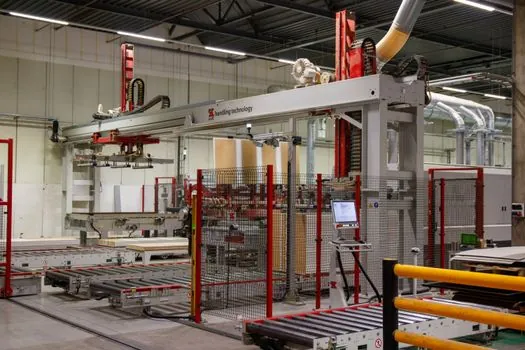
Sustained high throughput is the conveyor's home turf. A single cross-belt sorter line routinely clears several thousand parcels per hour with deterministic divert accuracy; replicating that with AMRs requires a fleet sized in the hundreds and dedicated floor space for charging and queueing. KNAPP's own decision matrix flags high throughput as the case where AMRs are less well-suited, and the cut is qualitative, not a published SKU volume figure [S3].
Conveyors also deliver lower per-parcel marginal energy and lower per-unit mechanical wear at steady state, because each parcel travels on a single powered loop rather than on a self-propelled chassis carrying its own battery, motors, and sensor stack. For 24/7 operations on a frozen SKU and route set, the lifecycle cost arithmetic still favors fixed sortation.
For a deeper look at how mobile fleets handle dense pick corridors without sacrificing aisle geometry, see the analysis of AMR minimum aisle width vs AGV.
Decision criteria, side by side
Five criteria separate the two in real projects. Route variability favors AMRs because the digital map is the configuration. Peak throughput favors conveyors because divert rate is mechanical, not negotiated by fleet software. Reconfiguration lead time favors AMRs, which can re-task in hours rather than the weeks a conveyor chute addition takes. Capex per parcel favors conveyors at very high sustained volume, and favors AMRs at low-to-mid volume because AMRs scale in unit increments [S5]. Floor footprint favors AMRs in tight, irregular buildings and conveyors in long, rectangular DCs where a single sorter line can be laid end-to-end [S3][S4].
Operationally, the comparison is rarely binary. The 2024 KNAPP guide explicitly lists "complementing an existing conveyor system" and "connecting directly to storage systems" as AMR use cases, meaning a hybrid where AMRs feed a fixed sortation loop is a common production pattern, not a transitional compromise [S3].
Who should pick AMRs, who should not
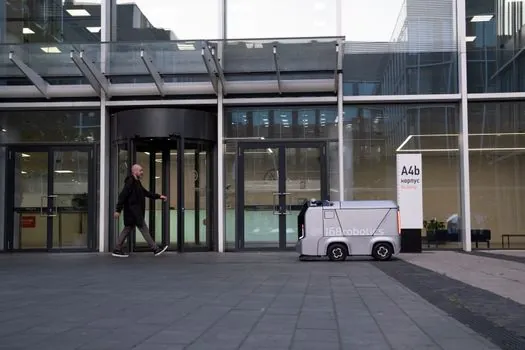
AMRs are the right tool when the order profile changes weekly, when the building is leased or expected to be reconfigured, when the SKU mix includes irregular dimensions that defeat standard cross-belt induct, and when labor availability is the binding constraint rather than capital. They are also the right tool when safety-rated collaboration with human pickers is required, since AMRs are designed to operate alongside human workers using LiDAR and camera-based obstacle avoidance [S7][S9].
Conveyor sortation is the right tool when the SKU set and lane count are stable for at least 36 months, when sustained throughput exceeds the equivalent of a 4-figure-per-hour envelope, when the building is owned and the layout is fixed, and when the operation is sensitive to per-parcel marginal cost. Operators should also stay with fixed sortation when the sort destination is a small number of high-volume lanes rather than a long tail of low-volume chutes, because the conveyor's per-destination economics dominate in that geometry.
Integration, safety, and standards to plan for
AMR integration hinges on three operational pieces. Wi-Fi coverage must be contiguous across all travel paths, since loss of comms can stall a fleet. Floor flatness and rack alignment must be within the chassis spec, because LiDAR localization drifts on uneven surfaces. And the WMS or WCS must expose order, inventory, and chute-assignment events to the fleet manager in near real time. The 2025 IMTS guide highlights that AMRs operate either individually for picking and packing or in coordinated fleets via fleet management software, which is the layer that owns the choke points [S5].
Safety for mobile robots in mixed-traffic warehouses is governed by the ISO 3691-4 family for driverless industrial trucks, with UL 3100 (the American National Standard for autonomous mobile platforms) covering AMR-specific electrical and functional-safety testing in the US market. For the order-picker side of any hybrid cell, OSHA Class II classification still governs high-level work, and the engineering implications of that class boundary are detailed in the spec-based selection write-up on low-level, medium-level, and high-level order pickers.
What to verify in any vendor proposal
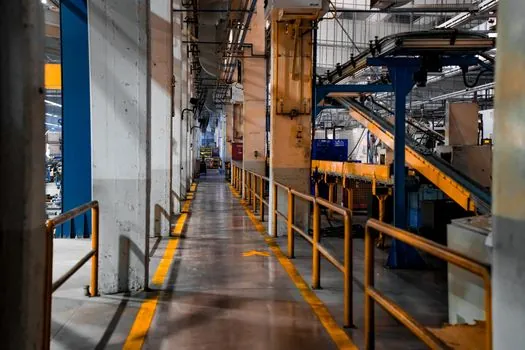
Ask for divert accuracy at the rated peak, not at average throughput, because AMR sortation accuracy often degrades nonlinearly near fleet saturation. Ask for the mean time between intervention events per 10,000 parcels, and whether human pickers are excluded from the sort cell during AMR-only runs. Ask for the recharge model: opportunity charging at 1C versus scheduled swap, and the resulting spare-fleet multiplier. Finally, ask for a 12-month reconfiguration cost ceiling written into the contract, because the AMR pitch is meaningless if every map edit is a change order. [S3]
For variable-order-profile operations, the decision is not which technology is newer, but which one's binding constraint matches the operation's binding constraint. AMRs are the right answer when the binding constraint is variability, conveyors are the right answer when it is sustained rate, and the engineering work is to keep that distinction from being blurred by sales copy.