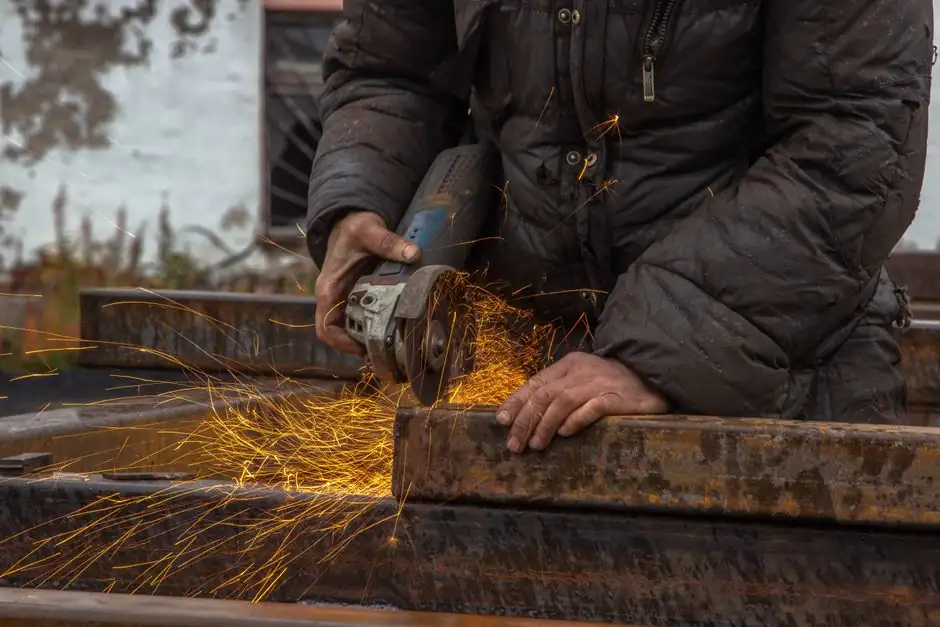
Angle grinders run abrasive discs at 6,600 to 11,000 RPM, and a single cracked wheel or removed guard can turn the tool into a fragmentation hazard; OSHA 1910.242(a) holds the employer responsible for keeping the tool in safe condition, while OSHA 1926.300(a) extends that duty to construction sites [S2].
Cornell's Environment, Health and Safety office lists the minimum operating protocol: wide-vision goggles or safety glasses plus a face shield, both handles attached, both hands gripping during use, and the auxiliary handle in place before the trigger is pulled [S1]. Weekly Safety's portable-grinder guide adds that the wheel label must be legible, the RPM rating of the disc must meet or exceed the tool's no-load speed, and the disc diameter plus thickness must fall within the manufacturer's specification, with the arbor (center hole) matched to the spindle [S2].
PPE Checklist: Eye, Face, Hearing, and Hand Protection
ANSI/ISEA Z87.1-rated safety glasses or goggles are the baseline eye protection on every published grinder toolbox talk; Cornell EHS layers a full face shield over those glasses for grinding and cutting work [S1]. Weekly Safety ranks face protection as highly recommended because ejected fragments and sparks travel beyond the goggle frame on standard 4-1/2 in (115 mm) and 7 in (180 mm) heads [S2]. Norton Abrasives extends the PPE list to hearing protection (typical angle-grinder sound pressure runs 95 to 103 dBA at the operator station), respiratory protection for dust-generating cuts on masonry or coated steel, plus gloves, apron, and metatarsal guards where kickback is credible [S4].
Loose clothing, jewelry, and unrestrained hair are excluded from the work envelope on every source reviewed; the operator must keep sleeves buttoned at the wrist and remove rings before the disc is energized [S1][S2]. For shop-floor readers cross-referencing accessory selection, the angle grinder encyclopedia entry documents the standard disc diameters (4-1/2 in, 5 in, 7 in, 9 in) and the corresponding arbor sizes (typically 5/8 in-11 UNC and M14) that this PPE protocol assumes.
Wheel Inspection: Ring Test, RPM Match, and Shelf Life
Every wheel mounted on a portable grinder must pass a ring test before use: suspend the wheel on a wooden dowel or a finger, tap lightly with a non-metallic object about 3/4 in from the edge, and listen for a clear ringing tone; rotate the wheel a quarter turn and repeat for a total of four quadrants, discarding any wheel that produces a dull thud [S2]. The wheel's printed RPM rating has to meet or exceed the grinder's maximum no-load speed, and a disc missing its label, wet or damp from storage, or showing visible cracks, chips, or surface deterioration is rejected on sight [S2][S4].
Norton Abrasives also advises verifying the expiration or shelf-life date printed on bonded abrasive wheels, since resin bonds degrade with humidity; Heamar's 10-tip construction guide reinforces that discs are never force-fitted, never trimmed with a different tool, and never mounted on a grinder whose RPM label has been painted over or removed [S4][S5]. For comparison, the fettling grinder reference covers higher-power stationary wheels where the same ring-test logic applies but the speed envelopes shift to 1,800 to 2,850 RPM on three-phase industrial units.
Guard, Handle, and Trigger Discipline
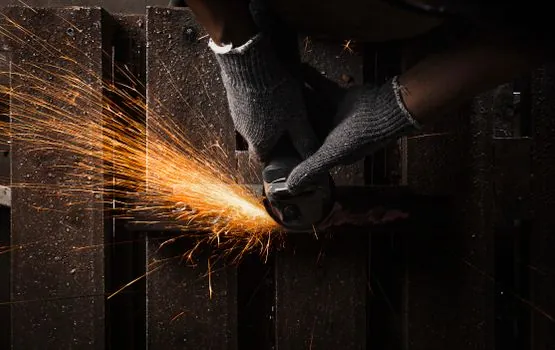
OSHA 1926.300(a) requires all hand and power tools to be maintained in a safe condition, and SafeWork SA explicitly cautions that 9 in (230 mm) angle grinders have been banned on some work sites because the larger wheel diameter raises kickback energy and the risk of severe lower-body laceration [S2][S3]. The wheel guard must be present, correctly oriented between the disc and the operator, and adjusted so the closing edge faces the workpiece, not the user's body [S1][S5].
Heamar's first two rules for construction workers are explicit: do not customize the grinder (no removed guards, no taped triggers, no aftermarket side handles), and confirm the disc is fully seated and the spindle lock fully released before the trigger is pulled [S5]. The two-hand grip rule on the main and auxiliary handles is repeated across all five sources, because single-hand operation is the documented precursor to kickback-related amputations when the disc snags on the workpiece [S1][S2][S4]. Operators moving between bench and field work can review the broader construction machinery and equipment reference for guard-retrofit considerations on aging fleets.
Work-Area Setup: Clamping, Clearance, and Hot-Work Permits
Weekly Safety's pre-job checklist requires a clean work area free of slip, trip, and fall hazards, no flammable liquids or debris within the spark envelope, and the workpiece secured in a vise or with clamps so both operator hands stay on the grinder [S2]. Other personnel must step back from the immediate cutting zone, and any grinder left unattended must be disconnected from power, with the plug locked out during disc changes, cleaning, or guard adjustment [S1][S2].
For cutting operations on painted steel, coated pipe, or any substrate that may release flammable vapor, Heamar adds a hot-work permit check and a fire-watch assignment for at least 30 minutes after the cut ends, because abrasive cutoff discs throw sparks at temperatures above 1,000 degrees F that can ignite solvent residue and shop rags [S5]. The same controlled-access logic is covered in more detail for adjacent tool classes in the floor grinder encyclopedia entry, which addresses dust collection and ignition-source spacing for concrete surface work.
Standards and Regulatory Anchors

Three regulatory anchors govern U.S. portable-grinder use: OSHA 1910.242(a) for general industry (hand and portable powered tools), OSHA 1926.300(a) and 1926.303 for construction (wheel guarding, RPM matching, ring testing) [S2]. ANSI B7.1 is the underlying consensus standard for abrasive wheel safety, and ANSI/ISEA Z87.1 governs the eye-and-face protection specified by every reviewed toolbox talk [S1][S2][S4].
SafeWork SA's 230 mm (9 in) prohibition is a site-level risk control rather than a national ban, and equivalent large-disc restrictions appear on Australian and UK construction sites following kickback incident reviews [S3]. For shop-floor readers, the lamps and light fittings reference touches on the explosion-proof lighting specified for grinder bays where flammable vapor is present.
Who This Protocol Is For, and Where It Stops
The five-source baseline applies to operators of corded and cordless right-angle grinders in the 4-1/2 in to 9 in disc range on construction, fabrication, and maintenance tasks. It does not cover bench or pedestal grinders (separate ANSI B7.1 guarding rules), surface-conditioning or wire-wheel attachments used without a cutting guard, or die and straight grinders whose smaller collets and higher free speeds require dedicated PPE ratings [S1][S4].
Trackable next signals include any 2026 OSHA citation data on 1926.303 guarding violations, updates to ANSI B7.1 on maximum operating speeds for resin-bonded cutoff wheels, and any expansion of the 9 in (230 mm) site-level bans by major U.S. general contractors following 2025 kickback incident reviews [S2][S3].
This topic is covered further in Casting mold sizing and selection: dimensions, shrinkage, and material match.