
A stud welder's working life is governed by three wear parts: the weld tip/chuck, the contactor/thyristor stack, and the DC bus capacitor bank; with proper rotation of consumables and scheduled lift testing, light auto-body units run 5-10 years while shop-class capacitor-discharge (CD) and drawn-arc units routinely cross 15 years before the gun or power source is scrapped [S1][S2].
Body-shop CD pin welders see 50-200 studs per shift and tip changes every 200-500 welds; industrial drawn-arc rigs running M6-M16 studs see 20,000-100,000 welds between major contactor services when operators follow duty-cycle curves in the OEM manual [S2][S3].
What Actually Fails First on a Stud Welder
The chuck, leg, and foot of the weld tip erode with every arc, and OEM guidance is to swap the tip once the leg wears past the marked limit, typically every 200-500 welds on a CD dent-repair gun, because a worn tip shifts the lift gap and produces cold or blown studs [S1][S3].
Beyond the tip, the contactor is the second failure node: on older transformer-based studs the mechanical contactor pits and welds closed at 50,000-100,000 cycles, while modern thyristor (SCR) power stages fail less often but still degrade when the heatsink fan clogs or the stud/ferrule mis-match forces overcurrent trips [S2][S3].
The DC bus capacitor bank in CD welders is the third wear item, with capacitance loss above 10-15% from the nameplate value manifesting as weak ignition, blown studs, and inconsistent fillet formation, the same symptoms a worn contactor produces, so a capacitance check with an ESR meter is the cheapest diagnostic before condemning the whole unit [S2].
Service Intervals and Consumable Rotation
Daily checks on a stud welding station should cover cable insulation, ground-clamp bite, chuck tightness, and a 5-10 stud lift test, with operators logging any missed ignition or excessive spatter because drift on these two symptoms predicts tip, contactor, and capacitor wear before the failure actually trips the welder [S2][S3].
Weekly to monthly service on a shop-class drawn-arc unit is dominated by the lift mechanism: re-set the lift per the OEM procedure, confirm the brass ball and set-screw are intact, then torque the rear cap back on, because a 0.5-1.0 mm lift error on a 3/8 in stud shifts the arc energy enough to flip a passing weld into a porosity reject [S3].
Annual or 50,000-weld intervals should include a capacitor health check, contactor resistance check across the main contacts (replace above ~50 milliohm typical for industrial contactors, though the exact threshold should be taken from the model manual), and a dielectric inspection of the weld cable jacket where it flexes at the gun strain relief [S2].
Decision Criteria: Repair, Rebuild, or Replace
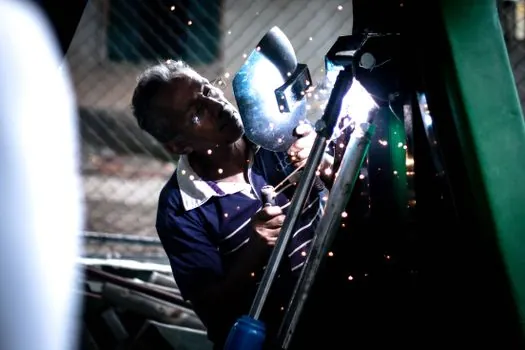
Choose repair when the fault is a consumable: tip, leg, ferrule, O-ring, or ground clamp, all of which sit under 5% of the cost of a new gun and are stocked as standard inventory on body-shop and construction sites alike [S1][S3].
Choose rebuild when the failure is in the power module: replace the contactor, SCR stack, or capacitor bank as a matched service kit from the OEM, because mixing non-OEM capacitors with the original charging resistor network changes the RC time constant and produces inconsistent arc ignition even if the new parts test good individually [S2].
Choose full replacement when the chassis itself is the limit: a 15-20 year-old transformer with a saturated core, a control PCB that is obsolete, or a unit that has been wet or impact-damaged; the rebuild labour plus parts typically crosses 60-70% of a comparable new unit, the same break-even ratio plant engineers use for rotary hammers and similar service-rated power tools [S2].
Use-Case Comparison: CD Pin vs Drawn-Arc vs Stored-Energy
For sheet-metal auto-body work, the stud welder class is the small capacitor-discharge pin gun, which delivers 50-200 welds per shift and is judged almost entirely on tip life, with a worn tip replaced every 200-500 welds and a full gun swap out at 5-10 years on a busy body-shop roster [S1].
For structural fabrication in construction machinery and steel erection, the drawn-arc (DA) stud welder running 3/8 to 1/2 in diameter studs is the workhorse, with ferrules, arc shields, and ceramic ferrule rings dominating the consumable cost; the chassis itself is rated for decades when the lift mechanism and contactor are serviced, and the duty cycle is the spec that drives chassis selection, not calendar age [S3].
For short-cycle production where stud length must be tightly controlled, stored-energy (CD) stud welding with a regulated DC bus produces the most repeatable fillet, but it is also the variant most sensitive to capacitor drift; rebuild the capacitor bank at the first sign of weak ignition, because continuing to push a degraded bank only burns the contactor and the SCR stack next [S2].
Limits, Misconceptions, and Common Failure Modes
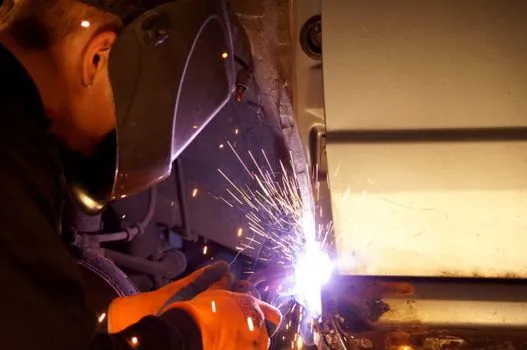
One persistent misconception is that a stud welder is replaced on a calendar schedule; in practice, replacement is symptom-driven, with weak ignition, inconsistent lift test results, and rising contactor resistance the three real triggers, because the transformer, chassis, and cabling have no inherent shelf life and only fail from heat, contamination, or mechanical damage [S2].
A second failure pattern is the mis-matched consumable: running the wrong ferrule diameter, wrong polarity, or wrong stud material grade for the base metal produces porosity, undercut, and over-current trips that operators blame on the welder when the actual fix is to step back to the OEM weld procedure sheet and verify the stud-ferrule-base-metal combination [S3].
A third limit is the cable: the weld cable and ground return are the most fatigue-loaded parts on a portable gun, and a fractured weld cable inside the jacket will read fine on a continuity test but fail under the 1,000-2,000 A peak of a drawn-arc cycle, so replace the cable set at the first sign of jacket cracking at the gun strain relief, not when it finally arcs to ground [S2][S3].
Standards, Sourcing, and Spec Anchors
Stud welding procedure and operator qualification in North America is governed by AWS D1.1 structural welding code sections on stud welding, with the equipment itself evaluated against UL and CSA listed power-conversion rules; European sites anchor to EN ISO 14555 for the welding process, and the OEM manual remains the binding document for daily lift settings, duty cycle, and consumable part numbers [S2][S3].
When sourcing a replacement gun, match the OEM chuck thread, lift travel, and stud-length range exactly, because a generic aftermarket chuck that is 0.1 mm longer on the leg will move the arc gap out of the calibrated range and produce the same cold-stud symptoms the operator was trying to fix; this is the same logic that governs rotary hammer service intervals, where the wear-part geometry, not the brand, decides whether the tool holds its spec.
Track these signals before the next scheduled audit: the lift-test reject rate on the first 5 welds of a shift, the contactor resistance trend logged at every quarterly service, and the capacitance reading on the DC bus; if any of these drift more than 10-15% from the commissioning baseline, schedule the contactor or capacitor service within the next 100 operating hours rather than waiting for a hard failure.
Spec-level background on the components involved: linear guide, and crossed roller guide.
