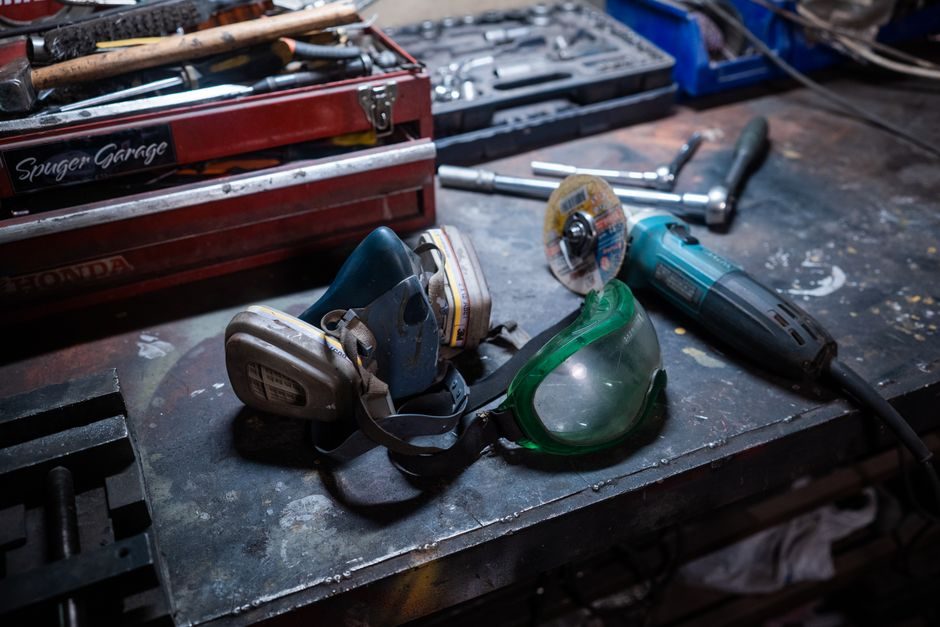
For asphalt patch prep, expansion-joint cleanout, and concrete spall repair, the working window for handheld angle grinders sits at 110-230 mm wheel diameter, 2.0-2.5 kW input, and 6,500-12,000 rpm no-load speed, with pneumatic 2.5 kW / 8,500-12,000 rpm models such as the AMTRU Angle-Grinder Serie 200 illustrating the upper end of the industrial duty class [S1].
Road crews typically need a tool that survives abrasive slurry, hot-curing asphalt fume, and intermittent duty on rebar-tinged concrete, so spec selection starts with the wheel size and power class first, then with the power source (electric 220 V vs pneumatic vs battery 18-54 V) and finally with the ergonomic and dust-management options that decide daily productivity [S4].
Duty Class and Wheel Diameter: 115 mm, 180 mm, 230 mm
Road-maintenance work splits into three diameter bands: 115 mm (4.5 in) for rebar exposure, joint cleanout, and paint-line removal; 180 mm (7 in) for general concrete scabbling and asphalt edge trimming; and 230 mm (9 in) for thick-coat asphalt milling and bridge-deck surface texturing [S4]. Industrial pneumatic units such as the AMTRU Serie 200 explicitly accept 110-180 mm wheels, covering the two heavier bands, while 230 mm wheels dominate the 9-inch high-performance segment shown on the manufacturer listings for surface-prep and asphalt cutting duties [S1][S4].
Selecting a smaller wheel than the cut depth demands step-cutting and re-positioning; selecting a larger wheel than the operator can safely control on a wet, oily, or sloped pavement invites kickback. The rule of thumb on road jobs: wheel diameter in millimetres should be at least 4x the deepest single-pass cut in millimetres, and the guard must be re-set whenever the wheel is changed to the operator-side, closed position per the tool's instruction manual.
Power Source: Electric 220 V vs Pneumatic vs Battery 18-54 V
Electric mains-powered grinders remain the default on curb-and-gutter work where a 220 V single-phase source is available, but pneumatic tools win on open roadway patches where spark risk near fuel spills or solvent residues is non-trivial; industrial pneumatic angle grinders are quoted at 2.5 kW (3.4 hp) with 8,500-12,000 rpm options in the 110-180 mm wheel class [S1]. Compressed-air supply must be sized at 1.0-1.2 m³/min at 6-7 bar to keep the tool at rated speed under load; undersized supply drops rpm and stalls the cut.
Battery 18-54 V brushless platforms have closed the gap on light rebar and paint-line duty, but at 230 mm wheel size and continuous asphalt work the energy density still trails corded tools, so for full-shift road maintenance the corded or pneumatic route is the practical default [S4]. For mixed indoor/bridge-deck work, the same selection logic used for gear motor selection applies: match the duty cycle and ambient, not the headline spec sheet.
Speed, Torque, and Disc Compatibility
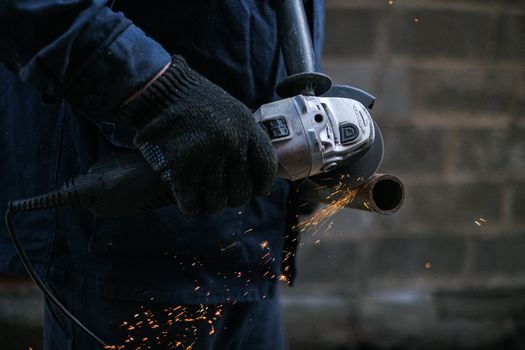
No-load speed is a misleading number: a 12,000 rpm grinder with a worn or undersized armature will slow to 4,000 rpm under a 230 mm diamond cup wheel load, glazing the abrasive and burning the asphalt. Pneumatic 2.5 kW units hold closer to rated speed under load because air motors have a flatter torque curve than universal motors at the same input power, which is why high-cycle road-prep contractors gravitate to them for diamond and cup-wheel work [S1].
Disc rated speed must exceed grinder no-load speed by a minimum margin (printed on every Type 27 / Type 42 abrasive wheel); mismatched pairing is the most common cause of wheel shatter on the jobsite. Diamond cup wheels for concrete are typically rated 80-100 m/s peripheral speed; depressed-centre cutting wheels for metal rebar exposure sit at 70-80 m/s. The grinder's wheel diameter and rated rpm together define the peripheral speed, and any wheel with a rated m/s lower than the grinder's no-load peripheral speed is unsafe regardless of brand.
Dust, Water, and Vibration on the Road Jobsite
Concrete and asphalt dust contain crystalline silica and polynuclear aromatic hydrocarbons respectively; OSHA 1926.1153 and equivalent EU Directive 2017/2398 obligations place the grinder's dust port at the centre of the tool selection, not as an accessory. Road-rated angle grinders in 2026 commonly ship with a 32-50 mm dust-port shroud compatible with M-class or H-class extraction; absence of the port forces the operator into respiratory PPE and slows the work pace below productive levels. [S1]
Vibration is the second fatigue driver: a 2.5 kW pneumatic 180 mm grinder typically posts 4-6 m/s² tri-axial vibration at the handle, against the EU daily exposure action value of 2.5 m/s² and limit value of 5.0 m/s² (Directive 2002/44/EC), so a single shift can consume the operator's daily vibration budget. Anti-vibration side handles, sprung mountings, and auto-balancer wheels are not optional comfort items; on a 4-6 hour road shift they are the difference between a crew that finishes the day and a crew in the clinic.
Selection Criteria Comparison: 115 mm vs 180 mm vs 230 mm Grinders
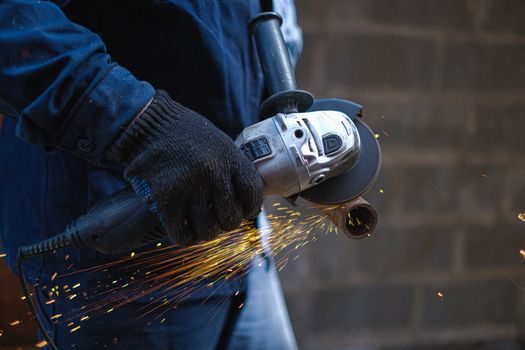
Lining the three wheel classes up against four road-maintenance decision criteria gives a usable spec map. (1) Best cut depth per pass: 115 mm ≈ 25-30 mm, 180 mm ≈ 40-50 mm, 230 mm ≈ 60-75 mm. (2) Operator fatigue on a 4-hour shift: 115 mm lowest, 180 mm moderate, 230 mm highest unless anti-vibration handle is fitted. (3) Power requirement under load: 115 mm 800-1,200 W, 180 mm 1,500-2,200 W, 230 mm 2,000-2,500 W with pneumatic industrial units sitting at the top of that range [S1][S4]. (4) Dust-port compatibility: most 180-230 mm industrial units accept 32-50 mm shrouds, while 115 mm DIY models often lack a port entirely.
For rebar exposure and joint cleanout in tight spaces, the 115 mm corded or 18 V brushless class is the default. For open-road asphalt patch prep and concrete scabbling, the 180 mm industrial pneumatic class with a cup wheel is the workhorse. For 230 mm heavy stock removal on bridge decks and thick asphalt overlays, expect a 2.0-2.5 kW corded or pneumatic machine, a Type 27 guard, and an H-class dust extractor running in parallel [S1][S4].
Failure Modes, Guarding, and When to Stop Using a Grinder
The four recurring road-jobsite failure modes are: (a) wheel shatter from speed mismatch, (b) kickback from pinch-cut on rebar, (c) electrical hazard from wet-cut on a non-GFCI/RCD-protected circuit, and (d) bearing failure from dust ingestion when the dust port is blanked off. Each has a hard rejection threshold: a chipped or out-of-round wheel is discarded immediately, a grinder that fails the run-down test (power on, release trigger, wheel should stop within 10 s per common OEM checklists) is taken out of service, and any tool that has been dropped from above 1 m is bench-inspected before re-issue. [S1]
Replace rather than repair when the armature shows commutator burn, the spindle threads are stripped, or the gear-housing runout exceeds 0.2 mm; these are not field-serviceable conditions on a road shift. For tool selection methodology that mirrors the structured approach used in masonry rotary hammer selection, the same spec-first, duty-second, brand-third logic applies here: lead with diameter and power class, then with dust and vibration control, and only then with the OEM shortlist.
Track the next decision node: before purchase, request the OEM's noise (dB(A)), vibration (m/s²), and dust-port declaration in writing, then cross-check the dust extractor compatibility against the grinder's shroud drawing. Two trackable signals for 2026: tighter enforcement of EU Directive 2017/2398 silica limits on road crews, and a continuing shift to brushless 54 V cordless platforms at the 180 mm wheel size, both of which will reshape the on-road shortlist within 6-12 months.
The underlying component specifications are covered under angle grinder, road roller, and fettling grinder.