
An angle grinder and a demolition hammer both draw roughly 1100-1500 W from a 220 V / 50 Hz mains, both ship in a similar yellow/black plastic clam-shell, and both have a side handle — but the shaft end is a 100-230 mm abrasive disc on one and an SDS-hex chuck on the other, and that single difference drives the entire use case split [S4][S5].
Commercial-angle grinder disc diameters in current Asian OEM catalogues are 100 mm (4"), 125 mm (5"), 150 mm (6"), 180 mm (7"), and 230 mm (9"), with the 115 mm size common in European/US retail, all keyed to a M14 spindle thread running at roughly 8000-11000 rpm no-load [S4][S5]. A demolition hammer is the other branch of that motor-power family: the chuck is SDS-hex or SDS-max, blow energy lands in the 8-20 J per-stroke range, impact frequency sits around 1400-3000 bpm, and the shaft spins only as a byproduct of the ratchet — it is not a drilling tool unless the manufacturer offers a rotary-hammer variant [S2][S4].
Output interface: abrasive disc vs SDS-hex chisel
The angle grinder's M14 spindle is built for bonded-abrasive or diamond-rimmed wheels, flap discs, wire cups and cutting guards sized to the disc diameter — 100 mm for sheet-metal trim, 125 mm as the all-rounder for fab shops, 180/230 mm for rebar and masonry cuts, with the 115 mm size filling the US/European retail slot [S4][S5]. Demolition hammer output is the opposite: a 30 mm or 18 mm SDS shank accepts pointed, flat and spade chisels, plus ground-rod drivers and tamper plates; the steel is struck longitudinally at 8-20 J per stroke and the operator pushes the bit into concrete, brick, asphalt or frozen ground [S2][S4].
The two interfaces are physically non-interchangeable: an M14-to-SDS adapter is a one-way emergency hack for light drilling with a small core bit, not a daily driver, and any attempt to mount an abrasive disc on a demolition-hammer spindle destroys the disc within seconds because the hammer has no constant-rotation governor [S2][S4]. Buying one to do both jobs is the classic site mistake.
Power, speed and impact: where 1500 W gets spent
Angle-grinder rated input clusters at 1100 W for the 100/125 mm body, 1400-1500 W for the 150/180 mm body, and 2000-2600 W for the 230 mm pro tier, with no-load speeds of 8000-11000 rpm and load speeds roughly 70-80 % of no-load [S4][S5]. Demolition-hammer rated input sits in the same 1100-1500 W bracket for the 5-10 kg class, but no-load speed is meaningless on a pure chipping tool — the marketing page calls out 1400-3000 bpm impact frequency and 8-20 J single-stroke impact energy instead [S2][S4].
That is the physics split: an angle grinder converts watts into rotational kinetic energy on a 100-230 mm disc and dissipates it through friction; a demolition hammer converts watts into reciprocating kinetic energy on a 30 mm piston and dissipates it through brittle-fracture work on concrete. The same 1500 W input cuts a 6 mm rebar in a few seconds on one tool and breaks 30-50 cm² of 30 MPa concrete per minute on the other — same wall-plug cost, completely different deliverables [S2][S4][S5].
Use-case split: cut/polish steel vs break concrete
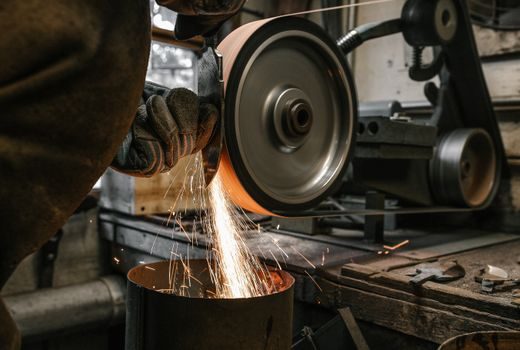
Angle-grinder jobs, in spec-sheet order: cutting rebar, pipe and sheet steel; beveling welds; grinding down weld seams; deburring castings; cutting stone, tile and concrete paver with a diamond wheel; rust/paint removal with a flap disc or wire cup; sharpening edge tools. Demolition-hammer jobs: breaking up concrete slabs, foundations and walls; chipping tile off a floor; cutting channels in brick and poured concrete for conduit; driving ground rods; tamping asphalt patches; busting frozen ground or rock outcrops in civil work [S2][S4].
The narrow overlap is "make a hole in concrete": an angle grinder with a 180 mm diamond cup wheel or dry-cut diamond blade can score or shallow-cut masonry, but a demolition hammer with a chisel bit will remove 10-50× more cubic centimetres per minute from a slab. If the deliverable is a square opening, not a slot, the demolition hammer wins; if the deliverable is a clean edge on tile or a precise cut in a 20 mm stone slab, the angle grinder wins. The 180 mm grinder also handles short rebar cuts that would otherwise chew a demolition bit [S2][S4][S5].
Selection criteria: weight, vibration, dust, guarding
Angle-grinder body weight runs 1.4-1.8 kg for the 100/115 mm compact tier, 1.8-2.5 kg for the 125 mm all-rounder, 3-4 kg for 180 mm, and 5-6 kg for 230 mm, with two-handed operation mandatory from 150 mm up and a wheel guard set within 30° of the work [S4][S5]. Demolition-hammer body weight is higher at the same wattage: 5-7 kg for the SDS-plus class, 8-12 kg for SDS-max, with vibration at the triaxial handle commonly 8-15 m/s² and mandatory anti-vibration gloves above 10 m/s² daily exposure per typical EU/China OEL guidance [S2][S4].
For spec-driven selection the decision matrix is four axes: (1) primary material — steel/stone vs concrete/brick; (2) deliverable geometry — cut/finish vs fracture/remove; (3) duty cycle per shift — under 2 h favors the lighter grinder, over 4 h on breaking work favors a 1500 W SDS-max with AVT; (4) dust environment — both need a dust shroud, but angle-grinder dust is fine abrasive (HEPA H13 minimum) while demolition-hammer dust is coarse silica (M-class extractor at 200 m³/h minimum) [S2][S4][S5]. Picking on wattage alone is the most common sourcing error: a 1500 W grinder cannot break a 100 mm concrete slab in any reasonable time, and a 1500 W demolition hammer cannot cut a 6 mm steel plate without destroying its chuck.
Comparison frame: grinder vs demolition hammer on decision criteria

Lining the two up against the criteria a buyer actually scores on: rated input power is essentially identical at 1100-1500 W for the mid-tier, with demolition-hammer pro models extending to 1700-2000 W; no-load speed is 8000-11000 rpm on the grinder, 0-1100 rpm on the demolition hammer's ratchet (and meaningless on a pure chipping body); impact energy is 0 J for the grinder, 8-20 J for the demolition hammer; tool weight at 1500 W is 2-3 kg for the grinder, 5-8 kg for the demolition hammer; disc/chuck fitment is M14 abrasive for the grinder, SDS-plus (18 mm) or SDS-max (30 mm) for the demolition hammer; primary output is cut/polish on steel and stone for the grinder, fracture/remove on concrete and brick for the demolition hammer [S2][S4][S5].
The comparison collapses to one rule: choose the angle grinder when the work spins against the workpiece, choose the demolition hammer when the work strikes into the workpiece. The 1100-1500 W rating overlaps because both are mid-size mains-powered tools, not because they are interchangeable — and the M14 / SDS-hex boundary is the cleanest spec-sheet line separating the two on any commercial OEM datasheet [S2][S4].
Limitations and failure modes
Angle-grinder failure modes: disc shatter from overload or wrong RPM rating (a 100 mm disc on a 11000 rpm spindle marked for 80 m/s is a fragmentation risk); wheel-guard deflection past 30° letting sparks into the operator; kickback when the disc pinches in a cut; and brush/armature failure on continuous 30-minute cuts without a cool-down. Demolition-hammer failure modes: bit seizure in the SDS chuck from concrete-dust ingress; piston-ring wear past 200-400 hours on a 1500 W body; handle-stem fracture from prying sideways instead of chipping vertically; AVT spring failure exposing the operator to 15-25 m/s² hand-arm vibration [S2][S4][S5].
Misuse crossover: using an angle grinder with a diamond cup wheel to remove 50 mm of concrete is technically possible but eats 4-8× the labour of a 1500 W demolition hammer, and the dust load is heavier because the grinder spalls dust rather than chipping it; using a demolition hammer with a wide chisel to "cut" thin sheet metal flexes the bit and usually stalls the motor within seconds. Both tools also overlap in operator PPE — Class F face shield, hearing protection above 85 dB(A), and a dust mask rated P2/P3 for masonry work — but the angle grinder needs a spark guard, while the demolition hammer needs a vibration-damped glove [S2][S4].
2026 sourcing signals

Current Asian OEM quotes for the 1500 W 125 mm angle-grinder body land at roughly CN¥ 230-385 ex-works per piece, with the same 1100-1500 W SDS-plus demolition hammer at CN¥ 350-560 ex-works, both MOQ 100-500 units for private-label runs [S1][S2][S3]. Cordless 21 V brushless variants in the same body sizes are now standard catalogue items from Jiangsu, Zhejiang and Hubei OEM factories, narrowing the corded-vs-cordless price gap to under 30 % for the 125 mm class [S1][S3]. Track through the EXW/FOB split on the next two sourcing RFQs to see whether cordless 21 V SDS-plus demolition hammers close the price gap on corded 1500 W bodies in 2026 H2.
For component-level specifications, see rotary hammer.
For related coverage, see GPU Upstream and Downstream Industries: 2026 Supply Chain and Demand Map.