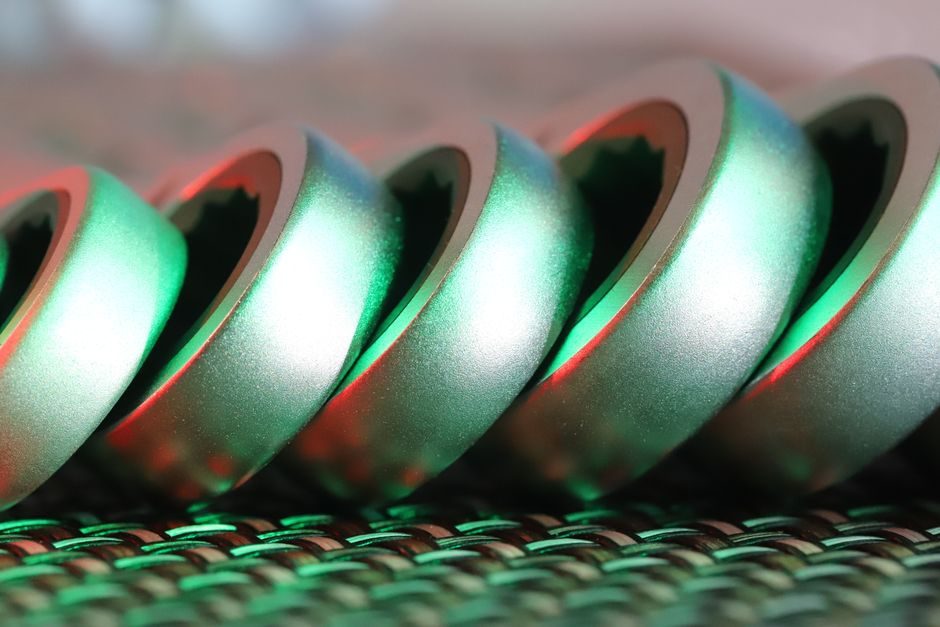
Single-row angular contact ball bearings carry combined radial and axial load on a single thrust direction, and the contact angle α — typically 15°, 25°, or 40° in the 7000-series — directly controls how much axial load the bearing can absorb before the raceway contact ellipse slides into an unsupported zone [S2]. Engineers should treat α, paired mounting arrangement, and limiting speed as a coupled set, because pushing α higher to gain thrust capacity almost always costs a measurable percentage of D<sub>N</sub> (diameter × rpm) headroom.
For a deep dive on how this bearing family is defined and how it relates to other rolling-element types, see the angular contact bearing reference, and for radial-load alternatives the ball bearing and roller bearing pages give the comparative geometry.
Contact Angle and Load Vector Mapping
LYC's 2026 catalog states that axial load capacity grows monotonically with α, while radial capacity stays roughly constant within the 15°–40° band [S2]. Sogou's technical entry on the same product family confirms the geometry: a 40° contact angle is the practical ceiling for most 7000-series units, beyond which cage-guided ball guidance becomes unreliable above ~1.5 million D<sub>N</sub> [S2]. The implication for selection is that α should be picked by the ratio of axial-to-radial load (F<sub>a</sub>/F<sub>r</sub>): below 0.3 stay in 15° (C-class, also called 7000C/7200C), from 0.3 to 1.0 move to 25° (AC), and above 1.0 specify 40° (B) [S2].
For high-precision machine-tool spindles where a 40° part is borderline on stiffness, design practice in the 2026 Okorder trade entry recommends the matched-pair DF or DT arrangement (face-to-face or tandem) to redistribute load across two rows without raising α further [S5]. This is the same load-distribution principle the LYC catalog applies to high-speed spindles running 15° universal flush-ground units in DB pairs [S2].
Mating Arrangements: DB, DF, DT and Universal Flush-Grounding
Single-row angular contact bearings transmit thrust in only one direction, so for bi-directional shaft support the standard practice is matched-pair mounting in back-to-back (DB), face-to-face (DF), or tandem (DT) configuration [S2]. A DB pair resists tilting moments from the line-shaft and is the typical choice for short, rigid spans; a DF pair is more tolerant of misalignment but carries less moment load; a DT pair is used when thrust capacity must be stacked against a single direction, for example in gearbox pinion shafts.
Solid Bearings Limited lists 2026 production examples of all three: 7234 B/DF at 170×310×104 mm for machine-tool main spindles, and 7244 B/DT at 220×400×130 mm for printing-machine cylinder support [S4]. The dimensional jump between the two — bore growing from 170 to 220 mm and width from 104 to 130 mm — illustrates the rule that DT stacks are noticeably wider than equivalent-load DF pairs. Shenli Industrial stocks the 150BTR10S and 200BTR10S high-speed spindle series in universal flush-ground tolerances for paired mounting without shims [S4]. For context on the wider bearing family, the slewing-bearing page covers large-diameter slow-speed variants used when a 7000-series part would be over-spec'd.
Speed, Lubrication and Cage Selection
Limiting speed for grease-lubricated 7000-series units typically sits 20–30% below the oil-bath figure; for a 40° contact angle this is roughly 1.0–1.2 million D<sub>N</sub> in grease versus 1.4–1.6 million D<sub>N</sub> in oil [S2]. Beyond that envelope, the limiting factor is cage stress, not ball-raceway contact fatigue — phenolic resin and brass cages handle the upper end, while pressed-steel cages are usually capped near 1.0 million D<sub>N</sub> [S2].
Selection should also respect the lubrication envelope of the housing: a 15° C-class unit that will run oil-mist at 1.5 million D<sub>N</sub> is a defensible spec, but the same unit on grease at the same speed will fail the cage first. The 2026 Made-in-China listings for ACBB units flag 2RS (rubber seal) and 2Z (metal shield) variants that should be specified only at lower speeds because the seal contact band raises operating temperature and limits the grease life [S3].
Internal Clearance, Preload and Tolerance Class
Single-row angular contact bearings are typically supplied with controlled internal clearance (C2, CN, C3, C4) rather than zero clearance, and the matched-pair application applies axial preload by clamping the inner or outer rings together. LYC's catalog note on 2026 production recommends light preload for high-speed spindles and moderate-to-heavy preload for heavy-load gearboxes, with the exact figure set by the duplex grinding tolerance on the ring faces [S2].
For universal flush-ground units (suffix G or GN by JIS B 1514, ABEC-7/-9 by ABMA), preload is set by the face-to-face or back-to-back mounting distance, so no shimming is required at the assembly stage [S2]. Trade catalogs confirm this in practice: Shenli lists the 150BTR10S and HSS7000/HSS7004 series as universal flush-ground, while 7019-type parts on Okorder are sold as loose single-row units intended for DB/DF/DT pairing with light preload applied via the housing stack [S4][S5].
Standard 7000-series rings and balls are through-hardened chromium steel to roughly 58–62 HRC after heat treatment, which gives the raceway the rolling-contact fatigue life required for most industrial drives. Where electrical-erosion damage is a documented risk — for example in large spindle motors with VFD-driven statics — the trade catalogs increasingly list hybrid ceramic-ball variants where silicon-nitride (Si<sub>3</sub>N<sub>4</sub>) balls run in steel rings [S3]. These hybrid parts trade a higher unit price for electrical insulation, lower density (≈40% lighter balls), and a small D<sub>N</sub> gain at high speed.
For comparison, the ceramic bearing encyclopedia entry documents the trade-offs in full material sets (full Si<sub>3</sub>N<sub>4</sub> rings and balls) versus hybrid configurations, including the price premium, lead-time, and failure-mode differences. Where corrosion is a concern — washdown food plants, marine gearboxes — 440C stainless rings are stocked, with a measurable capacity derating (typically 10–20% below the chrome-steel dynamic load rating) that must be carried into the selection calculation.
2026 Sourcing Landscape: China OEM Tier and Price Bands
The 2026 Made-in-China and Tradebearings listings cluster angular contact ball bearings into three observable price tiers. Tier 1 covers generic auto-grade ACBB units in the 30–60 mm bore range at US$1.00–20.00 per piece with MOQ of 1 piece from Shanghai Luvivo Supply Chain [S3]. Tier 2 covers precision industrial grades (P0/P6/P5) in the 7000C/AC/B series at US$0.78–1.358 per piece from Shenzhen Leading International Trading at MOQ 2 pieces for export [S3]. Tier 3 covers large-bore, matched-pair, and machine-tool spindle grades (HSS7000, HSS7004, 150BTR10S, 200BTR10S, 7019) with manufacturer-quoted supply capabilities of 500,000 pieces per month on the Okorder 7019 listing at MOQ 1000 pieces [S4][S5].
Shenli Industrial's 2026 stock list shows that spindle-grade ACBBs (HSS, BTR10S series) typically ship in 6–8 weeks from PO, while automotive-grade 2RS/2Z parts ship from bonded-warehouse stock within 2 weeks [S4]. Where the buyer's requirement falls between standard catalog and full custom — for example, a non-standard contact angle or ABEC-7P tolerance — Chinese OEMs accept technical drawings with a 2,000-piece MOQ threshold, and the export tariff reference on ETCN should be checked against the 8482.10 series customs heading for landed-cost calculation [S1]. For a view of how this sourcing profile compares with adjacent industrial categories, see the Cut-Off Machine Suppliers 2026 report and the Machine tool production technology reference, both of which reference Chinese OEM clusters in the same Jiangsu/Zhejiang corridor.
Common Selection Failures and Verification Gates

Three failure modes show up repeatedly in field returns: (1) α undersized for the actual F<sub>a</sub>/F<sub>r</sub> ratio, leading to edge-loaded raceway spalling within the first 2,000 hours; (2) DB/DF/DT pair mounted with the wrong face contact (face-to-face installed as back-to-back, or vice versa) so thrust is rejected in the loaded direction; (3) universal flush-ground units set with shims that defeat the factory-controlled preload class, shifting the operating point onto the steep part of the speed-stiffness curve [S2][S5].
Verification before release should include: confirming α against the F<sub>a</sub>/F<sub>r</sub> ratio with a calculated 1.2× service factor, checking the catalog limiting speed against the actual D<sub>N</sub> requirement with a 20% derate for grease lubrication, and validating the mounting arrangement against the shaft's tilt and thrust direction on the assembly drawing. The Made-in-China supplier data also flags that 2RS sealed ACBB units have a measured 10–15% D<sub>N</sub> penalty versus the open type, which should be carried into the speed selection at the design stage [S3][S6].