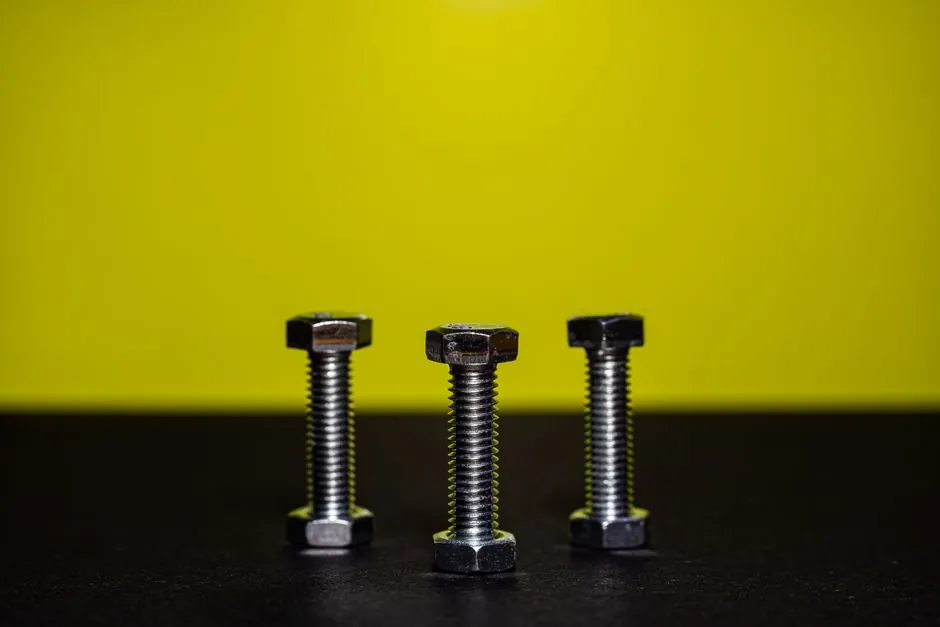
An anti-backlash nut uses a split or spring-loaded body to remove lead-screw reversal clearance, while a standard one-piece nut leaves normal thread clearance and costs less.
Choose an anti-backlash nut for repeatable positioning under reversing loads; choose a standard nut when cost, high axial load, or serviceability outweighs reversal accuracy.
Operating Principle and Performance Gap
A standard nut is one solid body whose threads mate with the lead screw, so axial clearance appears when load direction reverses [S6]. An anti-backlash nut is commonly divided into a main body and a follower, with a compression spring maintaining separation so the threads remain loaded in one direction [S6].
That preload is the decisive mechanical feature, not merely the nut material.
The installed result still depends on screw accuracy. PBC Linear describes lead-screw outside-diameter grinding to tolerances measured to a maximum of 0.0005 in (12 µm), followed by roll threading and automatic straightening [S3]. A low-clearance nut cannot remove geometric runout, pitch error, or torsional windup.
Decision Matrix: Four Selection Criteria
Compare the options by reversing-load accuracy, axial-load capacity, maintenance, and acquisition cost. Anti-backlash versions generally win on reversal accuracy because spring preload suppresses clearance [S3][S6]. Standard nuts generally win on simplicity and cost because they have one rigid body and no adjustment mechanism [S6].
On load capacity, do not select by catalog wording alone. A spring nut can produce useful force while the screw remains stationary, but a sufficiently high axial load can overcome the spring and permit axial movement. The spring force, nut geometry, screw diameter, and thread engagement must therefore be checked together rather than treated as independent ratings.
On maintenance, screw-adjusted anti-backlash nuts require periodic re-adjustment as the nut wears. Spring-loaded versions reduce that adjustment requirement, but the spring remains a wear and load-limit component [S4].
On cost, a lead-screw and spring-loaded anti-backlash nut combination is described as cheaper than a ball-screw equivalent and easier to assemble [S4]. That advantage is application-specific, not a universal price claim.
Material and Service Temperature Choices
Acetal, also identified as Delrin or POM in the cited fabrication example, is widely used for the screw-contacting element because it combines low friction, machinability, and wear resistance [S1][S2].
Acetal and POM should not be treated as unlimited-temperature materials. The related material comparison, Acetal vs PEEK Lead Screw Nuts for Heat Service, is relevant only as a candidate reference, while the supplied evidence confirms acetal construction but does not provide a temperature rating. Specify the resin grade and obtain its manufacturer data before assigning a service limit.
Brass remains a practical standard-nut material, while POM can serve as the sliding element in an anti-backlash arrangement. A maker discussion notes that only POM touched the screw in one arrangement and that anti-backlash action helped retain a 310 x 310 x 6 mm aluminum plate when power was removed [S5]. This is an installed example, not a universal load or retention specification.
PTFE is another valid low-friction direction. SDP-SI describes flanged anti-backlash lead-screw nuts made from acetal with PTFE [S1], while
Appropriate Loads and Operating Conditions
Use an anti-backlash nut where the load reverses and lost motion must be small at the end of travel. This covers powered axes, repeatable manual adjustments, positioning stages, and CNC axes where a standard nut visibly develops clearance after wear [S3][S4].
Use a standard nut where the load remains unidirectional, the screw is continuously driven, backlash does not affect the required result, or replacement simplicity dominates. A rigid nut avoids spring preload, spring fatigue, and periodic spring-loaded nut adjustment, making it the simpler mechanism when reverse clearance is acceptable.
Neither option should be selected without checking load, speed, duty cycle, lubrication, and screw diameter. A spring nut can preserve a favorable fit during direction reversal, but sustained thrust must not exceed what the spring preload and thread contact can sustain. A standard nut may tolerate greater axial loading, yet clearance remains inherent to the thread pair.
For thread-form selection, the supplied reference on ACME versus Trapezoidal Lead Screws is a separate comparison and must be combined with the nut decision. Nut material, backlash construction, screw geometry, and drive method affect performance as one system.
Installation, Adjustment, and Failure Modes
A DIY acetal nut can be formed around the plain portion of a screw by melting the polymer around a heated tap. The described method allows slight deformation to establish contact in both directions, producing virtually zero backlash in that installation [S2]. The same source warns that a hotter screw contracts more and can cause a looser fit [S2].
Commercial assemblies are preferable where thread form, preload, and repeatability must be controlled. PBC Linear reports concentricity below 0.003 in (75 µm) for the motor hollow shaft and notes that bearing preload can remove axial play and reduce system backlash [S3]. These values describe that manufacturer’s cited assembly process, not universal tolerances for every anti-backlash nut.
The principal failure modes are identifiable. Over-adjustment can create excess friction and premature wear; under-adjustment restores backlash [S4]. A spring that is too weak cannot resist reversal under higher load [S4]. Prototype T12 nuts also showed threading problems, while T8 nuts tested well in one development program [S4]. Thread-form verification is therefore mandatory for any nonstandard size.
Practical Selection Rules
Specify an anti-backlash nut when reverse-direction repeatability is a measured acceptance criterion, the load reverses, and spring preload can be selected above the expected reversal force. Use the lead screw nut family only where the mechanical interface includes a suitable locking feature; it does not replace backlash compensation by itself. [S3]
Specify a standard nut when the drive is unidirectional, axial load exceeds the practical preload range, or low cost and rapid replacement dominate. Pair the screw with a compatible lock nut only for retention against axial movement, not as a substitute for a preloaded anti-backlash design.
For a formal purchase specification, state screw diameter, pitch or lead, thread form, nut length, required axial load, reversing load, duty cycle, lubrication method, allowable backlash, material grade, and service-temperature limit. Confirm spring preload and thread contact with the nut supplier, because the supplied material does not establish universal load ratings or backlash tolerances.
Quote the result only after a reverse-position test, because nut clearance, screw runout, bearing play, and drive compliance can combine into a larger positioning error. The decisive choice is not simply “anti-backlash” versus “standard,” but whether spring-preloaded clearance control is worth its load, maintenance, material, and cost constraints.