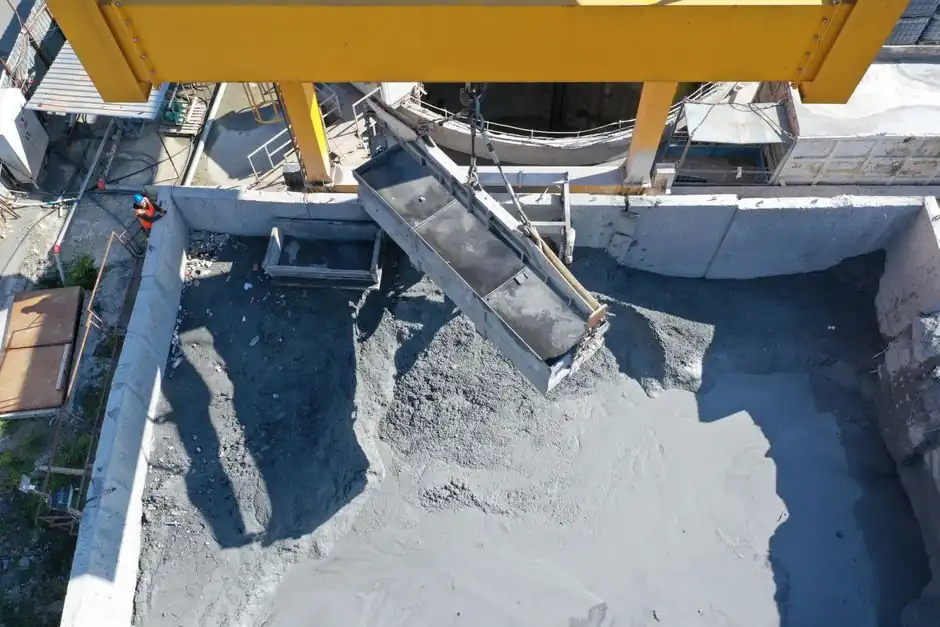
Apron pan conveyor chain uses overlapping steel pans for heavy bulk handling, while standard conveyor-chain attachments suit lighter products and cleaner duties.
The decision rests on load severity, material temperature, leakage tolerance, incline, capacity, and permitted chain speed, not simply on attachment strength.
What Apron Pan Conveyor Chain Is Designed to Carry
Apron pan conveyor chain is a heavy-duty conveying system in which overlapping steel pans form a trough while a rugged chain provides positive traction [S1][S3].
The carrying surface is a structural component rather than an accessory. The pans are mild steel, and the sidebars are medium-carbon steel [S5]. This makes the system suitable for cement, clinker, ore, sand, gravel, coal, castings, and industrial refuse moved horizontally or uphill [S1].
Apron conveyors fit slow- or moderate-speed service, and maximum chain speed depends on sprocket size [S5]. The chain remains beneath the pans, while overlap, deep pans, and optional seals limit spillage and protect the linkage from direct product impact [S3].
Decision Criteria for Heavy-Duty Material Handling
Choose apron pan conveyor chain when the product is heavy, sharp, abrasive, hot, dusty, fine, or prone to leakage. It is also appropriate when the conveyor must climb an incline and the load would damage or displace a belt [S1][S3][S4].
Specify standard conveyor-chain attachments when the duty involves packaged goods, modest bulk loads, clean transfer points, higher conveyor speeds, or applications where a flat carrying surface is unnecessary. Standard roller chain attachments are easier to integrate into conventional compact conveyors, but they do not provide the deep load-bearing pan and spill containment of an apron system.
Temperature is a materials-selection issue, not a generic speed allowance. Confirm the selected chain and pan metallurgy, heat treatment, and operating temperature against the actual product condition before procurement.
Apron Pan System vs Standard Chain Attachments
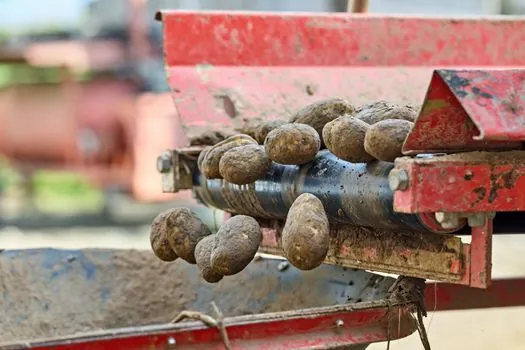
Apron conveyor chains use overlapping steel pans attached to a rugged chain to form a continuous, leak-resistant trough [S3]. Overlapping steel pans form a leak-resistant trough for moving heavy, sharp, or hot materials [S3].
For speed and mechanical complexity, apron systems favor slow- or moderate-speed operation, with chain speed limited by sprocket size; standard attachment systems can suit a broader range of conveyor speeds when the chain and drive are selected for that duty [S5].
The comparison is not between two identical chains. Apron pan conveyor chain integrates the traction chain and carrying surface into a bulk-handling system. A standard attachment chain uses the chain conveyor as its pulling element and adds discrete attachments, so the pan system generally carries more integrated engineering effort but handles severe material conditions more effectively [S1][S3].
Pan Styles, Chain Construction, and Service Limits
These are different capacity and containment choices, not interchangeable cosmetic options.
Webster apron chains use cottered construction and are interchangeable with other standard products of corresponding sizes and numbers [S5]. Pins are through-hardened alloy steel, bushings are case-hardened steel, and rollers are furnished in WEBLOY [S5].
Roller selection changes operating friction. Lower friction can reduce drag, but the final selection must match load direction, side shift, lubrication method, and contamination conditions.
Applications Where Each System Fits
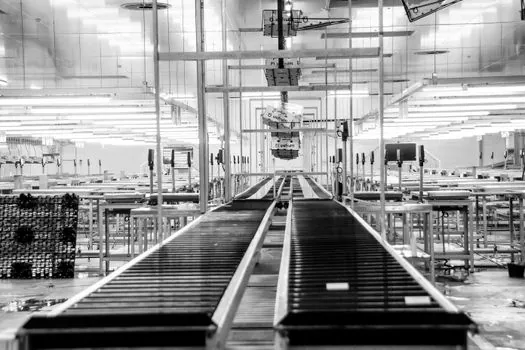
Apron pan conveyor chain is the stronger selection for cement and clinker, ore, coal, foundries, hot castings, abrasive bulk material, waste handling, and incline conveying [S1][S3][S4]. Its structural pans absorb large-lump impact and repetitive loading, support cleaner discharge, and reduce spillage [S5].
Standard attachments are appropriate for lighter, cleaner products handled on conventional chain conveyors. Where an installation uses a general conveyor chain with added flights or carriers, the selection should be based on product mass, attachment spacing, chain pitch, joint capacity, drive torque, and impact duty.
For cement plants, the drive-chain comparison in roller chain selection for cement plants covers pitch, service factor, and heavy-series rules separately from the pan and carrying-surface decision. Apron chain selection should be kept distinct from that drivetrain calculation.
Sourcing, Inspection, and Failure Controls
Request the chain number, pitch, width, pan style, plate thickness, roller type, sprocket configuration, material grade, heat treatment, capacity, and operating limits with each quotation. Webster chains are interchangeable with corresponding standard products of matching size and number, and replacement pans can be engineered for systems from other manufacturers [S5].
Do not rely on generic marketing claims to establish compatibility. Verify the 6-inch or 9-inch pitch class, 120-inch maximum-width statement, 1/4–1/2 inch pan-thickness range, and 3–6 inch wing-height range against the selected manufacturer’s catalogue before treating them as procurement limits [S3].
Track chain elongation and tension during scheduled inspections because stretched chain, worn bushings, damaged pins, blocked rollers, and deformed pans can cause tracking, seizure, spillage, or abrupt failure [S3][S5]. Confirm that the specified roller and lubrication arrangement matches the actual material and side-shift conditions.
Use apron pan conveyor chain for severe bulk handling on slow- or moderate-speed conveyors, and reserve standard attachments for lighter duties where speed, simplicity, and low added carrying weight dominate.