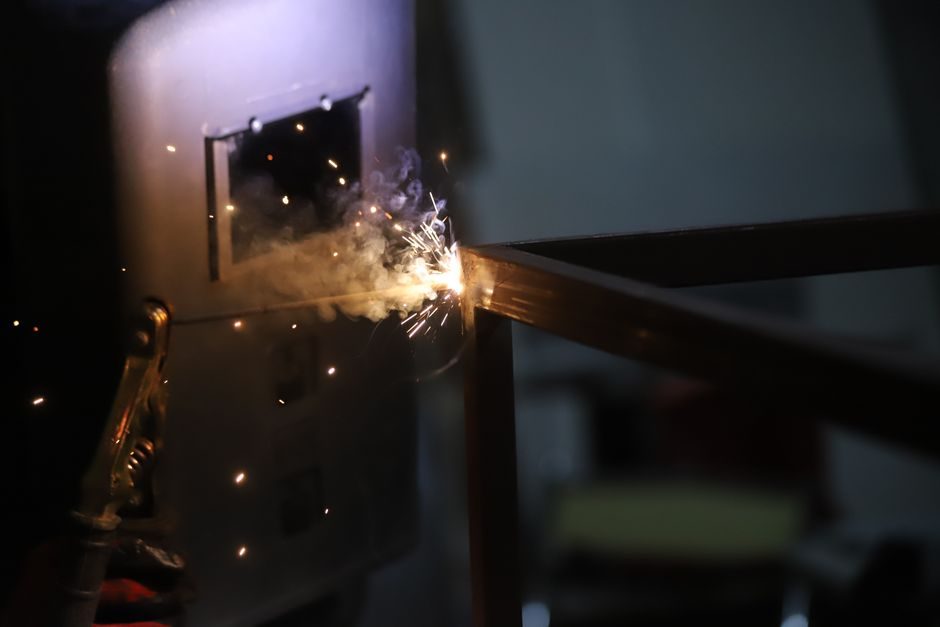
Arc welding machines produce coalescence by sustaining an electric arc between an electrode and the base metal, and the umbrella term covers shielded metal arc welding (SMAW, also called MMAW or stick), gas tungsten arc welding (GTAW/TIG), gas metal arc welding (GMAW/MIG), flux-cored arc welding (FCAW), submerged arc welding (SAW), and plasma arc welding (PAW) [S1][S9][S10].
The arc burns at temperatures above 3,000 °C in the gas column, melting both the workpiece and (in consumable-electrode processes) the filler rod, so equipment ranges from a 4–5 kg portable 160 A MOS-inverter MMA unit up to gantry-mounted submerged-arc and robotic arc-welding cells [S2][S5].
SMAW / Stick Welder: Where the Process Wins and Where It Loses
SMAW uses a flux-coated consumable electrode, so the flux decomposes in the arc to generate a shielding gas plus a molten slag that protects the weld pool, which is why the process works outdoors and on dirty or rusty steel without external gas [S9].
Equipment cost is the lowest of any arc process — portable inverter stick sets such as the MMA-160M class typically deliver a 20–160 A DC range with MOS-inverter electronics, anti-electric-net fluctuation, stable arc ignition, and a CE marking, weighing in at the light end of the portable-welder market [S5].
The trade-off is productivity: SMAW has a low deposition rate, the coated electrode must be replaced every few minutes (a 350 mm stick typically burns in 1–3 minutes at 100–150 A), and slag must be chipped off between passes, so duty cycle and arc-on time per shift are lower than with GMAW or SAW [S9].
SMAW is also unsuitable for reactive metals such as aluminium and magnesium, because the flux cannot provide the inert shielding those base materials require, and the slag inclusions degrade corrosion resistance on stainless [S1][S9].
GTAW / TIG: Highest Quality, Lowest Productivity
GTAW uses a non-consumable tungsten electrode and an external inert shielding gas (almost always argon), with a constant-current power source; the arc can be held stable at less than 10 A, which is the reason TIG dominates thin-section stainless, aluminium, magnesium, nickel-base alloys, and dissimilar-metal joints [S1][S3].
Because the tungsten does not melt into the pool, there is no flux entrapment, weld splatter, or sparks that mar the base metal, and the resulting welds are stronger, more ductile, and more corrosion-resistant than SMAW or GMAW deposits in equivalent base materials [S1].
AC TIG additionally breaks up the aluminium oxide skin during the positive half-cycle, which is why AC-TIG is the standard process for welding aluminium and magnesium alloys without chemical cleaning [S3].
The cost of that quality is throughput: TIG is "significantly slower than most other electric welding techniques," has a lower filler-metal deposition rate, and the tungsten electrode has a limited current-carrying capacity — exceeding it causes tungsten melting and tungsten inclusions in the pool [S1][S3].
Argon consumption, a complex machine head, and the demand for a skilled hand-feed operator push per-joint cost above SMAW, GMAW, and SAW, so TIG is almost never used for primary structural fabrication on mild steel [S3].
Plasma Arc Welding (PAW) and Submerged Arc Welding (SAW)
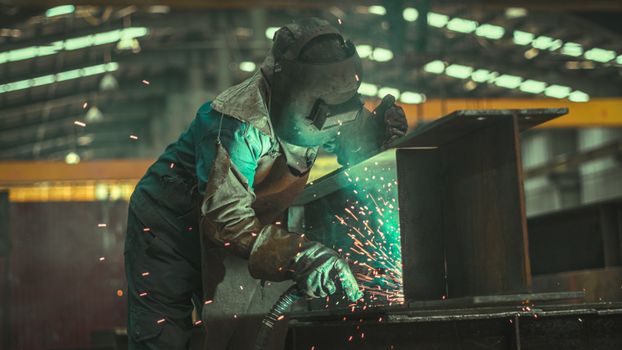
PAW constricts the arc through a water- or gas-cooled copper nozzle, separating the plasma jet from the shielding-gas envelope; the process was discovered by Robert Merrell Gage in 1957 and is typically run with a sintered-tungsten electrode, producing a higher energy density and narrower, deeper weld than TIG at comparable current [S10].
That constriction gives PAW higher travel speed and better penetration control on thin-wall stainless and aerospace alloys, but the torch is more complex, the nozzle has a finite stand-off tolerance, and the equipment cost is well above a TIG package, so PAW is concentrated in high-precision tube and sheet shops [S10].
SAW forms the arc beneath a granular flux blanket that melts to generate the shielding gas and slag, so there is no visible arc, almost no fume, and very high deposition rates on thick-plate butt and circumferential seams in pressure-vessel, shipbuilding, and structural-beam lines [S2].
SAW requires a flux recovery system and is limited to flat or horizontal-fillet positions, but its high travel speed and multi-wire (tandem/twin) variants are why gantry submerged-arc welding machines dominate H-beam and thick-plate production [S2].
Process Comparison on Decision Criteria
Selection between arc-welding processes is driven by four criteria: base-metal chemistry, joint thickness, required productivity, and positional flexibility [S1][S3][S9][S10].
On base metal, SMAW and GMAW cover carbon and low-alloy steel; TIG extends that to stainless, aluminium, magnesium, and nickel-base alloys; PAW is reserved for thin-wall stainless, titanium, and aerospace nickel alloys where a narrow, deep fusion zone is required; SAW is restricted to steels tolerant of the flux chemistry [S1][S3][S9][S10].
On thickness, TIG is the standard below ~3 mm because the arc can be held below 10 A; SMAW and FCAW cover the 3–25 mm range most efficiently; SAW and multi-arc SAW dominate above ~10 mm plate, where deposition rate per shift matters more than equipment cost [S1][S2][S3][S9].
On productivity, the deposition rate order is SAW > FCAW > GMAW > SMAW > TIG, while on positional flexibility the order inverts: TIG ≈ SMAW (all-position) > GMAW (downhand and short-circuit modes can do all-position) > FCAW > SAW (flat/horizontal-fillet only) [S1][S2][S9].
Operator Safety, Fume, and Power-Supply Discipline
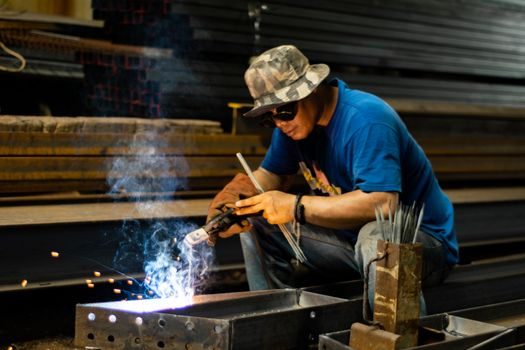
Every arc process emits intense ultraviolet and visible light — TIG is documented to produce "brighter ultraviolet rays than other welding processes," so a DIN 9–13 auto-darkening helmet, flame-resistant clothing, and a fume-extraction station are mandatory at any current above ~30 A [S1].
Stick (SMAW) fume is dominated by flux constituents such as manganese and silicates, while stainless GMAW fume carries hexavalent chromium and nickel, which is why European plants are increasingly routing fume through LEV with HEPA after-filter stages; the underlying CE marking on portable inverter sets covers electrical safety only, not fume exposure [S5].
When an Arc Welder Is the Wrong Tool
Arc welding is the wrong choice for austenitic stainless sanitary tubing in pharmaceutical or food service where a fully autogenous TIG or orbital TIG root is needed to eliminate crevices — the slag and spatter from SMAW or GMAW cannot be tolerated [S1].
It is also the wrong choice for thin aluminium sheet below ~1 mm in a non-laboratory setting, where the heat input of even a 10 A TIG arc is hard to control without pedal-current profiling and where resistance spot welding or laser welding is now standard in battery and electronics enclosures.
For very long outdoor runs on structural steel, flux-cored self-shielded wire (FCAW-S) often replaces shielded stick or MIG because the wind tolerance is higher, but the fume rate climbs further, so a powered air-purifying respirator becomes the deciding factor over equipment cost.
Specifying an Arc Welding Machine: A Working Checklist
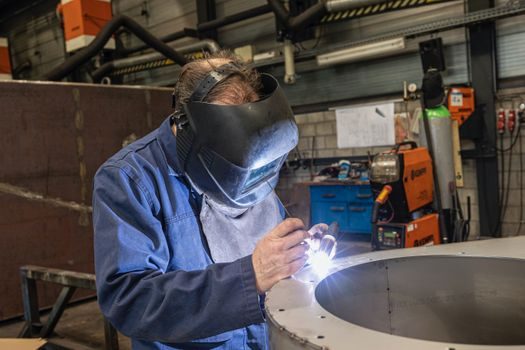
Lock the base-metal chemistry and thickness first, then match the process: carbon steel ≥3 mm → SMAW or GMAW; stainless or aluminium → TIG (AC for aluminium); thick plate → SAW; precision thin-wall tube → PAW [S1][S3][S9][S10].
Verify the power-source duty cycle at the project's ambient temperature, the input voltage tolerance (MOS-inverter sets commonly spec a wide ±15–20 % mains fluctuation range), and the IP rating of the housing for site conditions, then check the cooling-air path and the warranty terms on the IGBT stack [S5].
For robotic integration, confirm the arc-welding robot system can be paired with the chosen welding source over the fieldbus in use (EtherCAT, DeviceNet, or analogue setpoint), and that the seam-tracking sensor is rated for the reflectivity of the base metal — stainless and aluminium reflect more than mild steel and confuse optical trackers if not filtered [S2].
A related engineering reference for spec boundaries across these process families sits in Arc Welding Machine Types: Process Map, Spec Boundaries, and Selection Criteria, while site-side electrical and duty-cycle details are covered in Arc Welding Machine Installation: Power, Grounding, and Duty-Cycle Specs; for comparison against a non-arc joining method, see Fire-Rated Door Advantages and Disadvantages: Spec Trade-Offs.
The underlying component specifications are covered under arc welder, coding machine, and core machine.