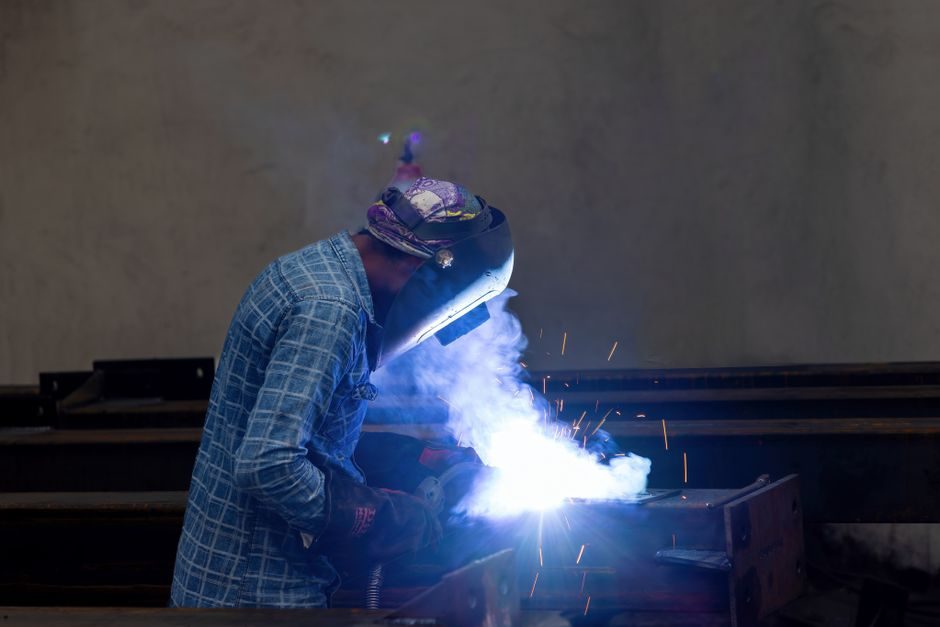
Arc welding covers at least six distinct process families operating between roughly 3,500 °C and 4,000 °C at the arc column, with electrode diameters, current polarities, and shielding schemes changing the metallurgical outcome on every joint [S2].
The category is not one product but a family: manual stick (SMAW), MIG/MAG (GMAW), TIG (GTAW), flux-cored (FCAW), submerged-arc (SAW), and stud/arc-bolt systems, each tied to specific current, gas, and positional limits [S2][S1]. Selecting between them means matching base metal, thickness, productivity target, and field-portability requirements against the process envelope below.
Core Process Families and How They Differ
The first partition in arc welding machine selection is electrode consumability and shielding medium, not current rating. DC metallic arc welding uses a consumable stick electrode with DC polarity, AC metallic arc welding uses the same consumable concept on AC supply, and carbon arc welding uses non-consumable carbon rods — historically the first industrial arc process [S2].
Atomic hydrogen arc welding (AWA) and shielded metal arc welding (SMAW) sit further down the family tree: AWA uses two tungsten electrodes in a hydrogen atmosphere to generate the arc, while SMAW relies on a flux-coated stick that produces its own protective gas and slag cover as it burns [S2]. Both are still listed as reference types in process textbooks dated within the past 12 months [S2].
MIG (GMAW) and MAG variants add a continuously fed consumable wire plus an external shielding gas, while TIG (GTAW) uses a non-consumable tungsten electrode with inert gas — TRUMPF's published description of arc welding explicitly groups its CE-certified cells under MIG and MAG processes with TÜV test certification [S4]. Submerged-arc welding (SAW) and plasma-arc welding (PAW) round out the higher-productivity and higher-precision tier, with PAW constricting the arc through a fine-bore nozzle for stable keyhole welds [S8].
Power-Source Architecture: Transformer, Inverter, and Engine-Driven
Beyond process family, the power-source topology drives roughly 30–50% of the weight, efficiency, and dynamic-response gap between machine classes. Conventional transformer-rectifier (AC or DC) sets remain the cheapest per amp; DC inverter arc welders dominate the catalog offerings from Chinese OEM export channels, with explicit "DC Inverter ARC Welding Machine" listings on industrial B2B portals as of 2026-07-06 [S5].
For field work without grid power, engine-driven DC generator-constant-current welders are still specified under the U.S. federal commercial-item description A-A-59397, originally issued 24 January 2000, which superseded MIL-W-80037C (7 August 1980) and governs constant-current DC generator welding machines driven by internal combustion engines [S9]. That standard is the cleanest reference when a procurement spec needs to pin a portable engine-driven stick/TIG machine to a documented baseline.
Inverter topology is what lets a 5–7 kg portable stick welder deliver the same arc force as a 90 kg transformer-rectifier, and the coding machine and labeling machine adjacent production cells increasingly expect a single-phase 230 V supply rather than a three-phase drop — TRUMPF's cell documentation lists CE-marked MIG/MAG packages that integrate with this class of supply [S4].
Electrode, Polarity, and Arc-Envelope Parameters
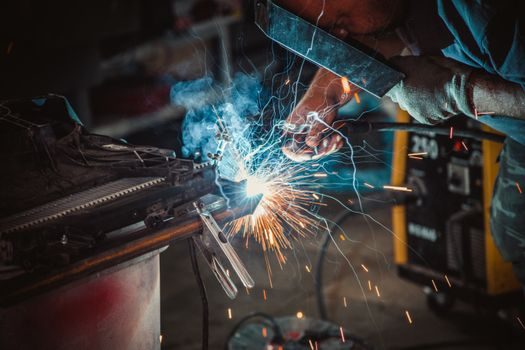
Every arc welding decision bottoms out in three numbers: electrode diameter, current (with DC+/DC−/AC polarity), and arc length — typically held between 3 mm and 6 mm to keep the arc stable [S2]. DCEN (DC electrode negative) gives deeper penetration on mild steel; DCEP (DC electrode positive) gives higher deposition rate and is standard for stick (SMAW) on cellulosic and low-hydrogen electrodes.
Stud welding sits at the high-productivity end of the family. A CNC bench-type capacitor-discharge stud welder from THOMAS WELDING SYSTEMS welds Ø 3 mm to Ø 8 mm studs over a 500 × 300 mm process area, with positioning accuracy of ±0.2 mm, repeatability ±0.1 mm, and resolution ±0.025 mm, on a 230 VAC ±10% 50 Hz mains feed [S1]. That spec sheet quantifies the precision ceiling of a compact CD stud cell: anything tighter requires moving to a servo-driven multi-axis arc welder with backlash-checked gearboxes.
Plasma arc welding narrows the arc through a water- or gas-cooled nozzle, using a sintered tungsten electrode in most builds, and was patented by Robert Merrell Gage in 1957 [S8]. The constricted arc is what makes PAW the preferred process for thin-wall stainless and titanium tube joints where MIG would burn through.
Selection Map: Matching Process to Application
Use SMAW (stick) for field repair, structural steel erection, and dirty/rusty base metal where portability beats finish quality. Use GMAW (MIG/MAG) for production welding of carbon steel, stainless, and aluminum sections above 1 mm thickness — the process feeds wire continuously, so deposition rate is the differentiator. [S2]
Use GTAW (TIG) for non-ferrous metals, root passes on pipe, and any joint where slag-free, spatter-free bead cosmetics matter; the trade-off is roughly 1/3 the deposition rate of MIG at equivalent amperage. Use FCAW for outdoor heavy-section steel where wind would blow away MIG shielding gas. Use SAW for thick-plate pressure vessel and shipbuilding longitudinal seams at high travel speeds. Use PAW when wall thickness drops below 1.5 mm on stainless/titanium and keyhole-mode control is needed [S8].
Capacitor-discharge and short-cycle stud welding fit the fastener-attachment niche: a CD stud cell at the spec above hits Ø 3–8 mm at ±0.1 mm repeatability, which is the production-engineering envelope for sheet-metal enclosures, busbar assemblies, and filling machine / cutting machine frame fasteners [S1].
Limits, Failure Modes, and Standards Touchpoints
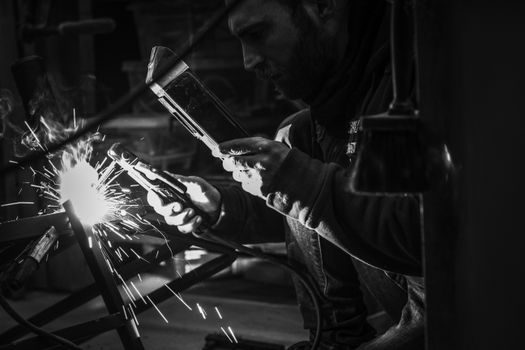
Arc welding's main metallurgical constraints, not marketing constraints: the bare electric-arc process is unsuitable for reactive metals (aluminum, titanium) without inert shielding, unsuitable for very thin sheet without backing or pulsed current, and demands a 3–6 mm arc gap to stay stable — drift outside that window and the operator either extinguishes the arc or blows a hole [S2]. Operator skill is the single largest variable: the source material explicitly lists "skilled operators" as a process prerequisite [S2].
For European builds, CE-marked MIG/MAG cells tested by TÜV are the documented compliance route, and TRUMPF publishes its welding cells as "complete and safe" with CE certification for arc welding under the MIG and MAG families [S4]. For U.S. federal and defense procurement, the A-A-59397 CID remains the cleanest engine-driven welder reference, covering constant-current DC generator sets with internal combustion drive [S9].
Process automation is the dominant trend: arc welding robot cells now cover "almost all areas of welding production" including automotive vehicles, spare parts, and engineering machinery, with heavy-duty and high-frequency spec lines on the OEM catalog [S3]. Vendor consolidation is visible in the supplier base — established Chinese makers such as Fervor (founded over 20 years ago, 20,000 m² production base) market "one-stop welding and cutting solutions" as a single-vendor bundle [S7]. The industrial-spec WSM 500 platform also continues to ship through cross-border B2B catalogs as a baseline arc welding machine [S6].
Sourcing Signals and Tracking Nodes
Track three verifiable signals going forward: (1) inverter topology penetration into the 200–500 A portable stick/TIG segment, where the WSM 500-class machines and Fervor-style catalog vendors compete on weight and arc-force metrics [S6][S7]; (2) CE/TÜV certification statements on robotic MIG/MAG cells from European-system integrators, where TRUMPF's published wording is the current benchmark [S4]; (3) precision-spec sheets on CD stud welders, where ±0.1 mm repeatability and ±0.025 mm resolution are the working floors for the Ø 3–8 mm stud range [S1].
See also our earlier report, Dynamic Balancing Machine Selection: Rotor Type, Drive, and ISO Grade.