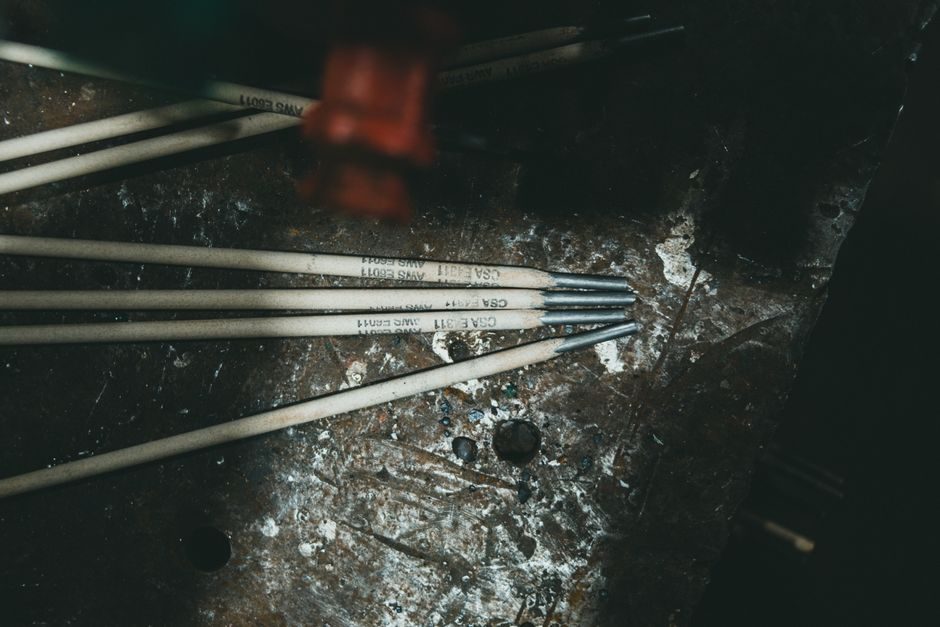
Arc welding covers any fusion process that joins metals by heating them with an electric arc, and the four families an engineer will actually choose between on a 2026 spec sheet are shielded metal arc (SMAW/stick), gas tungsten arc (GTAW/TIG), gas metal arc (GMAW/MIG/MAG) and submerged arc (SAW) [S5]. A.C. inverter-controlled gantry welders such as the DX BLAST M/TZ series weld structural profiles automatically with a three-spindle seam-tracking arc-guide and integrated flux recovery [S1], while the Welding Alloys FTR rail-welding machine automates frog and rail restoration with X-Y-Z travel of 400 x 200 mm on track gauges between 1420-1472 mm and complies with NF EN 13977 [S2].
Portable stick welders built around inverter topologies now hit consumer-tier price points as low as US$25-45 per piece, while industrial AC arc welding stations sit at US$515-620 and automated gantry/submerged-arc profile welders at US$3,000-7,000 per set on Chinese B2B catalogs [S3]. Selecting between them is therefore less about brand and more about matching electrode polarity, duty cycle, base-metal thickness and the level of seam-tracking automation the joint geometry actually needs.
Process Family: Which Arc Method Fits the Joint
Arc welding is divided into non-consumable-electrode processes (TIG/GTAW, plasma) and consumable-electrode processes (stick, MIG/MAG, flux-cored, submerged arc), each tuned to a different thickness range, position capability and cleanliness tolerance [S5]. TIG with its non-consumable tungsten electrode produces the cleanest, most controllable arc for stainless, aluminium and thin-wall work, and inverter DC argon-arc units such as the WSE series ship at roughly 50 kg per unit with EXW pricing around CNY 3,000 per piece for one-piece MOQ. Stick (SMAW) remains the lowest-capex route for field repair and outdoor work because the flux-coated electrode handles dirt, rust and wind that would destabilise a gas-shielded arc.
For thicker plate and long straight seams, submerged arc welding (SAW) and MIG/MAG dominate because the continuous wire feed and high deposition rates keep heat input high and stop-start time low [S6]. A submerged-arc gantry such as the DX BLAST MZ/TZ platform welds two beam pieces simultaneously and is not limited by web height, so structural-steel fabricators running repeated I-beam or H-beam production specify SAW gantries rather than portable sticks [S1]. The trade-off is that SAW demands a granular flux bed, dust extraction and a fixed floor-level workflow that portable SMAW simply does not require.
Current Type: AC, DC and Inverter Choices
AC arc welding machines remain standard for transformer-rectifier shops and for welding magnetised steel or aluminium where the alternating envelope cleans the oxide film each half-cycle, and a 2026 Made-in-China category snapshot lists AC arc welding machine entries from multiple Chinese manufacturers with prices clustering around US$515-620 per piece with a one-piece MOQ [S3]. DC output, by contrast, gives a smoother, more directional arc with easier starting and less spatter, which is why inverter DC TIG units (WSE series and equivalents) dominate stainless and aluminium fabrication shops where cosmetic bead quality matters.
Inverter topology has collapsed the weight and size of portable welders, putting genuine 200-500 A DC capability into a package that a single operator can carry to site, and the WSM 500 inverter platform is one of the model codes still appearing on 2026 B2B portals for general-purpose stick and MMA work [S4]. Buyers should treat the "inverter" label as a power-electronics architecture rather than a process licence: an inverter can drive SMAW, GTAW or GMAW depending on the front-panel mode and the torch/ground lead set, but the underlying current type (AC, DC+, DC-) is still set by the application [S5].
Duty Cycle, Output and Cooling Class
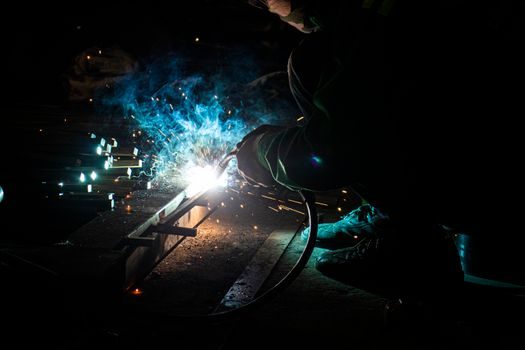
Duty cycle at a stated amperage (commonly quoted as X% at 40 °C ambient, e.g. Automated profile welders and gantries such as the DX BLAST M/TZ series are designed for sustained operation with integrated flux recovery and three-spindle seam tracking so the arc length stays in regulation across long runs [S1]. For intermittent site welding, the same 500 A class in a portable inverter package will out-publish a heavier transformer-rectifier set simply because the inverter's thermal mass is managed by IGBT switching losses rather than 50/60 Hz iron.
Cooling is the second gate: water-cooled torches are mandatory above roughly 250-300 A continuous GMAW or above 200 A continuous GTAW to keep the torch body below the 70-80 °C handle-temperature limit found in EN ISO 25980. Air-cooled MIG guns are acceptable for lower-amperage, intermittent fab work but become the failure point on aluminium MIG production runs where heat dissipation in the liner is the rate-limiting step. The FTR rail welder uses a touch-screen pendant and a motorised wheel with a brake system for emergency stop, illustrating that field-grade automated welders embed their own safety controls rather than relying on the operator's reflexes [S2].
Automation Level: Manual, Semi-Auto and Gantry
Manual stick (SMAW) and basic MIG with a foot-pedal or finger-trigger torch remain the default for site repair, pipeline tie-ins and one-off fabrication, and a portable inverter stick welder with a 1-piece MOQ is available from Chinese suppliers at US$25-45 per piece on 2026 B2B listings [S3]. Semi-automatic MIG/MAG with a constant-voltage power source, wire feeder and water-cooled torch sits in the middle of the cost stack and is the workhorse of sheet-metal, automotive and light-structural shops where deposition rate matters more than ultimate cosmetics [S5].
Full automation comes in two flavours: seam-tracking gantries for structural profiles and robotic cells for high-mix repetitive parts. The DX BLAST M/TZ series is a gantry-style profile welder with A.C. inverter control and three-spindle arc-guide tracking for stable travel speed on H-beams and box sections [S1]. The Welding Alloys FTR is a portable automated rail welder that welds up or down 1:10 gradients and 12 m radius curves, with up to 80% cost saving on frog/rail restoration versus full replacement [S2]. For buyers specifying automation, the critical questions are travel envelope (X-Y-Z stroke), track-gauge or profile cross-section, conformity to EN 13977 for rail applications, and whether the controller is pendant-only or supports CNC path import.
Selection Criteria: A Side-by-Side Comparison
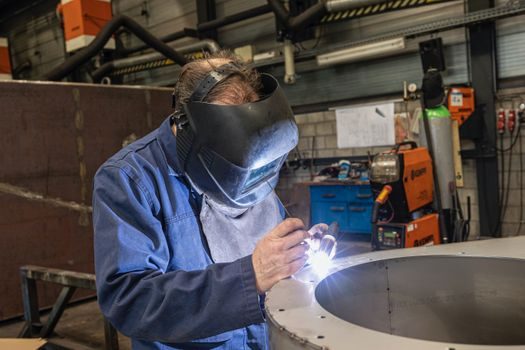
The four practical process choices line up against the main decision axes as follows. (1) Manual stick/SMAW: lowest capex (US$25-45 per piece on 2026 B2B listings [S3]), tolerant of dirty/rusty steel, poor cosmetics, slow deposition; (2) DC inverter TIG/GTAW (WSE-style): cleanest bead on stainless and aluminium, 50 kg portable class, mid capex around CNY 3,000 per piece, slower travel; (3) MIG/MAG (GMAW) semi-auto: high deposition, good for sheet and thin plate, requires shielding gas, gas cost is an ongoing OPEX line; (4) SAW gantry (DX BLAST MZ/TZ [S1]) or automated rail (Welding Alloys FTR [S2]): highest throughput, requires fixed installation or rail access, lowest operator skill per metre of weld, capex in the US$3,000-7,000+ band for the welder alone [S3].
Two further axes decide the final pick: portability (manual stick and small inverter TIG score; SAW gantry loses) and field-grade safety certification. The FTR rail welder carries CE marking under the Machinery Directive 2006/42/EC and the Low Voltage Directive, and conforms to NF EN 13977 for railway track welding [S2], which is the type of third-party evidence a specifier should demand for any automated welder installed in a track possession or a CE-marked plant. For structural fabrication, EN ISO 3834 quality requirements for fusion welding of metallic materials set the framework that gantry suppliers are expected to work within, and the inverter/MMA specification sheets rarely make this explicit, so the buyer has to ask.
Failure Modes and Sourcing Red Flags
The three recurring failure modes on 2026-spec arc welders are: (a) mis-stated duty cycle on inverter data sheets, (b) inadequate input-voltage tolerance for sites with weak generator power, and (c) consumable and torch spare-part availability, particularly for water-cooled MIG barrels and TIG gas lenses. The WSM 500 inverter and similar portable units are commonly sold with 1-piece MOQ on Alibaba showrooms [S4], which makes small-quantity sourcing easy but also means spec consistency between batches is the buyer's responsibility to verify. Foshan-based welding-machine factories and similar Guangdong OEM/ODM shops are now the dominant low-capex supply base for portable stick and inverter welders, and a 1-piece MOQ is the standard starting point on 2026 listings.
Buyers should refuse any data sheet that does not state (1) welding current range in amps, (2) duty cycle at the rated amperage and ambient temperature, (3) open-circuit voltage for stick electrode compatibility (typically 60-90 V DC for MMA), (4) input voltage and phase (single-phase 220 V vs three-phase 380 V), and (5) protection class (IP21S minimum for shop floor, IP23S preferred for site work). The gantry-style SAW and profile welders such as the DX BLAST M/TZ series list their A.C. inverter architecture and integrated flux-recovery system explicitly [S1], which is a useful tell that the supplier understands continuous-production duty rather than intermittent repair work. For deeper reading on selection logic for adjacent joining equipment, see the linear guide selection map for travel-stage mechanics and the arc welder process guide for a process-level overview.
Standards, Conformity and a Quoted Spec Line
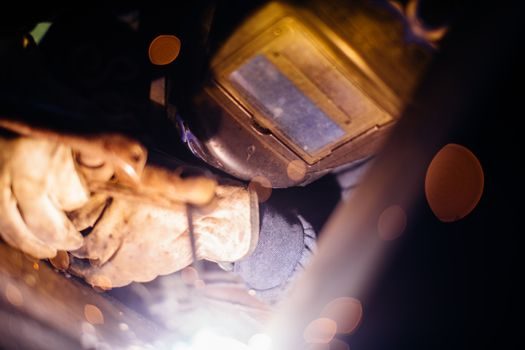
The standards that govern arc welding equipment selection in 2026 are mostly process and quality rather than product safety: EN ISO 3834 sets fusion-welding quality requirements for fabricators, EN ISO 25980 covers transparent welding curtains for arc-radiation protection, NF EN 13977 governs railway track welding, and the CE Machinery Directive 2006/42/EC plus the Low Voltage Directive cover the assembled welder [S2]. Weld procedure qualification typically references ISO 15614-1 (steel) and ISO 15614-2 (aluminium), while welder qualification is governed by ISO 9606-1. None of these are optional on a CE-marked automated welder destined for a European rail or structural plant.
A concrete spec line worth quoting directly: the Welding Alloys FTR rail-welding machine "conforms to Low Voltage Directive 2006/42 CE, norm NF EN 13977" and "welds up or down 1:10 gradients and 12 metre radius curves" with a 400 x 200 mm X-Y-Z envelope on 1420-1472 mm track gauge [S2]. For buyers comparing the DX BLAST M/TZ gantry line, the differentiating spec is the "three-spindle seam-tracking arc-guide mechanism" with A.C. inverter control and "flux auto-recovering system" on a double-column beam platform [S1]. Two trackable signals to watch over the next two quarters: (1) Made-in-China and Alibaba 2026 inverter-stick pricing stabilising in the US$25-45 per-piece band, which is the floor of credible consumer-grade hardware [S3], and (2) automated profile-welder capex holding above US$3,000 per set, separating genuine gantry-class equipment from toys [S3]. For an adjacent guide on matching machine capacity to workshop load, see the cutting machine selection logic.
For related coverage, see Electric Linear Actuator Selection: Drive, Load, Guidance and Feedback Gates.