
Moisture ingress tied to potting defects accounts for 10% to 30% of all field-related PV module degradation, making the potting station one of the highest-leverage cells in a module line [S3]. The most expensive failure modes are not exotic: they are undercure, insufficient adhesion to the substrate, and voids from trapped or entrained air, all of which can be traced back to upstream choices in chemistry, dispense hardware, and process windows [S1].
Two-part silicones, epoxies, and polyurethanes dominate J-box potting, with the choice driven by thermal conductivity, dielectric strength, and temperature stability rather than unit cost [S1][S5]. On automated lines the dispense step is a metered, servo-driven shot into a positioned box, with the encapsulation itself acting as the final environmental barrier after the gasket and cover [S2][S4].
Where Potting Defects Originate: Substrate, Ratio, and Cure
Potting failures cluster into three families: material-related, dispense-related, and cure-related, and they are rarely independent [S1]. A change in the substrate surface energy, a contamination event, or a switch to a different backsheet can silently break adhesion even when the meter-mix ratios are perfect, and conversely a ratio drift of a few percent can masquerade as a substrate problem if you only look at the bond line [S1][S2].
On the dispense side, material ratio, flow rate, and shot size consistency are the three levers that line integrators actually control, and Graco's case-study work treats all three as critical, not just ratio [S2]. In a two-part silicone, separate A and B reservoirs must stay homogeneous (most failures attributed to chemistry are actually settlement in storage, not bad incoming material), and the dynamic mix head has to stay within its working time, otherwise the advancing viscosity skews the shot weight long before any visible defect appears [S1].
Cure-side issues fall into two camps: undercure, which leaves the material soft and low in crosslink density, and cure poisoning, where contaminants on the substrate (sulphur from a glove, amine residues, mould-release agents) inhibit addition-cure silicones entirely [S1]. The DuPont technical manual flags contamination, mixing errors, and working-time over-runs as the three dominant root causes of bond-line non-conformance, and recommends lot acceptance tests (LAR) at receipt plus a recipient-side verification test rather than relying on the incoming certificate alone [S1].
Automated Potting Machine: What the Spec Sheet Hides
Typical auto J-box potting cells on 2025-2026 lines run panel sizes from 1,680-2,650 mm in length and 992-1,500 mm in width, with a cycle time of 20 seconds or less, panel positioning accuracy of plus or minus 1 mm, an overall footprint near 3,600 by 2,000 by 1,560 mm, supply of 220 V at roughly 1 kW, and shop-air at 0.5 MPa, with the head carrier weighing about 350 kg [S4]. One to three servo-driven potting heads are common, and the head's traverse envelope is what determines how many box positions a single cell can service before a re-anchor step is required [S4].
The 20-second cycle is a marketing number, not a process number. The real constraint is the pot life of the two-part system at the dispense temperature versus the head travel time, and the cure kinetics of the bulk fill inside the sealed box [S1][S2]. On meter-mix machines, ratio drift shows up first as a shift in durometer or as bond-line voids; shot-size drift shows up first as overfill onto the gasket land, which then breaks the cover seal and creates a secondary moisture-ingress path even when the potting itself is sound [S1][S2].
Material Chemistry Trade-off: Silicone vs Epoxy vs Polyurethane

Potting material is the largest single variable in the J-box bill of materials, and the three families trade off against each other on four decision criteria: temperature range, dielectric strength, adhesion to common plastics (PPE, PA, PPO), and field repairability [S1][S5]. Silicones lead on temperature stability, typically -40 to +200 C service, and on UV/weathering, but they bond less aggressively to commodity plastics without primers [S1]. Epoxies bond aggressively and have higher dielectric strength, but they are stiff and difficult to rework in the field, and they are more sensitive to cure poisoning [S1][S5].
Polyurethanes sit in the middle on temperature (commonly -40 to +120 C), bond well to most plastics, and are easier to rework than epoxy, but they carry a moisture sensitivity during cure that the other two do not [S1][S5]. Across the industry, IEC 61215 and UL 1703 set the qualification envelope, and the IP rating (commonly IP65 or IP67 for outdoor J-boxes) defines what the potting and the gasket have to deliver as a system, not individually [S5]. Inside the box, bypass diodes are embedded in the potting compound, and the potting is what gives them mechanical stability, so undercure here is both an insulation failure and a mechanical one [S5].
Process Variables That Drive the 10-30% Failure Window
The widely cited 10% to 30% range for moisture-ingress-related field failures is a process-quality envelope, not a fixed number: tight potting lines sit at the low end, lines with substrate variation or ratio drift sit at the high end [S3]. The largest controllable drivers are substrate preparation, mixing ratio, shot size, and the cure profile, and the cheapest inspection upgrades (glass test, butterfly test, snap time) catch most of them on the line rather than in the field [S1].
Substrate preparation is the single most under-controlled variable on automated lines [S1]. The DuPont manual specifies a two-cloth cleaning method with an approved organic solvent, and explicitly flags solvent choice and wipe technique as common failure contributors because residue layers under 50 nm are enough to destroy adhesion in a silicone system [S1]. On a high-throughput line, this becomes a fixture and wipe-pattern engineering problem, not a chemistry problem, and the difference between a controlled wipe and a casual wipe shows up as a bond-line delamination six to eighteen months into field service [S1][S3].
Glue-line geometry matters as much as the chemistry [S1]. Three parameters define a robust bond: glue-line bite (the overlap length on the substrate), glue-line thickness (the controlled bond-line gap), and glue-line fillet (the radius at the edge of the bead), and the manual recommends designing all three in advance rather than letting the dispense head decide them by default [S1]. On the cure side, two-part systems need to be dispensed within their working time at the actual line temperature, and the facility ambient needs to be held stable, because a 5-10 C shift can move the snap time by tens of minutes and silently push the cure outside its qualified window [S1].
Inline Inspection: From Glass Test to Automated Optical
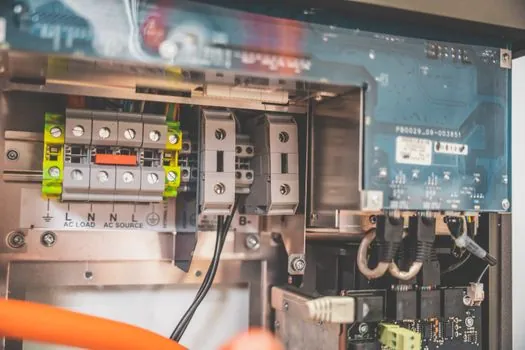
The classical inline checks are cheap and they catch most of the failure modes before the box is lidded [S1]. The glass test verifies mix quality by dispensing a sample onto a glass plate and inspecting for streaks; the butterfly test folds the sample to look for incomplete mixing; the snap time test pulls a small sample and measures the gel point, and a snap time outside spec is the earliest warning that the ratio has drifted or the material has aged [S1]. These three tests, run on first-shot and on timed intervals, are the difference between a controlled process and a forensic one [S1][S2].
At the next tier, automated optical inspection of the potted box (after dispense, before lidding) is becoming common on higher-tier lines, with the trade-off being better encapsulation visibility versus harder field repair, because a fully potted box with internal monitoring electronics cannot be opened without destroying the encapsulation [S6]. Sensor-enabled boxes add a new failure mode: data-integrity exposure, since the Modbus or Ethernet interface that pulls temperature, voltage, and current out of the box is also an attack surface, and the potting does not protect the bus [S5].
Standards, Storage, and What the Manual Actually Requires
The DuPont Fortasun technical manual is the clearest single public reference on the J-box potting process and lists the four functions the potting agent has to deliver: environmental protection, electrical insulation, thermal conductivity, and temperature stability [S1]. UL 94 certification is the standard flammability gate for the cured material, and the manual lists additional UL testing on top of that for the finished assembly [S1]. On the incoming side, the manual recommends a recipient-side quality verification test independent of the supplier's certificate, because a lot can pass the supplier's LAR and still fail in the customer's specific substrate and meter-mix combination [S1].
Storage and shelf life are the failure modes that quietly dominate audit findings [S1]. Both parts of a two-part system must stay homogeneous in storage, and condensation-cure silicones are particularly sensitive to headspace humidity and to temperature excursions during transport, so storage condition controls, not just expiration dates, are the actual line of defence [S1]. On automated meter-mix dispense, equipment maintenance is named explicitly: ratio drift, worn static mixers, and air entrainment at the changeover are the three dispense-side root causes that show up as field failures months later [S1][S2].
Comparison: Three Potting Chemistries on Four Decision Criteria

Choosing between silicone, epoxy, and polyurethane for a J-box on an automated line comes down to four questions, and the answer usually maps cleanly to a chemistry rather than to a brand [S1][S5]. On temperature range, silicone (-40 to +200 C) outperforms epoxy (typically -40 to +150 C) and polyurethane (typically -40 to +120 C); on dielectric strength, epoxy leads, silicone is close behind, and polyurethane trails; on adhesion to PPE/PA/PPO without primer, polyurethane and epoxy outperform silicone; on field repairability, polyurethane is the easiest, silicone is workable, and fully cured epoxy is essentially destructive to remove [S1][S5].
For rooftop and floating-PV modules, silicone dominates because the temperature window and UV stability outweigh the adhesion gap; for tracker-mounted and BIPV modules with smaller boxes and tighter geometry, epoxy is common because the bond strength and dielectric margin are worth the rework penalty; for boxes that carry field-replaceable electronics or where the line cannot guarantee substrate cleanliness, polyurethane is the engineering compromise [S1][S5]. Across all three, the upstream constraints are the same: a two-cloth solvent wipe, a homogeneous storage state, a ratio-controlled meter-mix, and a snap-time check on first shot [S1].
The cleanest signal to track into 2026 is the convergence of inline AOI and module-level monitoring, because the same data path that catches a potted-box void (via thermal-imaging AOI) also feeds the box's own temperature and humidity sensors, and a line that is instrumented end-to-end will pull its field-failure rate toward the 10% end of the published band rather than the 30% end [S3][S6]. A second trackable signal is the rise of one-part room-temperature-cure sealants as a secondary seal around the J-box lid, which shifts some of the moisture-ingress burden off the potting and back onto a more inspectable interface [S1].
Component reference pages worth checking: explosion proof junction box, agv robot, and air quality monitor.
See also our earlier report, 15 MW+ offshore turbines: 2026 spec reality, vessel costs, and Asia-Pacific rollout.