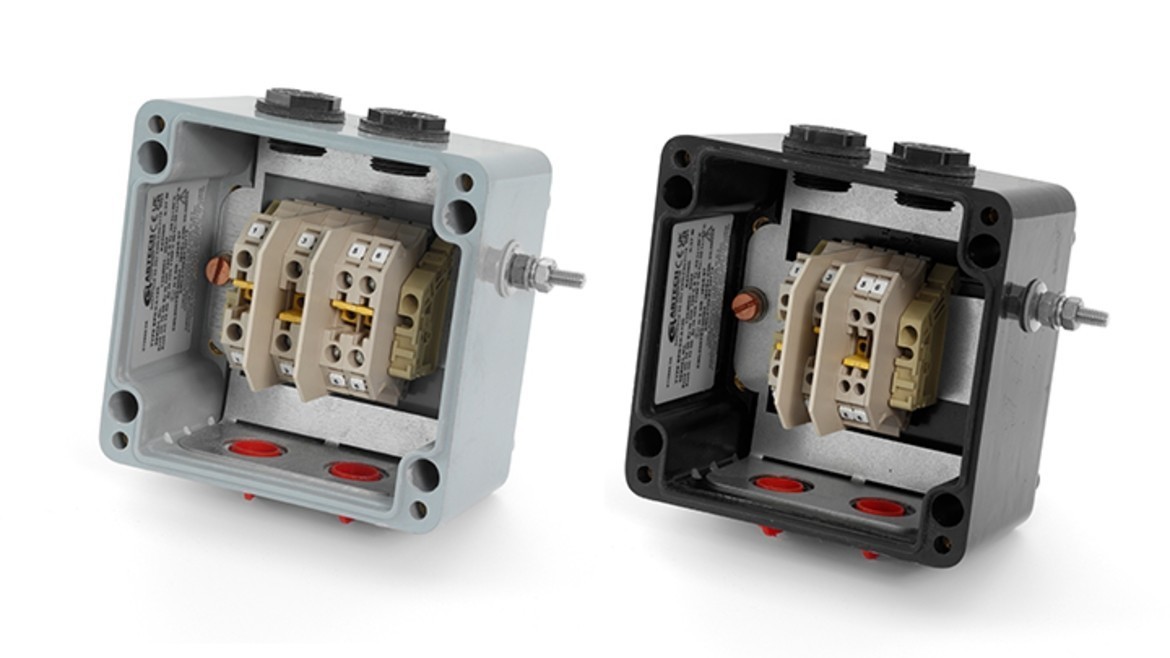
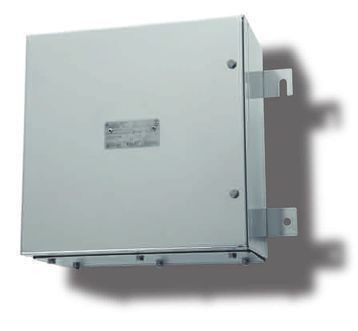
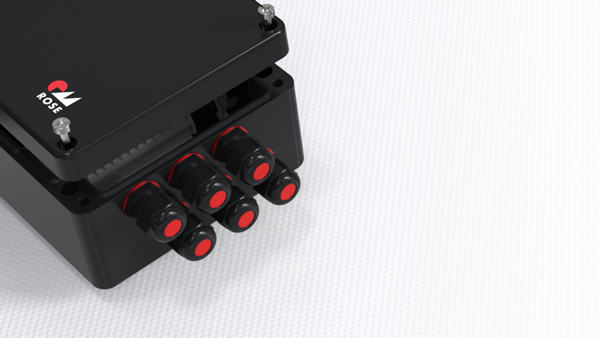
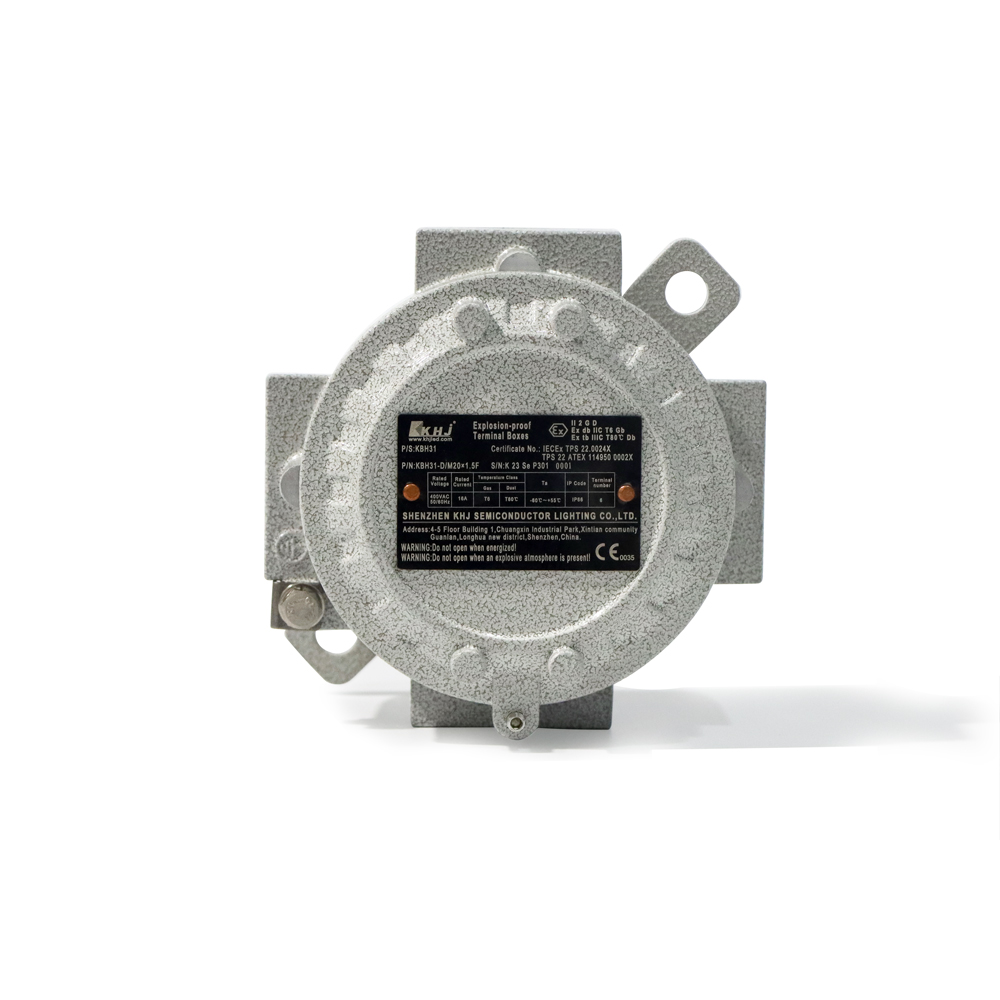
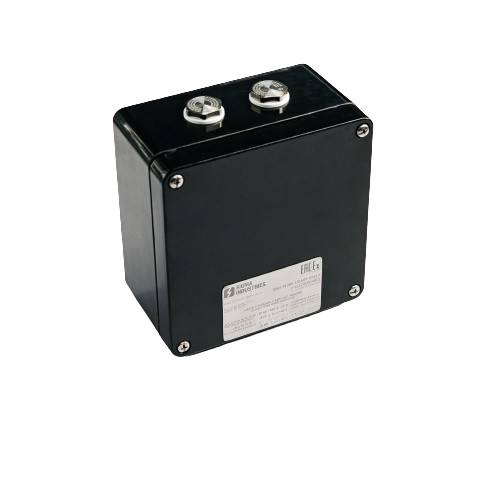
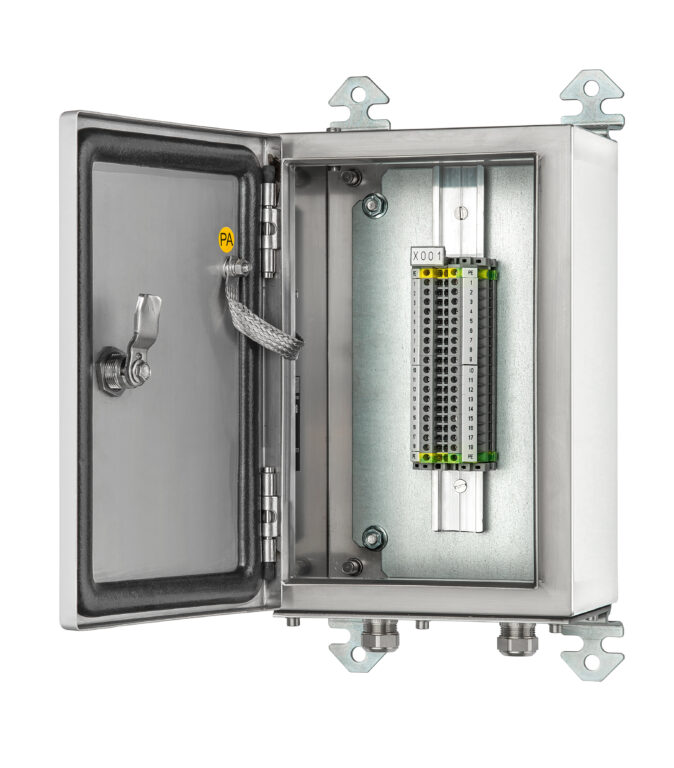
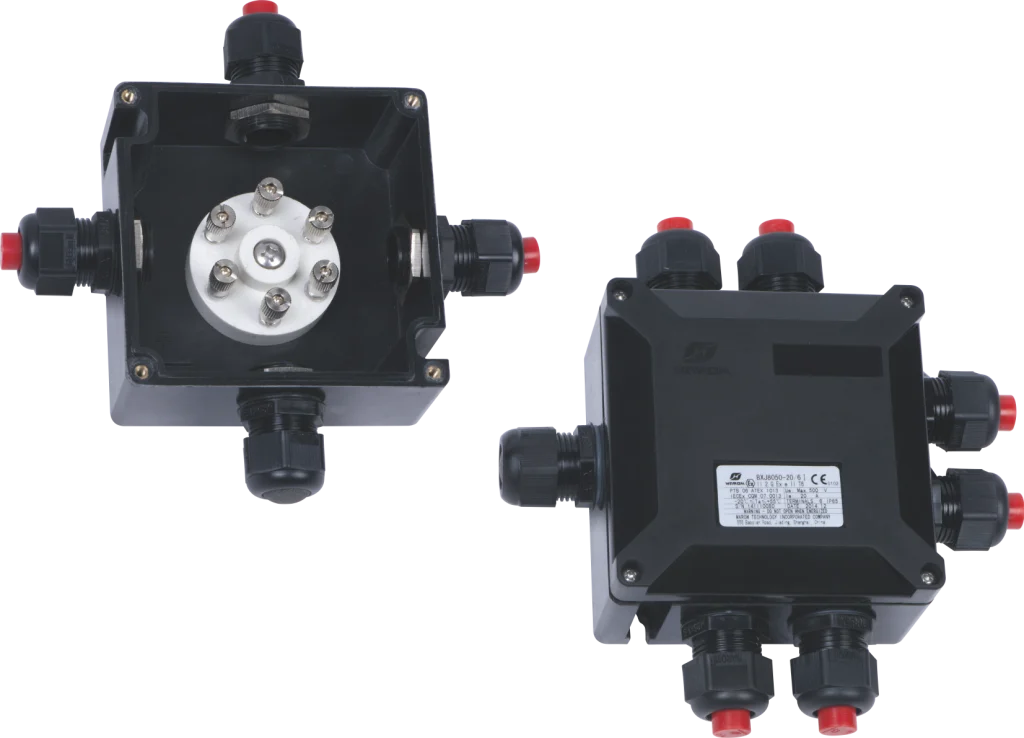
An explosion-proof junction box is a certified electrical enclosure that lets cables be terminated, branched, or interconnected inside a hazardous area where flammable gas, vapour, or dust may be present. Unlike an ordinary junction box, it carries a recognised explosion-protection concept, most commonly Ex d (flameproof) or Ex e (increased safety) under the IEC 60079 series, so that the wiring inside it can never become the source of an ignition that escapes to the surrounding atmosphere.
The two concepts solve the same problem in opposite ways. A flameproof box contains an internal explosion and quenches it; an increased-safety box prevents any spark from forming in the first place. Choosing correctly, and matching the box to the zone, gas group, and temperature class, is the heart of a compliant installation.
Photo: HAZLOC ELECTRICAL EQUIPMENTS, CC BY-SA 4.0, via Wikimedia Commons
This guide is written for procurement engineers and design engineers specifying enclosures for hazardous areas. It covers 6 chapters: what an explosion-proof junction box is, the Ex protection concepts, hazardous-area zones and gas groups, enclosure materials and ingress protection, the spec-sheet parameters that drive selection, and the decision sequence, with 7 FAQs. All parameters reference the public IEC 60079 series (parts 0, 1, 7, 10-1, 14, 31), IEC 60529 for ingress protection, the ATEX directive 2014/34/EU, and the IECEx scheme.
Chapter 1 / 06
What is an Explosion-Proof Junction Box
An explosion-proof junction box is an enclosure certified to house electrical terminations and connections within a classified hazardous area. Its job is mundane in an ordinary plant, joining cables, branching circuits, terminating field instruments, but in an environment where a leak of flammable gas, solvent vapour, or combustible dust can form an explosive atmosphere, an ordinary plastic or sheet-metal box is a potential ignition source. A loose terminal, a corroded connection, or a transient arc can release enough energy to ignite the surrounding mixture. The certified box exists to remove that risk by design, not by chance.
Two ideas dominate the field, and they are opposites. The first, flameproof protection (type Ex d to IEC 60079-1), accepts that an ignition may occur inside the box and engineers the walls and joints to contain the resulting explosion and to cool the escaping gases below the auto-ignition temperature of the external atmosphere before they leave. The second, increased safety (type Ex e to IEC 60079-7), works upstream: it eliminates the possibility of an arc or spark in normal operation by enlarging creepage and clearance distances, using certified terminals, limiting surface temperatures, and sealing the box to keep dust and moisture out. A flameproof box is heavy and machined; an increased-safety box is lighter and sealed. Both are legitimate, and the right choice depends on the zone and on what the box contains.
The distinction from a domestic or general-industrial junction box is the certification chain behind it. A compliant explosion-proof box carries a type-examination certificate (an EU-Type Examination Certificate under ATEX, a Certificate of Conformity under IECEx, or both), a permanent marking that declares its equipment group, protection concept, gas subgroup, temperature class, and Equipment Protection Level, and a manufacturer who controls the design under a quality assurance notification. Field modification of any kind, drilling a new entry, repainting a flame path, or swapping a non-certified gland, voids that chain. This is why selection, not improvisation, governs the whole life of the product.
Historically, flameproof enclosure design grew out of coal mining, where firedamp (methane) explosions drove the earliest "flameproof" electrical apparatus in the early twentieth century; mining equipment is still classified as Group I, while all surface industry is Group II. The increased-safety concept matured later for terminal boxes, luminaires, and motor connection chambers where no normal-operation sparking occurs. Today the IEC 60079 series harmonises both globally, and the ATEX directive makes conformity mandatory across the European Economic Area while the IECEx scheme provides internationally recognised certificates accepted in dozens of countries.
Application scale spans the heaviest industries. Explosion-proof junction boxes terminate field wiring on offshore oil and gas platforms, in onshore refineries and tank farms, across petrochemical and fertiliser plants, in pharmaceutical solvent-handling suites, in grain handling and sugar plants where combustible dust is the hazard, and in paint and coating lines. The same physical box may serve gas duty in one plant and dust duty in another, distinguished only by its marking and its accessories. There is no universal box; the engineering task is to map the area classification onto a specific, certified product.
Chapter 2 / 06
Protection Concepts: Ex d, Ex e, Ex de, Ex i
The protection concept is the single most important attribute of an explosion-proof junction box, because it dictates the construction, the permitted zone, the weight, and the cost. Four concepts cover almost all junction and terminal box duty. The table below summarises how each one prevents ignition and where it is used.
Concept
Standard
How it protects
Typical box use
Ex d flameproof
IEC 60079-1
Contains internal explosion, quenches escaping gas via flame path
Prevents arcs and sparks, raised creepage and clearance, no flame path
Terminal and junction boxes, GRP or polyester
Ex de combined
IEC 60079-1 + 60079-7
Ex e terminal chamber bolted to Ex d device chamber
Control stations, motor connection boxes
Ex i intrinsic safety
IEC 60079-11
Limits energy so no spark can ignite, even in fault
Instrument and signal boxes, Zone 0 capable
Ex d, flameproof. This is the containment approach. The enclosure is built strong enough to withstand the pressure of an internal explosion without rupture or permanent deformation, and every joint between mating parts is a precision-machined flame path that lets hot combustion gases escape only after they have been cooled below the surrounding gas auto-ignition temperature. The flame path is the safety element: IEC 60079-1 specifies a minimum joint length and a maximum gap for each gas group and enclosure volume. Because the box must be heavy and rigid, Ex d junction boxes are typically copper-free cast aluminium or stainless steel. The penalty of Ex d is that the certified flame path is fragile in service: it must never be painted in the joint, scratched, or fitted with a gasket, and only flameproof-rated cable glands may enter it.
Ex e, increased safety. This is the prevention approach, and it is the dominant concept for plain terminal and junction boxes. Ex e applies elevated safety margins so that arcs, sparks, and excessive temperatures cannot occur in normal operation: certified terminals with guaranteed clamping, enlarged creepage and clearance distances to prevent tracking, defined maximum surface temperatures, and a sealed enclosure (usually IP66) to keep moisture and dust off the connections. Because no internal explosion is anticipated, the box does not need machined flame paths and can be moulded from glass-reinforced polyester or polyamide, which is far lighter and corrosion-proof. Ex e is permitted in Zone 1 and Zone 2 for components that do not arc in normal use, which is exactly what a terminal box is.
Ex de, the combination. Real apparatus often needs both. A control station, a motor connection box, or an instrument with a switching device uses an Ex d chamber for the arcing component and an Ex e chamber for the field terminations, joined by certified flameproof bushings. Cables enter the lighter Ex e terminal chamber through standard increased-safety glands, which is cheaper and more serviceable than routing every cable through a flameproof entry. The marking then reads Ex de.
Ex i, intrinsic safety. For low-energy instrument and signal circuits, intrinsic safety (IEC 60079-11) limits the available electrical energy so low that no spark or hot surface can ignite the atmosphere, even under two faults for the ia subdivision. Ex i is the only concept that can reach Zone 0 (EPL Ga), and intrinsically safe junction and marshalling boxes are common for 4-20 mA and fieldbus instrument loops because the box itself can be opened live without a hot-work permit. The box is usually a simple Ex e or general enclosure; the protection lives in the circuit and its associated barrier, not in the walls.
Chapter 3 / 06
Zones, Gas Groups, and Temperature Classes
A junction box can only be selected once the hazardous area has been classified. The classification produces three coordinates that the box marking must satisfy: the zone (how often the hazard is present), the gas subgroup (how easily the substance ignites), and the temperature class (how hot a surface the substance tolerates). Getting any one wrong invalidates the installation regardless of how good the box is.
Zones. Under IEC 60079-10-1, gas areas are divided into three zones. Zone 0 is where an explosive gas atmosphere is present continuously or for long periods. Zone 1 is where it is likely to occur in normal operation. Zone 2 is where it is unlikely and, if it does occur, will persist only briefly. Combustible dust areas use the parallel Zones 20, 21, and 22 under IEC 60079-10-2. Each zone demands an equipment with a matching Equipment Protection Level (EPL): Ga, Gb, Gc for gas and Da, Db, Dc for dust. The rule is simple and absolute: the EPL of the installed equipment must be equal to or higher than that required by the zone.
Gas zone
Required EPL
ATEX category
Typical protection for a box
Zone 0
Ga
1G
Ex ia (intrinsic safety) only
Zone 1
Gb
2G
Ex db, Ex eb, Ex ib
Zone 2
Gc
3G
Ex ec, Ex nR, plus any Zone 1 type
Zone 21 (dust)
Db
2D
Ex tb (IEC 60079-31)
Zone 22 (dust)
Dc
3D
Ex tc, plus any Zone 21 type
Gas subgroups. Group I is mining (methane and coal dust) and is a separate world. All surface industry is Group II, divided into subgroups IIA, IIB, and IIC by how readily the gas propagates a flame, measured chiefly by the Maximum Experimental Safe Gap (MESG). IIA covers propane and most hydrocarbons and has the widest safe gap; IIB covers ethylene; IIC covers hydrogen and acetylene and has the narrowest safe gap and the lowest ignition energy. A box certified for IIC also covers IIB and IIA, but not the reverse. For dust, Group III subdivides into IIIA (combustible flyings), IIIB (non-conductive dust), and IIIC (conductive dust such as metal powder). Always specify the box to the worst-case subgroup present.
Temperature classes. The maximum surface temperature of the equipment must stay below the ignition temperature of the surrounding gas or dust. IEC 60079-0 defines six temperature classes for gas, from T1 (maximum surface 450 degrees Celsius) down to T6 (maximum surface 85 degrees Celsius). A junction box rarely dissipates much heat, so the limiting factor is usually the ambient temperature and any heat conducted from cables, but the class still appears in the marking and must be no hotter than the process demands. Dust apparatus instead carries an explicit maximum surface temperature, for example T80 degrees Celsius, because dust layers insulate and can self-heat. A T6 (85 degrees Celsius) box satisfies any colder-igniting gas; a T1 box does not.
Reading a full marking ties these together. A label of "II 2G Ex eb IIC T6 Gb" declares: surface industry equipment, ATEX category 2G for Zone 1 gas, increased-safety protection of the high subdivision (b), gas subgroup IIC (hydrogen capable), temperature class T6 (85 degrees Celsius surface), and Equipment Protection Level Gb. A buyer can verify in one line whether the box fits the area. North American practice instead uses the NEC Class/Division system (Class I Division 1 or Division 2, gas groups A through D), and the two systems are not interchangeable: equipment must be certified for whichever scheme the site uses, although many global makers list both.
Chapter 4 / 06
Enclosure Materials and Ingress Protection
Once the protection concept and zone are fixed, the enclosure material is chosen to survive the physical environment: corrosion, temperature, mechanical impact, and weight on the supporting structure. The material also constrains the protection concept, because a flame path can only be machined in a rigid metal, while a sealed Ex e box can be moulded. The table below compares the four mainstream materials.
Glass-reinforced polyester (GRP). This is the default for Ex e terminal and junction boxes. It is light, electrically insulating, and immune to the salt-laden, humid atmospheres of offshore and coastal plants, where aluminium would need careful coating. R. STAHL series 8146, for example, moulds its Ex e terminal boxes from glass fibre-reinforced polyester resin, offers eight basic sizes, and certifies them Ex eb IIC for gas and Ex tb IIIC for dust, with degree of protection IP66 and an ambient range that reaches -50 degrees Celsius. The trade-off is lower mechanical strength than metal and a surface that can accumulate static, so large GRP boxes carry anti-static measures and earthing provisions to satisfy the certificate.
Copper-free aluminium. Flameproof Ex d boxes need a strong, machinable metal, and copper-free aluminium alloy (typically under 0.4 percent copper, such as LM6) is the workhorse. The low copper content avoids forming incendive sparks if the box is struck, and the alloy casts and machines accurately enough to hold the tight flame-path tolerances IEC 60079-1 requires. Eaton Crouse-Hinds series EJB enclosures use copper-free aluminium and are listed for Class I Division 1 with IECEx and ATEX certification, designed for threaded rigid conduit entry. In chloride-rich offshore air aluminium is usually epoxy-coated to resist pitting.
Stainless steel 316L. Where corrosion is most aggressive, offshore topsides, pharmaceutical washdown, or sour (hydrogen sulphide) service, 316L stainless steel is specified for both Ex d and Ex e boxes. It offers the best corrosion resistance and the highest mechanical strength, at the cost of weight and price. Electropolished 316L is used in hygienic and pharmaceutical areas where the box must be wiped down without trapping product.
Ingress protection. Explosion protection and ingress protection are separate ratings that always appear together. IEC 60529 defines the IP code: the first digit is the dust rating (6 means fully dust-tight) and the second is the water rating (5 jets, 6 powerful jets, 7 temporary immersion, 8 continuous immersion). Industrial Ex junction boxes are commonly IP66, dust-tight and resistant to heavy seas and washdown, with offshore and harsher duties moving to IP66/IP67 or IP68 using an additional cover O-ring. A point engineers often confuse: IP rating governs dust and water sealing, while a flameproof box is deliberately not gas-tight. Its safety comes from containing and quenching an internal ignition, not from sealing gas out, so the two ratings address different failure modes and both must be specified.
Chapter 5 / 06
Key Specification Parameters
A junction box datasheet can list two dozen lines, but only a handful drive a compliant, serviceable selection. The parameters below are the ones to read first, because each can disqualify a box that otherwise looks suitable.
Ex marking and certificate. The full code (for example II 2G Ex eb IIC T6 Gb, or II 2D Ex tb IIIC T80 degrees Celsius Db) is the primary spec. It must satisfy the zone, gas or dust subgroup, and temperature class of the area. Always trace it to a live ATEX or IECEx certificate number; a marking without a verifiable certificate is worthless. For combined boxes the marking carries both letters, Ex de.
Ingress protection (IP). Read alongside the Ex marking, never instead of it. IP66 is the practical baseline for industrial outdoor and washdown duty; specify IP67 or IP68 where temporary or continuous immersion is credible.
Material and ambient temperature. The enclosure material (GRP, copper-free aluminium, 316L) sets corrosion behaviour, and the certified ambient temperature range constrains where the box may be installed. Increased-safety GRP boxes commonly cover -50 to +75 degrees Celsius depending on the temperature class assigned (a colder ambient is allowed at the cooler T6 class, a hotter ambient only at lower classes). Verify both ends of the range against the site extremes.
Cable entries. The number, position, and thread form of entries (metric M16, M20, M25, M32, M40, M50, M63, or NPT, or no pre-drilling) are fixed by the certificate. You cannot add entries in the field without voiding certification. Each entry takes a correspondingly certified Ex cable gland matched to the same gas group, EPL, and IP rating; for Ex d entries the gland must be flameproof-rated, sometimes with a barrier or compound. Unused entries must carry certified blanking plugs.
Terminal capacity. For Ex e boxes the certificate fixes the maximum terminal size and the number of terminals the box can carry while still meeting creepage, clearance, and temperature limits. R. STAHL series 8146, for instance, accepts series terminals up to 300 mm-squared in its larger sizes. Overfilling a box with terminals or oversized conductors can exceed its certified power dissipation and surface temperature, so respect the rated terminal schedule rather than the physical space.
Enclosure dimensions and mounting. External width, height, and depth (a mid-size GRP box such as the R. STAHL 8146/1083 is about 340 by 340 by 150 mm and weighs around 8 kg) determine fit, weight on the support, and internal wiring volume. Confirm the mounting pattern, whether the cover is hinged or bolted, and whether captive cover screws are needed so they cannot be lost in the field.
Earthing and bonding. Internal and external earth terminals are mandatory for metal boxes and for anti-static bonding of large GRP boxes. The certificate states the maximum earth conductor cross-section. Continuity of the protective bond is part of the explosion-protection scheme, not an optional extra.
Wall thickness and flame path (Ex d only): defined by the certificate and IEC 60079-1; never machined, painted, or gasketed in the joint.
Impact resistance: IEC 60079-0 impact test, typically 7 J for normal-risk equipment, 4 J for low-risk, relevant for GRP and light-alloy boxes.
Static dissipation: required for large non-metallic surfaces to prevent charge accumulation.
Chapter 6 / 06
Selection Decision Factors
To turn the preceding chapters into a specific certified box, follow the decision sequence below. The most common compliance failures come not from a single wrong line, but from deciding the material or the entries before the area classification is settled. Use these steps as a fixed RFQ template.
Confirm the area classification: obtain the hazardous-area drawing and read off the zone (0/1/2 or 20/21/22), the gas or dust subgroup (IIA/IIB/IIC, IIIA/IIIB/IIIC), and the temperature class or maximum surface temperature for every flammable substance present. Everything else derives from this.
Choose the protection concept: for a plain terminal or junction box in Zone 1 or 2, Ex e is usually correct and lightest; if the box contains an arcing or hot component, use Ex d or an Ex de combination; for low-energy instrument loops consider Ex i, which alone reaches Zone 0.
Match the EPL to the zone: Zone 0 needs Ga, Zone 1 needs Gb, Zone 2 needs Gc, with the dust equivalents Da/Db/Dc. A higher EPL always covers a lower zone, never the reverse.
Select the enclosure material: GRP for corrosion and light weight, copper-free aluminium for general Ex d, 316L for the harshest corrosion or mechanical duty. Match the certified ambient range to the site temperature extremes.
Fix the ingress protection: IP66 as the industrial baseline, IP67 or IP68 where immersion is credible. Remember this is separate from, and additional to, the Ex marking.
Specify the entries and glands: set the number, position, and thread form of cable entries with the manufacturer so the box is certified as supplied; pair each entry with a correspondingly certified Ex gland (flameproof-rated for Ex d) and certified blanking plugs for spares. Never field-drill.
Size the terminals and interior: respect the certified maximum terminal size and count, not the physical space, so creepage, clearance, and surface-temperature limits hold; allow spare ways for future loops.
Verify certification and documentation: obtain the ATEX EU-Type Examination Certificate and/or the IECEx Certificate of Conformity by number, plus NEPSI for China or FM/CSA for North America as the site requires, and confirm the marking on the supplied box matches the certificate.
One last dimension that is easy to overlook is manufacturer serviceability: availability of certified spare covers, glands, and blanking plugs; local technical support for re-certification after maintenance; and clear installation, operation, and maintenance instructions, which are themselves part of the certificate. A box is in service for decades, and the certified flame path or seal must be maintained correctly at every cover opening. R. STAHL, Pepperl-Fuchs, Eaton (Crouse-Hinds and CEAG), Cortem, Rose Systemtechnik, and Warom all maintain global certification portfolios and spare-part supply, which makes them dependable choices for projects that must stay compliant long after commissioning. Whatever the brand, the discipline is the same: never modify a certified box in the field, and verify every marking against its certificate before installation.
FAQ
What is the difference between an Ex d and an Ex e junction box?
An Ex d (flameproof) junction box accepts that an internal ignition may occur and contains it: thick walls and precision-machined flame-path joints withstand the internal explosion pressure and cool any escaping gases below the surrounding gas auto-ignition temperature, per IEC 60079-1. An Ex e (increased safety) box takes a prevention-first approach defined in IEC 60079-7: it raises creepage and clearance distances, uses certified terminals and tightened temperature limits so that no arc or spark can occur in normal operation, with no flame path. Ex d boxes are heavy machined aluminium or stainless steel; Ex e boxes are usually lighter GRP polyester or polyamide. Many installations combine them as Ex de: an Ex e terminal chamber bolted to an Ex d device chamber.
How do I match a junction box to my hazardous-area zone?
Under IEC 60079-10-1, gas areas are classified Zone 0 (hazard continuous or long periods), Zone 1 (hazard likely in normal operation), and Zone 2 (hazard unlikely, brief if it occurs). Equipment carries an Equipment Protection Level that must match or exceed the zone: EPL Ga for Zone 0, Gb for Zone 1, Gc for Zone 2. A Gb box covers Zone 1 and Zone 2; a Gc box covers Zone 2 only. For dust, Zones 20, 21, 22 map to EPL Da, Db, Dc and use Ex t enclosure protection (Ex tb for Zone 21). Always confirm the area classification drawing and the gas subgroup and temperature class of the specific flammable substances before selecting.
What is a flame path and why does the gap matter?
In an Ex d flameproof enclosure the flame path is the machined joint between two mating surfaces, such as the cover-to-body flange or a spigot, through which hot gases from an internal explosion must travel before reaching the outside atmosphere. IEC 60079-1 specifies a minimum joint length and a maximum gap for each gas group and enclosure volume. A long, narrow path gives more surface area to absorb heat and quench the escaping gases below the external auto-ignition temperature. Group IIC (hydrogen, acetylene) demands the tightest gaps because its Maximum Experimental Safe Gap is below 0.5 mm, while IIA gases tolerate wider joints. This is why flameproof flanges must never be painted in the joint, filed, or fitted with a gasket: any of these defeats the certified flame path.
Which enclosure material should I choose: GRP, aluminium, or stainless steel?
GRP (glass-reinforced polyester) is light, corrosion-proof, and the default for Ex e terminal boxes; it suits offshore, coastal, and chemical plants and typically serves -50 to +75 degrees Celsius depending on temperature class. Copper-free aluminium (LM6 or similar, under 0.4 percent copper) is the workhorse for Ex d flameproof boxes: it machines precisely for flame-path joints and is strong, but needs a coating in chloride atmospheres. Stainless steel 316L is chosen for the harshest corrosion (offshore, pharma washdown, hydrogen sulphide) and high mechanical strength, at higher weight and cost. Polyester and polycarbonate also serve smaller Ex e boxes. Match the material to the corrosion environment first, then to mechanical and temperature demands.
What does the IP rating on an explosion-proof box actually protect against?
The IP (Ingress Protection) code in IEC 60529 is separate from explosion protection but is always specified alongside it. The first digit rates solids: IP6X means fully dust-tight. The second digit rates water: IPX5 is water jets, IPX6 powerful jets, IPX7 temporary immersion, IPX8 continuous immersion. Industrial Ex junction boxes are commonly IP66, dust-tight and resistant to heavy seas and washdown; offshore and subsea-adjacent duties move to IP66/IP67 or IP68 with an additional O-ring. Note that IP rating governs dust and water sealing, not gas tightness: a flameproof box is not gas-tight, it is engineered to contain and quench an internal ignition, so the two ratings address different failure modes.
Can I drill my own cable entries into a certified explosion-proof box?
No. The certificate covers the box only as supplied, including the position, thread form, and quantity of entries. Field-drilling new holes voids the Ex certification and, on an Ex d box, destroys the certified wall thickness and flame-path geometry. Use only the factory entries, fitted with correspondingly certified Ex cable glands or stopping plugs of the same gas group, EPL, and IP rating. For Ex d entries the gland must itself be flameproof-rated (often with a barrier or compound seal). Unused entries must be closed with certified blanking plugs, never ordinary plastic plugs. If you need a different entry pattern, order the box pre-drilled by the manufacturer under their certificate.
Which manufacturers and series fit explosion-proof junction box duties?
For Ex e GRP terminal and junction boxes, R. STAHL series 8146, Pepperl-Fuchs (including the former Bartec lines), Eaton CEAG GHG series, and Rose Systemtechnik are widely specified, ATEX and IECEx certified, and rated to IP66. For Ex d flameproof aluminium and stainless boxes, Eaton Crouse-Hinds EJB and EJBX series (copper-free aluminium, Class I Division 1 and IECEx), Cortem EJB series, and Warom (BXJ) are common. Ex de combined boxes from these makers bolt an Ex e terminal chamber to an Ex d device chamber. In China, NEPSI-certified suppliers such as Warom and Feice price below imported brands and suit non-critical loops, but always verify the certificate number, gas group, temperature class, and EPL against your area classification.
Explosion-Proof Junction Box Manufacturers
Source-backed product routes. Open a company dossier for procurement scope and cited evidence.