Interior finishing demands tighter tolerances than structural layout: a 3 mm error in a door head height becomes visible the moment a casing is scribed to the floor, while the same error in a footing elevation passes inspection. Selecting an automatic level for finishing work therefore starts with the target drywall finish level (Q1 through Q5) and works backward to instrument class, range, and crew size [S5][S4].
The catalog split is sharp. Optical automatic (dumpy) levels with a compensator and a 20x-32x telescope deliver 1.5-2.5 mm/km double-run accuracy and remain the reference for one-person rod reads on cabinetry, door heads, and floor flatness checks [S1]. Self-leveling rotary and line laser levels cover the 20-50 m interior envelope in seconds and let a four-person trim crew work off the same plane, but their ±0.1-0.3 mm/m spec is a different error model and a different use case [S3][S4].
Finish Tier to Instrument Class Mapping
Q1 drywall (tape embedded, tool marks and ridges acceptable) needs only a layout reference and tolerates a spirit-level or cheap line laser; Q2 (embedded tape, excess compound scraped) is the typical garage or warehouse tier and pairs with any general-purpose automatic level holding ±2 mm/m [S5]. Q3 (smooth surface, no tool marks, free of ridges) is the residential default and demands an automatic level with a damped compensator so the line of sight stays horizontal through HVAC vibration [S1][S3]. Q4 (flat, smooth, free of marks; suitable for flat/matte paint) and Q5 (Level 5: smooth, uniform, free of tool marks, suitable for gloss and severe lighting) require the optical-automatic route: 20x-32x magnification, an internal compensator with ±15 arc-minute self-leveling range, and a stadia-rod read that resolves to the millimeter [S1][S5].
For cabinetry tops, door heads, and floor-flatness checks, the optical automatic level is the workhorse: setup on a tripod, two-person rod work, 1.5-2.5 mm/km closure, and the same instrument that the surveyor used for the slab elevation check [S1][S2]. When the room is large enough that rod moves exceed 15-20 m or three trades need the same reference at once, a rotary laser with a detector becomes the faster answer; line lasers (cross-line and 360-degree) fit the 3-8 m cabinet-to-ceiling range where a rod is impractical [S3][S4].
Optical Automatic vs Rotary Laser: Decision Criteria
Four criteria separate the two families on a finishing job. Working range: optical automatic levels read a stadia rod out to 60-100 m and lose nothing in that envelope; rotary lasers with a detector typically spec 300-600 m diameter, so range is rarely the limit indoors [S2][S3]. Crew count: a rod-and-instrument setup needs two people, while a self-leveling rotary or line laser lets one trim carpenter mark a whole wall by himself [S3][S4]. Error model: optical automatic levels report closure against a known benchmark and accumulate 1.5-2.5 mm/km along the traverse; laser levels spec a per-meter tolerance (often ±0.1-0.3 mm/m) that does not average out over distance, so a 30 m sight from a rotary at 0.2 mm/m is a 6 mm potential error, versus roughly 0.05 mm over 30 m from a 1.5 mm/km optical automatic level [S1][S3]. Surface type: glossy paint, polished stone, and stainless trim reflect the laser beam and produce hot spots; optical automatic levels read a physical rod and ignore reflectivity [S1][S4].
On those four axes, the choice maps to room size and finish tier. Small rooms (under 5 m), single trim carpenter, glossy or reflective finish: line laser, cross or 360-degree, with a wall mount. Medium rooms (5-20 m), two-person crew, matte or eggshell paint: optical automatic level, 20x-32x telescope, damped compensator. Large open-plan or multi-room fit-out, multiple trades on the same reference: rotary laser with a detector and a grade rod, set once per room [S3][S4].
Setup, Calibration, and Crew Workflow
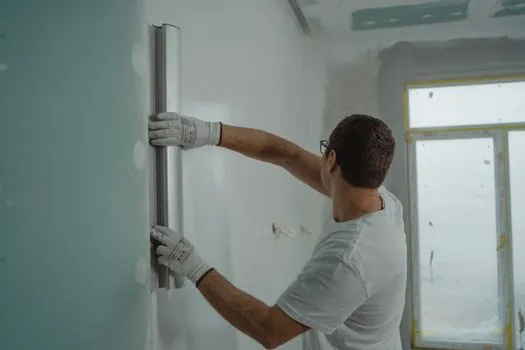
Optical automatic level setup is a four-step sequence: tripod on a stable pad (not fresh concrete or a hollow floor), circular bubble centered between the leveling screws, line of sight aimed at a backsight rod for the initial reading, then a foresight rod to close the loop [S1][S3]. The compensator handles residual mis-leveling within its self-leveling range, so the operator does not re-touch the screws during the traverse; the telescope's stadia lines give a distance read at the same time as the height read, which is how a one-person observer can verify that a door head is 2.07 m above finish floor (AFF) and 3.2 m from the corner reference [S1][S3].
Laser workflow is faster but more sensitive to interruption. Once the rotary is leveled (or self-leveled), the beam becomes the horizontal reference; a trim carpenter marks cabinet tops, ceiling grids, and chair rails directly off the detector held on the rod [S3][S4]. A line laser (cross-line) clips onto a wall mount or sits on a short tripod and projects plumb up, plumb down, and level simultaneously, which is the standard setup for bathroom tile and kitchen cabinet installation where one person needs both a horizontal and a vertical plane at the same time [S4].
Limitations and Failure Modes in Finishing Work
Compensator drift in optical automatic levels shows up as a 1-3 mm elevation error after the instrument has been moved or jolted; the fix is a two-peg test before each session, not after the cabinetry has been scribed [S1]. Laser levels fail differently: a beam blocked by a worker, a ladder, or a drywall sheet leaves the far end of the room un-referenced, and the crew marks from a stale memory of the last clear line; the fix is a visible beam (green 510-530 nm is the modern default for interior finishing) and a detector with an audible tone [S3][S4].
Reflective surfaces, including gloss paint, polished stone, stainless trim, and glass, scatter a laser beam and create hot spots that read as a brighter line on the detector and a fainter line elsewhere; optical automatic levels are immune because the rod is a physical target [S1][S4]. Vibration from HVAC, a miter saw, or a nail gun can knock a manual compensator out of range and tilt the line of sight; damped (magnetic or air-damped) compensators are rated for jobsite vibration and are the spec to look for, not the cheapest serviceable unit [S1][S3]. Temperature gradient across a sunlit window wall will bend a laser beam visibly over 10-15 m and quietly at shorter ranges, which is why finish work near curtain walls is done with a shaded instrument and a shorter sight, or switched to an optical automatic level [S3].
Standards, Sourcing, and Crew Sizing

No single ISO or DIN standard governs interior-finishing tolerance, so the reference chain runs through the drywall finish level definitions (Q1-Q5), the manufacturer's published accuracy spec on the instrument, and the project's finish-floor and finish-ceiling benchmarks established at slab survey [S5]. For procurement, automatic levels from Topcon, Nedo, Leica, Nikon, Sokkia, Spectra Precision, and Stabila are stocked alongside DJI mapping drones, DEWALT laser tools, and SECO accessories at major US distributors, with same-day shipping on in-stock items ordered before 3 p.m. [S2].
Crew sizing follows the instrument, not the other way around. Optical automatic level work is a two-person minimum: one at the instrument, one on the rod, with a third for marking when cabinetry or grid ceiling is being set out. A rotary laser with a detector collapses this to one trim carpenter per room, which is why finish-out contractors carrying three to five active rooms will own one rotary and rent an optical automatic level for the benchmark traverse at slab and at ceiling-grid rough-in [S2][S3].
Selection Checklist for the Finishing Contractor
Match finish tier first: Q1-Q2 work tolerates a general-purpose line laser; Q3-Q5 work needs an optical automatic level with 1.5-2.5 mm/km closure or a rotary laser with a detector and a documented ±0.1-0.3 mm/m spec [S1][S3][S5]. Match room size second: under 5 m, line laser; 5-20 m, optical automatic level; over 20 m or multi-trade, rotary laser with detector [S3][S4]. Match surface third: glossy, reflective, or stainless trim rules out laser, points to optical automatic level. Match crew fourth: one trim carpenter, laser; two-person rod team or benchmark traverse, optical automatic level [S1][S4].
For a typical interior fit-out crew running three to five rooms, the practical kit is one optical automatic level (20x-32x, 1.5-2.5 mm/km, damped compensator) for benchmarks, door heads, and floor-flatness checks, plus one rotary laser with a detector for ceiling grid, cabinet tops, and chair-rail layout, with the optical automatic level re-checked by a two-peg test at the start of each shift. A crew doing single-room bathroom or kitchen fit-out under 5 m can work entirely off a cross-line laser with a wall mount and skip the optical automatic level entirely [S1][S3][S4].
For teams also coordinating structural fastening or hanger layout before the finish stage, a spec-driven map of stud welder selection for interior finishing lines up with the same Q-tier tolerance logic and can share the same benchmark traverse. Trackable signals to watch over the next two quarters: adoption of green-beam rotary lasers as the interior-finishing default (replacing red beam in the 3-15 m range), and tighter accuracy specs (±0.05 mm/m) on mid-price rotary units as MEMS self-leveling modules drop in cost [S3][S4].
Detailed specification references: automatic level, and automatic molding line.