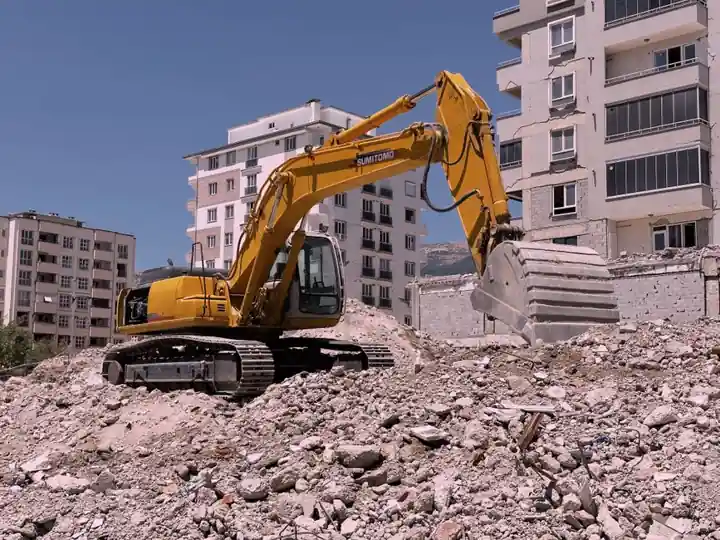
Demolition work is not a single tool class, and a concrete groove cutter spec must be matched to three variables: excavator carrier weight, concrete compressive strength, and the cut pattern the job requires (chase, control joint, or cut-and-break) [S1][S2].
KEMROC's published demolition range covers attachments from 2 t mini-excavators up to 50-60 t heavy EX carriers, with KR/KRD drum cutters for material removal, KDS diamond saws for clean grooving, and DMW cutter wheels for cut-and-break demolition, each rated to a specific carrier tonnage window [S1]. For wall-chase and slotting work at the light end, handheld electric wall chasers around 4800 W with 5 in. diamond blades handle brick, marble, and granite slotting on 110 V site power [S3].
Carrier-Class Windows and What They Unlock
KEMROC's published carrier-class map lines attachments to excavator tonnage: KDS 20 and KR 18 cover 2-4 t, KR 45 sits at 9-15 t, KR 80 and KDS 50 cover 15-25 t, KR 120 covers 25-45 t, KR 150 and KRD 150 reach 30-50 t, and DMW 220 tops out at 35-60 t, with EK 110 at 25-32 t and EK 150 at 35-50 t for the heavy cutter-wheel bracket [S1]. That carrier class is the first filter, because hydraulic flow, stick pin geometry, and weight all shift once you cross the 10 t, 25 t, and 40 t thresholds.
For demolition specifically, the 15-30 t mid-EX band is the workhorse: KDS 50 (15-25 t) for diamond sawing, KR 80 (15-25 t) for drum cutting, and the 25-45 t KR 120 give enough hydraulic head to push through reinforced slab without bogging the carrier. Below 6 t, the concrete groove cutter category effectively becomes a wall chaser or hand-held saw class, not an attachment.
Concrete Strength Cutoff and Blade Choice
KEMROC rates its demolition attachments to handle concrete with uniaxial compressive strength up to 100 MPa, which covers structural mixes from C25/30 through C70/85 and most demolition-grade reinforced slabs [S1]. For cut-and-break demolition specifically, DMW cutter wheels are designed to groove the concrete and weaken the structure so chunks break off in manageable pieces, and KEMROC claims 4-7x the output of a conventional rock breaker in this configuration [S1].
Above 50 MPa, the practical decision moves to diamond tooling rather than carbide picks, and a water-fed blade path becomes mandatory for dust suppression. KEMROC's KDS diamond saws and DMW cutter wheels are offered with optional water nozzles for exactly this reason, which improves visibility and controls respirable crystalline silica on site [S1]. On a 4800 W wall chaser, dustproof housings and infrared sighting are the equivalent controls for indoor chase work at lower power [S3].
Noise, Vibration, and Urban-Site Constraints
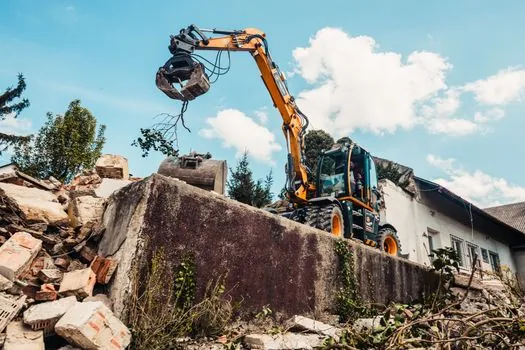
Demolition attachments in the KEMROC range operate at noise levels around 75-80 dB, which the OEM frames as suitable for urban and residential projects where conventional breakers would exceed local noise ordinances [S1]. That range is materially lower than a hydraulic breaker on the same carrier, and the low-vibration profile also reduces the risk of micro-cracking in adjacent structures the contractor is preserving.
For indoor or occupied-building work, the equivalent choice is a demolition hammer sized to the slab thickness, paired with a wall chaser for the chase and a vacuum extraction shroud for dust. The wall-chaser class runs on standard 110 V site power, which matters for tenant-occupied retrofit where diesel generator noise is itself a constraint [S3]. When vertical reach is the issue, an aerial work platform sized to the cut height is the safer alternative to scaffolding a handheld chaser.
Cut-and-Break vs. Drum Cut vs. Diamond Saw: Decision Map
Three concrete-cutting patterns cover almost every demolition scenario, and each maps to a different attachment class on the same carrier. A diamond saw (KDS 20 to KDS 50) is the right pick when the cut line must be clean, square, and limited in depth, such as a control joint in a slab-on-grade or a clean separation cut before lifting out a section. A drum cutter (KR 18 to KR 150) is the right pick for material removal, surface profiling, and trenching where the kerf is not critical. A cutter wheel (DMW 130 to DMW 220) is the right pick for cut-and-break demolition, where the goal is to weaken a large mass of concrete so it fractures into transportable chunks at 4-7x the throughput of a breaker [S1].
Selection criteria, applied in this order: (1) carrier tonnage available, which caps the attachment model; (2) concrete strength and rebar density, which picks between diamond and carbide; (3) cut pattern, which picks between saw, drum, and wheel; (4) site constraints, which rule in or out water-fed dust suppression and noise-limited attachments. Early-entry saws (soff-cut or green saws) sit in a separate niche, used to cut control joints in freshly poured concrete within hours of placement, not in true demolition [S2].
When a Groove Cutter Is the Wrong Tool

A concrete groove cutter is the wrong primary tool when the demolition is bulk reduction of thick walls or foundations above ~1 m, where a standard hydraulic breaker or a demolition hammer sized to the carrier moves material faster per shift hour. It is also the wrong tool for steel cutting: drum cutters and diamond saws bind on rebar cages, and a torch, shear, or plasma class tool is the correct secondary tool. For rebar processing on a demolition site, the Rebar Threading Machine Picks for Demolition guide covers diameter, drive, and site-fit trade-offs after the concrete is separated. Where studs and shear studs are involved in the cut line, the Stud Welder Picks for Demolition and Heavy Steel Cutting Jobs reference lays out the CD vs drawn-arc call. [S1]
It is also the wrong tool for trenchless work and small-diameter through-cuts in masonry, where a marble cutter or a plasma cutter on thinner stock is the appropriate spec class. Conflating those tools is a common catalog error, and it leads to undersized motors burning out on hard aggregate.
On-Site Verification Before Spec Sign-Off
Before locking a concrete groove cutter spec, verify three numbers from the research material: the carrier operating weight window for the chosen attachment model (e.g. KDS 50 = 15-25 t, DMW 220 = 35-50 t or 40-60 t depending on variant), the concrete uniaxial compressive strength ceiling (100 MPa for the KEMROC demolition range), and the noise emission (75-80 dB for the same range) [S1]. These three values, plus the 4-7x cut-and-break productivity claim versus a rock breaker, are the hard spec anchors the OEM publishes for the demolition use case [S1].
Two trackable signals to watch going into the next spec cycle: first, whether mid-EX carrier classes (15-30 t) consolidate around DMW cutter wheels for cut-and-break as the default demolition productivity baseline; second, whether dust-suppression water kits become standard rather than optional on KDS and DMW attachments as silica-rule enforcement tightens on urban sites. Both shifts would change the cost-per-cubic-meter math on the next demolition tender.
