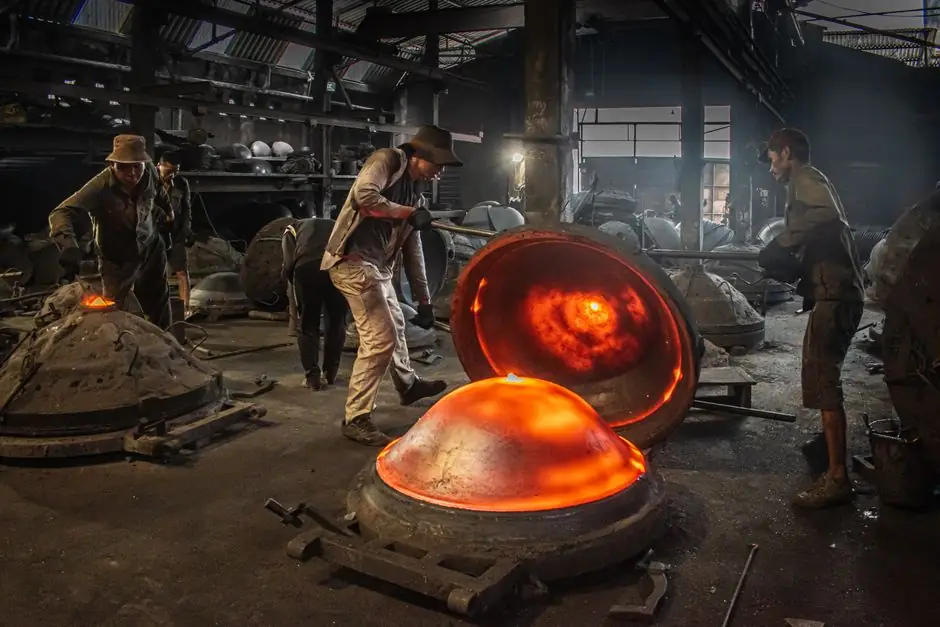
An automatic green sand molding line running a horizontal flaskless matchplate configuration can produce more than 400 molds per hour with little or no manual involvement, while a hand-served jolt-squeeze matchplate station typically delivers 60-120 molds per hour per operator [S4].
The same throughput arithmetic applies to plastics: a 10-second reduction on a 60-second injection molding cycle generates over $50,000 in additional annual profit per machine, and most molding cells run 20-40% slower than their optimal cycle [S2]. The economic gap between an automatic molding line and a manual bench is therefore set by cycle time, not by headline press tonnage.
Green Sand Molding: 400+ Molds/Hour Automatic, 60-120/Hour Manual
Modern automatic horizontal flaskless molding platforms produce in excess of 400 molds per hour with little or no manual involvement, and un-cored production rates above 200 molds per hour are routinely cited for in-line and cross-loop configurations [S4]. The same white paper notes that standard jolt-squeeze matchplate stations are limited by the operator's ability to perform the manual flask handling, cope/drag rollover, and pattern set functions between squeezes, which puts the practical per-operator ceiling at roughly 60-120 molds per hour on a green sand matchplate [S4].
For a foundry evaluating a green sand expansion, the math is direct: a single automatic flaskless cell replaces three to six manual matchplate stations, drops headcount per mold from one operator to a fraction of an FTE, and eliminates the variability that comes with hand-rammed sand. The productivity offset recovers the higher capital cost of an automatic molding line over the first one to three years of operation, depending on flask size and pouring rate.
Injection Molding Cycle Breakdown: Cooling Dominates 60-80% of Cycle
Cooling time is consistently reported as 60-80% of the total injection molding cycle, with one training source placing the range at 80-90% for typical wall sections [S2][S5][S7]. Fill time takes 5-10% of the cycle, pack/hold another 10-15%, and mold open plus ejection absorb the remainder [S2]. Because cooling is the largest single time bucket, any change that shaves even one second off cooling pays back faster than trimming injection or ejection phases.
A 25% cycle time reduction adds $50,000-$150,000 in annual capacity value per machine, and per-part costs drop 15-20% when cycles are optimized to design-intent rather than historical-quote values [S2]. A representative scenario: a 30-second cycle trimmed to 28 seconds saves 1,000 machine hours across a 15,000-hour job, worth $40,000 at a $40/hour machine rate, exactly the kind of margin erosion that gets locked in during the first production run [S5].
Cycle Comparison: Manual, Semi-Auto, and Full Automatic Cells
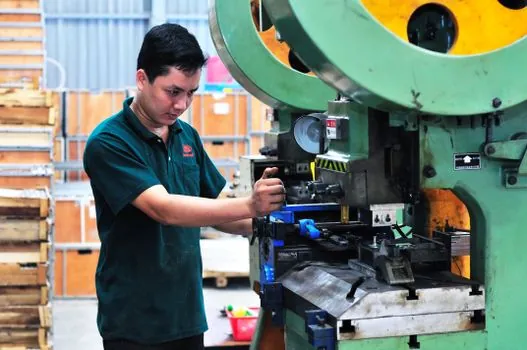
Manual cells are governed by operator speed. On an injection molding machine running in semi-automatic mode, mold open time must be long enough for the operator to remove parts and inspect cavities, which adds 2-6 seconds versus a robot-served cell [S5]. A robotic or part-picker take-out removes that human pause and lets the press clamp close at its mechanical limit, typically the difference between 32-second and 28-second cycle times in the worked example above [S5].
For green sand, the comparison stacks the same way:
Manual matchplate (jolt-squeeze, hand-served): 60-120 molds/hour per operator, high variability, dependent on flask weight and pattern complexity [S4].
Mechanized matchplate with rollover and push-out: 120-200 molds/hour, one operator per station, reduced manual lifting [S4].
Automatic horizontal flaskless matchplate: above 200 molds/hour un-cored, above 400 molds/hour cored, no operator at the molding station [S4].
The selection question is volume threshold: below roughly 40-60 molds per hour sustained demand, a manual matchplate still amortizes faster; above that, the labor savings and consistency of an automatic molding line win.
Bottleneck Economics: 20-40% of Cycles Run Slower Than Optimum
Industry data cited in February 2026 indicates that most injection molders operate 20-40% slower than their theoretical optimum, primarily because cooling channel design, venting, and pack/hold profiles are locked in before the first part is molded and rarely revisited [S2]. The same source reports that cycle times range from 10 seconds for thin-wall packaging to 120+ seconds for thick technical components, meaning the manual-versus-automatic gap scales with wall thickness and material [S2].
For green sand, the parallel finding is that hand-served matchplate output is bounded by operator stamina, not by machine capability, and the bottleneck shifts from cycle to material handling once a line is automated. Foundries planning a molding line expansion typically use 200 molds/hour un-cored as the break-even throughput against a manual matchplate, with 400+ molds/hour justified when cored work is included [S4].
Selection Criteria: When Automatic Pays, When Manual Still Wins
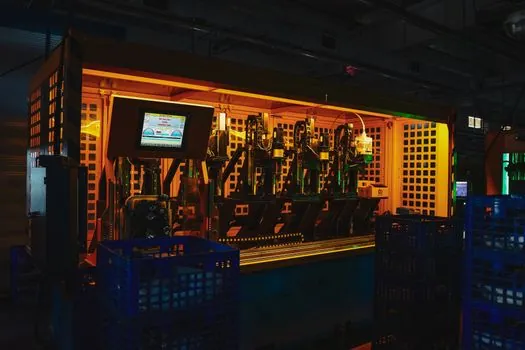
An automatic molding line pays back fastest in three situations: high cored work where manual core setting would otherwise cap throughput, foundries running more than one shift where the labor delta is doubled or tripled, and operations with tight casting consistency requirements that hand ramming cannot meet [S4]. Manual matchplate remains the rational choice for job-shop foundries running short runs, heavy flasks that exceed flaskless machine capacity, or low-volume patterns where tooling amortization dominates per-mold cost [S4].
For injection molding, the equivalent decision pivot is part volume and cycle sensitivity: high-volume thin-wall parts where a 2-second cycle reduction moves six figures of profit justify a robot-served cell with closed-loop cooling, while low-volume thick-section parts are often better served by a semi-automatic station with a skilled operator tuning each cycle by hand [S2][S5]. The shell molding machine class sits in between, typically slower per cycle than an automatic green sand line but with tighter dimensional tolerance for medium-volume runs.
Standards, Sourcing, and Trackable Signals
Cycle rate comparisons in green sand foundries are reported in the EMI white paper on manual and automatic expansions, which uses molds per hour as the primary throughput unit and ties per-mold cost to operator count and flask size [S4]. For plastics, the equivalent reference points are the 10-120 second cycle range, the 60-80% cooling share, and the 20-40% suboptimality benchmark, all consistent across Paulson Training, Protoshop, and the Evok Poly February 2026 analysis [S1][S2][S5][S7]. No single ISO or ASTM standard governs molds-per-hour, so the comparison rests on OEM-rated throughput and validated cycle logs rather than a regulatory figure.
Trackable signals for the next 6-12 months: SMED pattern changeover benchmarks on automatic flaskless lines, where setup time is the second bottleneck after raw cycle, and cooling-channel conformal design adoption in injection tooling, which directly targets the 60-80% cooling share that dominates cycle economics. See also this 2026 breakdown of automatic molding line pattern changeover SMED numbers and setup pitfalls for the changeover-side of the same throughput equation.