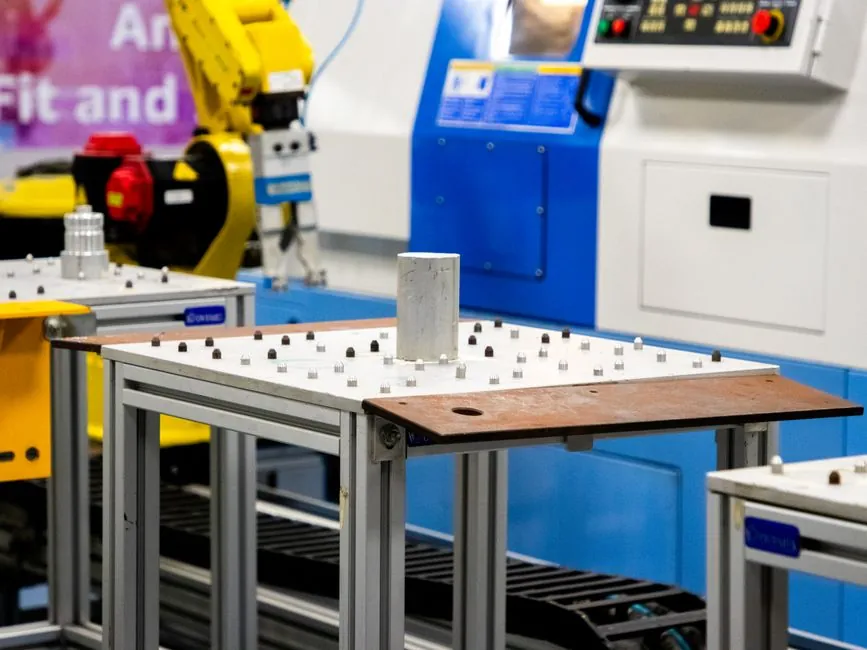
Foundry-grade automatic molding lines such as the FCMX allow 9 seconds of core set-time inside the production sequence, with high-speed mold handling reaching roughly 200 mph, positioning the core-setting robot as a non-negotiable pacing element in modern flaskless cells [S6].
In plastics, the equivalent bottleneck is the take-out robot: a Cartesian, mostly servo-driven axis that must enter, grip, and exit the open mold before clamp close, which is why the dry-cycle (mold open/close without injection) is the first number procurement engineers benchmark [S1][S2].
How the cycle is actually built, and where the robot steals time back
Total injection-molding cycle time is the sum of clamp close + inject + hold (cooling) + clamp open + part ejection, and a fully automatic semi-auto loop will hold each of those steps to a fixed clock budget once auto cycle is engaged [S7]. Cooling typically dominates, but in flaskless automatic molding lines with an automatic core machine, the core set step is the gating event: if the core robot cannot finish its in-mold placement inside the allowed window, the clamp close is held and the entire cell waits.
For high-cavitation plastic parts, ENGEL's iQ motion control automatically re-profiles the mold-movement ramps and has been published to reduce dry cycle time by 12% on supported press platforms, while two-platen machine builders such as YIZUMI have published a 55% shorter dry cycle on their D1 series through servo-driven clamping and stroke optimization [S5][S2]. The dry cycle is the only segment where the take-out robot, the molding line conveyor, and the clamp compete for the same physical window, so trimming it is the most leveraged mechanical change available to a cell owner.
Take-out robot versus general six-axis arm, and what the EOAT actually does
A take-out robot is an automation system that removes molded parts, runners, or sprues from an injection molding machine after each cycle, and is purpose-built around three needs: fast extraction inside the mold-open window, repeatable motion to protect mold and part, and physical fit inside the cell's guarding envelope [S1]. General six-axis articulated arms are not specified for this duty, because their footprint, control architecture, and price target differ from the purpose-built Cartesian sprue pickers, top-entry units, and side-entry units that dominate the cell.
End-of-arm tooling (EOAT) is what converts that Cartesian travel into a usable cycle: grippers, vacuum cups, or sprue nippers transfer parts to conveyors, cooling fixtures, vision inspection, or palletizers. When the EOAT, the molding machine ejector sequence, and the downstream conveyor are all on one shared fieldbus, the robot's egress path can be released as soon as the part clears the mold half, which is how EU-series injection-molding robots from Topstar are documented to shorten the effective cycle by collapsing empty-grab dwell and stop dwell into the next clamp-close step [S3].
Selection criteria that actually move the cycle number
For procurement, five numbers define whether an automatic molding line will hit its takt target: press tonnage, part weight plus runner weight, target cycle time, EOAT changeover time, and floor footprint including guarding reach [S1]. The right robot depends on press size, part weight, cycle-time target, EOAT requirements, downstream handling needs, and available floor space; a cell spec'd faster than the press can physically clamp is a wasted axis, and a cell where the robot is slower than the clamp close will see the press wait on the robot every cycle.
Two-platen presses add one more variable: the moving platen stroke length and the platen parallelism envelope, because the take-out robot must enter the open mold between the moving platen face and the stationary platen face. Adjusting clamping speed parameters, reducing unnecessary mold stroke, and calibrating mold open/close sensor positions are the three documented levers on the D1-series that recover the lost margin without changing the robot [S2]. On the plastics side, the published ENGEL figure of 12% shorter dry cycle time is the benchmark cell designers compare against when validating any new motion-control claim [S5].
Comparison of the three robot options on a molding line
For a cell spec, the three credible take-out architectures line up against four decision criteria as follows. A Cartesian sprue picker is the lowest-cost and fastest into a small press (under roughly 200 t) but cannot reach side-cavitation parts. A top-entry servo Cartesian is the workhorse for presses from 200 t to 1,000 t and pairs with conveyor or cooling-fixture handoff, the configuration that Yushin, YIZUMI integration partners, and Topstar's EU-series all document for cycle-time reduction [S1][S2][S3]. A side-entry robot is required when the part geometry blocks vertical extraction, but its in-mold time is the longest of the three because the approach stroke shares the clamp-open window with ejection. A general six-axis arm is technically possible but is almost never specified because it loses the dedicated fast-extraction, repeatable-motion, and machine-fit optimization that defines the category [S1].
On a flaskless automatic molding line with a core-setting robot, the core set step runs in parallel with sand shooting and squeezing, and the published 9-second core set window on the FCMX is the design budget a maintenance engineer plans tooling changeovers against [S6]. If the core robot's repeatability drifts above the cell's sand-flow tolerance, the core set must be slowed to avoid crush, and the clamp cycle stretches with it, which is why the spec sheet should always carry a repeatability number (typically ±0.05 mm to ±0.1 mm for servo core setters) rather than only a payload number.
What integration with downstream automation actually unlocks
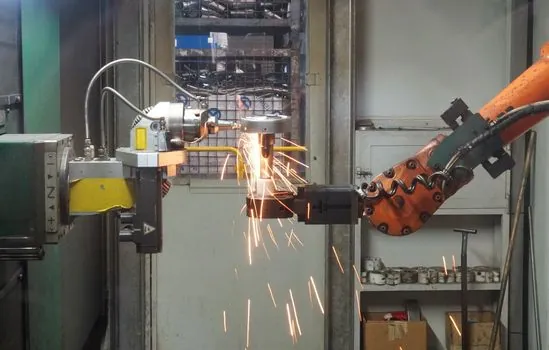
Automating part removal on a custom injection-molding cell eliminates the human-fatigue cycle-time variation that keeps OEE below its practical ceiling, and one Cadrex case study documents a 3-machine cell going from one operator per press to one operator across three presses after automating, while the same firm doubled mold cavitation because the robot could reach into deep, hard-to-access tool pockets without strain [S4]. That second-order effect, the fact that automation makes multi-cavity tools economically feasible rather than just faster, is the real ROI driver in custom molding.
For mass-production two-platen cells, the same logic applies to cooling and post-processing: with automated robotic integration, cooling cycles can be initiated while the part is being removed or while secondary processes are running, which converts sequential idle time into parallel work and is one of the four documented optimization levers on the D1 series [S2]. Modern controllers on these presses, such as the European KEBA controller used on YIZUMI D1 machines, support unlimited alarm and process logs plus SPC and PDP data tracking, so the cycle-time number is auditable after the cell is commissioned rather than being a one-time acceptance test value [S2].
Limits, failure modes, and what to watch on the spec sheet
A take-out robot cell is not the right answer when the part mix changes faster than the EOAT changeover can keep up, because every gripper swap is a planned stop and the ROI math falls apart below a certain annual volume. It is also wrong for parts with very short demold times (under roughly 4 s) where the robot's in-mold extraction cannot physically fit inside the mold-open window; in that case the constraint is the press, not the robot, and the right fix is a faster press or a higher-cavitation tool, not a more expensive axis [S1].
On the foundry side, the 9-second core set window is a machine design target, not a guaranteed production number: it assumes matched sand, matched binder, and a tool that is in good condition. Once the time relay on the core setter drifts or the sand moisture moves, the operator will lengthen the core set to protect the tool, and the cycle stretches with it. Likewise, on the plastics side, ENGEL's 12% dry-cycle reduction is conditional on iQ motion control being licensed and active on the specific press platform, and the YIZUMI 55% dry-cycle figure is published for the D1 series, not as a generic two-platen claim [S5][S2].
The next node to track is whether servo core setters with documented ±0.05 mm repeatability ship as standard on the next FCMX-class machine generation, alongside whether the 12% dry-cycle benchmark from ENGEL is replicated on two-platen presses beyond the D1 series, since both numbers are the realistic ceiling for any cell spec being written through 2026.
This topic is covered further in Timing Belt Selection for Steel Mill Drives: Pitch, Cord, and Heat Tradeoffs.