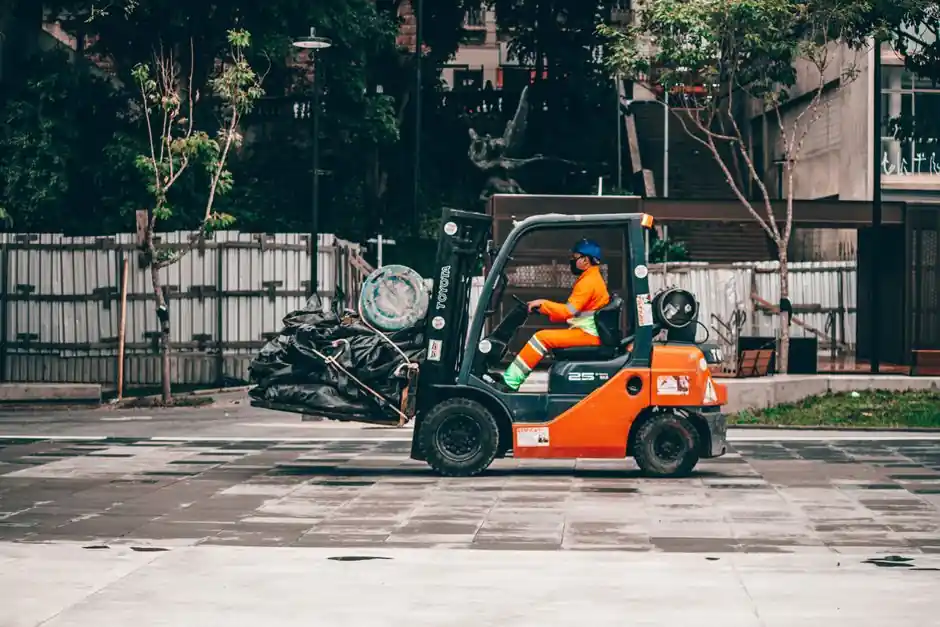
Autonomous forklift revenue in 2026 is being sized between USD 3.17B and USD 8.76B by global market reports, with the central cluster falling at USD 4.32B (360iResearch, 2026-09-06), USD 5.61B (Fact.MR, 2026-03-23), and USD 5.9B (Grand View Research, projected from 2026) [S2][S4][S1].
The 2026 CAGR band across reports runs from 4.60% (Fact.MR, 2026-2036) to 13.11% (360iResearch, 2026-2032), with 9.7% also reported for 2026-2033, reflecting differing report scopes across autonomous forklift definitions [S2][S4][S7].
How 2026 analysts actually scope the category
Fact.MR's 2026 scope covers five forklift types (counterbalance, pallet jack, reach truck, order picker, stacker) across five navigation technologies (LiDAR, vision-guided, SLAM, magnetic-guided, plus a residual bucket), three load-capacity tiers, two autonomy levels (semi- and fully autonomous), five application categories, and eight end-user segments across 40+ countries [S2].
360iResearch pegs the "autonomous forklift system" market at USD 3.81B in 2025 reaching USD 4.32B in 2026, a narrower definition that emphasises systems-level integration (vehicle + fleet manager + WMS/WES link) rather than vehicle unit shipments [S4]. MarketsandMarkets draws the tightest line, starting from USD 3.17B in 2026 and projecting 9.7% CAGR to USD 6.07B by 2033, by excluding manually operated trucks and non-forking AMRs [S7].
Exclusions are consistent across reports: manually operated forklifts, fixed-path AGVs running on embedded wire or tape, conveyor systems, and AMRs without forking or lifting mechanisms all sit outside the autonomous forklift market definition [S2]. The Business Research Company's USD 8.76B 2026 figure appears to use the broadest envelope, including semi-autonomous retrofits and a wider truck-type mix [S8].
Navigation stack: where LiDAR, SLAM, and magnetic-tape still split
LiDAR navigation is described as the dominant 2026 navigation technology in autonomous forklifts because obstacle-detection accuracy and environmental mapping resolution are required for safe operation in dynamic warehouses where human workers, manual forklifts, and inventory configurations change continuously [S2].
The Beacon Robot 2026 buyer guide quantifies sensor adoption: roughly 50% of 2026 autonomous forklift systems are reported to use LiDAR and computer vision together for real-time mapping, with ML-based path refinement layered on top of the sensor stack [S5]. Polaris's 2026 taxonomy draws the line between AGV-class forklifts (fixed magnetic-tape, wire, or laser paths) and AMR-class forklifts (dynamic, infrastructure-free SLAM), positioning autonomous forklifts as a functional category that can be built on either navigation backbone [S3].
For 2026 procurement, the practical split is: magnetic-tape or wire-guided systems fit greenfield facilities where route changes are rare and the operator accepts infrastructure modification; SLAM/AMR-class systems fit brownfield warehouses and 3PL operations where rack positions and pick faces shift weekly. Hybrid stacks (LiDAR + vision + floor fiducials) are now common in counterbalance and reach-truck classes above 1.5 t rated capacity [S5].
Comparison: autonomous forklift vs AGV forklift vs AMR forklift
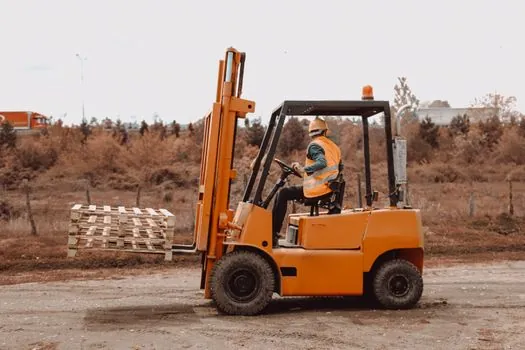
Three categories are consistently distinguished in 2026 spec sheets: autonomous forklift (sensor + LiDAR + AI, fixed or dynamic routes, forklift-class palletised loads), AGV forklift (fixed magnetic-tape/wire/laser paths, low flexibility, point-to-point transport), and AMR forklift (SLAM and AI, infrastructure-free, lighter payloads, real-time layout adaptation) [S3].
On four 2026 decision criteria, the comparison reads: navigation method (autonomous: sensor + LiDAR + cameras; AGV: fixed path; AMR: dynamic SLAM); flexibility (autonomous: moderate-to-high; AGV: low; AMR: high); primary task (autonomous: lift, stack, transport pallets; AGV: point-to-point; AMR: lighter general-purpose); and best-fit environment (autonomous: high-throughput repetitive warehouses; AGV: stable greenfield lines; AMR: changing layouts and mixed-SKU 3PL) [S3]. Polaris's 2026 framework also flags AMR-class forklifts as a navigation category that some autonomous forklifts use, not a separate physical truck class [S3].
Who autonomous forklifts are FOR, and who should still buy manned trucks
Autonomous forklift systems are specified for repeatable pallet movements, point-to-point transport, loading and unloading support, and operations where predictable routes can be established and monitored; the strongest fit is high-throughput, repetitive-task warehouses and fulfilment centres running 24/7 [S3][S4].
They are not the right tool for variable, low-volume, or highly dynamic environments, including outdoor yards with mixed weather exposure, sites with frequent layout changes that exceed SLAM re-mapping time budgets, or operations where single-shift manual handling is already cost-competitive [S3]. The 2026 Polaris table also flags that traditional forklifts retain an edge where human judgement is needed for exception handling, non-standard load geometries, or one-off moves in confined spaces [S3].
Buyers in 2026 are also weighting serviceability, cybersecurity, interoperability with WMS/WES, battery management (typically Li-ion, with opportunity charging at 1C-2C peak rates), and measurable productivity and safety outcomes, not headline vehicle price [S4]. AI is most useful where it is integrated with deterministic safety architecture and disciplined operational supervision, and validated safety controls plus human override procedures remain non-negotiable for industrial deployment [S4].
Regional adoption split, as of 2026
Fact.MR's 2026 country-level CAGR rankings put China first at 6.8% (mega-warehouse construction for e-commerce), India at 6.2% (logistics infrastructure modernisation), South Korea at 5.5%, Germany at 4.8% (Industry 4.0 warehouse integration), USA at 4.5%, Japan at 4.0%, and UK at 3.8% [S2].
North America in 2026 is characterised by large distribution facilities, persistent labour-productivity pressure, and strong demand for scalable warehouse automation; the region's facilities increasingly seek systems that work alongside conventional forklifts, conveyors, automated storage, and warehouse software rather than operate as standalone equipment [S4]. For reference spec data on the manned baseline that autonomous fleets are replacing, see the forklift encyclopedia page, and for the all-terrain variants deployed in outdoor yards that autonomous units rarely service, the rough terrain forklift page.
Vendor landscape 2026: who actually ships product
AGVNetwork's 2026 top-10 list names AGBEE, SMARLOGY, BALYO, ROCLA, VisionNav, MABO E&A, EK Robotics, and TOYOTA as the principal autonomous forklift vendors in 2026, with the list anchored on units that ship production fleets rather than pilot demos [S6].
Beacon Robot's 2026 feature roundup separately highlights TWIICE and Linde Material Handling as reference integrators shipping LiDAR-plus-vision stacks into 2026 deployments [S5]. Across the 2026 vendor set, the consistent differentiators are safety-rated perception (ISO 3691-4 type approvals where applicable), WMS/WES integration depth, and the size of the installed fleet available for benchmarking. For units that share the same sensing-and-navigation lineage as AGV platforms, the AGV robot encyclopedia entry covers the underlying navigation and control architecture.
2026 buyer checklist: what the spec sheet should show
A 2026 autonomous forklift spec sheet should explicitly state: navigation stack (LiDAR model and channel count, vision cameras, SLAM or fiducial-augmented), safety certification (ISO 3691-4 driverless industrial truck compliance, plus regional approvals where required), payload and lift-height envelope (typical 1.0-3.0 t for counterbalance, up to 5-6 t for heavy reach), battery chemistry and opportunity-charging rate, WMS/WES interface protocol list, fleet-manager cybersecurity posture, and human-override latency [S3][S4].</h2> <p>Integration complexity should also be quantified: WMS/WES integration, facility layout considerations, and traffic management with manual forklifts are the three integration cost drivers that most affect 2026 ROI calculations [S3]. Buyers should also validate edge-processing resilience, data governance, explainable operating rules, and the documented human override procedure before signing a purchase order, since 2026 analysts flag these as the failure modes that turn a pilot into a stranded asset [S4].