
Per Fact.MR's 2024 robot cell outlook, the global robot cell market was valued at US$ 3.2 billion in 2023 and is projected to reach US$ 12.8 billion by 2034, growing at a 14.6% CAGR [S5]. That growth rate is roughly twice the 7-8% CAGR widely cited for the broader industrial-robot market over the same window, which is why the "robot cell vs. standalone robot" question is now a sourcing decision, not a marketing one.
A turnkey robotic cell bundles a manipulator, end-effector, guarding, safety scanners, a PLC or industrial PC controller, and the application-specific fixturing into one tested, pre-commissioned package; the integrator does the engineering once, then re-deploys the same build for many end users [S3][S4]. For plants evaluating their first automation cell, the question has shifted from "which robot arm" to "which cell SKU do I integrate into my line".
Market Sizing: Cells vs. Standalone Robots, 2024-2034
Robot cell sales are forecast at 14.6% CAGR from 2024 to 2034, against a US$ 3.2 billion 2023 base and a US$ 9.3 billion absolute-dollar opportunity across the period [S5]. The cell market's 2024 estimate is US$ 3.5 billion, against an installed base of several hundred thousand new industrial robots shipped globally per year, and the cell number captures complete systems, not bare arms [S5].
For comparison, the International Federation of Robotics has historically tracked industrial-robot installations at high single-digit annual growth, and Interact Analysis projected the cobot market alone at US$ 2.2 billion by 2026 [S2]. The cell segment therefore looks like the higher-CAGR slice of the same underlying robot market, because the integrator is adding engineering value, safety integration, and application fixturing on top of the arm.
What "Turnkey" Actually Includes
A turnkey robotic cell is defined by four non-negotiable traits: standardized hardware and software, modular swap-in/out subassemblies, full documentation and training, and reliability tested before shipment [S3][S4]. Standardization means a customer buying two cells in 2024 and 2026 gets the same motion controller, the same safety scanner brand, and the same programming environment, with only fixturing and reach changed per application [S3].
Modularity is the lever that lets an integrator amortise the engineering across dozens of deployments, and it is also where a servo motor or pressure sensor swap is treated as a stocked SKU rather than a re-engineered BOM line [S4]. For end users, that compresses the cell-side of a project from 12-16 weeks of bespoke integration to typically 2-4 weeks of on-site installation and commissioning, which is the source of the "faster ROI" claim integrators lean on [S3].
Comparison: Turnkey Cell vs. Standalone Robot vs. Custom Integration
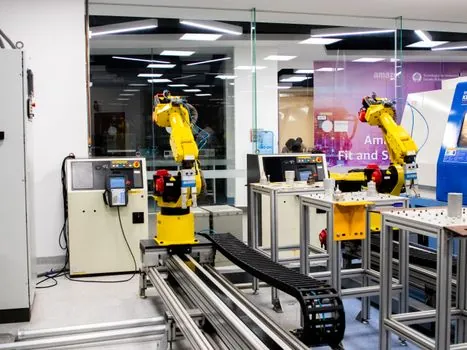
On a 2-4-criterion matrix, the three delivery models line up as follows. (1) Engineering time per deployment: turnkey cell is lowest because the design is reused, custom integration is highest, standalone robot sits in the middle and depends on the buyer's in-house team. (3) Time to first part: turnkey cell typically weeks, custom integration typically months, standalone robot plus in-house integration falls in between depending on application. (4) Scalability across product variants: turnkey cells score highest because the modular subassemblies can be reconfigured; a standalone robot plus custom tooling is the least scalable [S3][S4].
The trade-off is flexibility: a fully custom integration can be tuned to a process that a standard cell's reach, payload, or guarding envelope cannot accommodate, and a standalone arm bought off the shelf is the right call for R&D labs and very low-volume work where standardisation would over-spec the build [S3]. For anything approaching serial production, the cell wins on total cost of ownership even when its sticker price is higher [S3][S4].
Application Segments Driving the 14.6% CAGR
Manufacturing and assembly was 35.5% of the 2023 robot cell market at US$ 1.4 billion, making it the single largest application bucket in the Fact.MR dataset [S5]. Within that bucket, palletizing, machine tending, welding, and electronic assembly are the four cell templates that get re-deployed most often, because the fixturing patterns are highly repeatable across end users in the same sub-vertical [S3].
Outside discrete manufacturing, robot cells are tracking into last-mile delivery, hospitality, and healthcare pilots, where the same pre-engineered platform idea is being applied to mobile service robots [S5]. For industrial buyers the relevant signal is the medium-term 2027-2030 forecast in the same report, which calls out "enhanced connections, better sensors, and machine learning integration" as the features that move a cell from a fixed recipe to a re-configurable asset, and that is the window when most plants will make their second or third cell purchase [S5].
Regional and Material Mix

North America is forecast to hold 28% of the 2024 robot cell market, with a regional CAGR of 6.85% through 2034, while China is tracking at 12% CAGR over the same window, and the top three countries together represent 49.5% of global sales [S5]. The faster China number reflects ongoing capacity build-out in EV battery and electronics assembly, both of which are heavy cell-template users.
Aluminum-structured robot cells are the dominant sub-segment, projected at US$ 2.2 billion in 2024 or 72.6% of total cell market value, which tracks with the broader shift to lightweight welded and extruded frames for service robots and collaborative cells [S5]. For sourcing teams, the practical takeaway is that aluminum-frame cells are now a stocked catalog item at most Tier-1 integrators, while steel-frame heavy-payload cells remain more project-engineered.
Standards, Safety and Sourcing Constraints
Turnkey cells are bought on the assumption that the integrator has already discharged the safety conformity work, ISO 10218-1 for the robot system, ISO/TS 15066 for collaborative operation where applicable, and the regional machinery-safety regimes such as the EU Machinery Regulation and OSHA 1910.212 in the US. The integrator's documentation pack, risk assessment, CE/UL declaration, and validated safety zones is what makes the cell "turnkey" rather than a kit of parts, and it is also the deliverable that end users most often under-weight during vendor selection [S3][S4].
The main sourcing constraint in 2024-2026 is integrator capacity, not robot supply: a flow meter or industrial valve on the cell's process side is usually stocked, but qualified safety engineers who can sign off a new cell template are a 6-12 month bottleneck, which is one of the structural reasons pre-engineered cells are scaling faster than bespoke builds [S3].
Signals to Track Through 2026

Two nodes are worth watching. First, the 2027 milestone in the Fact.MR forecast window, when "enhanced connections, better sensors, and machine learning integration" are expected to push cells from fixed recipe to re-configurable asset, is the cleanest single inflection point for capex planning [S5]. Second, the cobot share of new cell shipments, currently embedded in the broader cell total, is a leading indicator because cobot-based cells are the format most often bought by first-time automation buyers, and the cobot segment was projected to reach US$ 2.2 billion by 2026 in Interact Analysis data cited by Universal Robots [S2]. Together, those two numbers will tell buyers whether the 14.6% CAGR is holding, accelerating, or rolling over before the 2034 endpoint.
Background reading: Electric forklifts vs IC forklifts: who is actually outselling whom.