
A back-to-back (DB) arrangement of single-row angular contact ball bearings provides the highest moment-load resistance among the three standard pairings, because the contact lines diverge outward and the effective load centers sit far apart on the shaft [S1][S2].
Face-to-face (DF) pairs share the same hardware but converge the contact lines, shrinking that spacing and reducing moment capacity while gaining misalignment tolerance; tandem (DT) pairs stack load lines in parallel and add axial capacity but offer essentially no moment resistance on their own [S1][S6].
Why DB Geometry Wins on Tilting Moments
The moment resistance of a duplex pair is set by the distance between the two pressure cones, which is governed by the contact angle (commonly 15°, 25°, 30°, or 40°) and the bearing series [S1][S2]. A DB pair, with contact lines diverging from the shaft axis, produces a wider effective span between the resultant load lines than DF, giving it the largest tipping-moment lever arm in a standard duplex set [S1][S2][S4]. That same geometry also raises system rigidity, which is why DB sets are the default for machine-tool spindles, screw chillers, and high-stiffness pump shafts [S1][S4].
Single-row angular contact bearings themselves are intended for combined radial-plus-axial loading, with standardized contact angles and a high shoulder on one ring that defines the load path [S1][S3]. When the duty cycle includes overturning or tilting forces (shaft deflection, gear separation loads, belt pull), the standard recommendation across bearing catalogs is to specify the pair in DB rather than DF or DT [S2][S4][S6].
DB, DF, and DT Compared on Four Decision Criteria
Engineers selecting a duplex arrangement trade four properties: moment-load capacity, axial load capacity, misalignment tolerance, and effective bearing width. The table below captures the consensus from current OEM technical literature. [S3]
Arrangement: DB (back-to-back). Contact lines: diverge outward. Moment-load capacity: highest of the three standard pairings [S1][S2][S6]. Axial capacity: bidirectional, each direction carried by one bearing [S1]. Misalignment tolerance: low (small allowed misalignment) [S1]. Typical use: machine-tool spindles, pumps, gearboxes with overturning loads [S1][S4].
Arrangement: DF (face-to-face). Contact lines: converge inward. Moment-load capacity: lower than DB because the load-center spacing shrinks [S1]. Axial capacity: bidirectional, each direction carried by one bearing [S1]. Misalignment tolerance: greater than DB [S1]. Typical use: shafts with known misalignment or where DB width is constrained [S1][S4].
Arrangement: DT (tandem). Contact lines: parallel, same direction. Moment-load capacity: essentially none in the single-plane sense; stacks add unidirectional axial capacity [S6]. Axial capacity: additive in one direction only [S1]. Misalignment tolerance: comparable to a single row [S1]. Typical use: pure thrust loads in one direction, or pre-stages inside a more complex stack [S1][S6].
Contact Angle and Series Drive the Numbers
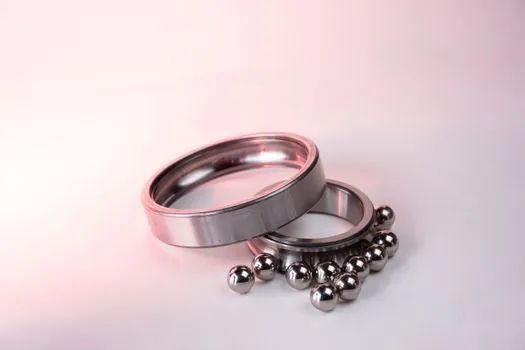
Standard catalog contact angles are 15°, 25°, 30°, and 40° for single-row angular contact ball bearings; larger angles shift capacity toward axial load and slightly widen the moment lever arm inside a DB set [S1][S4]. The Schaeffler single-row range covers series 718..-B, 70..-B, 72..-B, 73..-B, and 74..-B, with universal-match suffixes (U, UL, UA, SU, etc.) allowing direct DB, DF, or DT mounting without shims [S3]. Specifying the universal-match design is the practical way to lock in the intended DB geometry at the build stage, instead of relying on shop-floor selection from a basic-design single row [S3].
For a fixed bore and OD, dynamic and static load ratings differ between an equivalent double-row design and a paired arrangement: NSK's 5206 double-row (30 mm bore, 62 mm OD, 23.8 mm width, 25° contact) carries 29.6 kN dynamic / 21.1 kN static, while a 7206ADB(M) paired arrangement on the same bore and OD (32 mm width, 30° contact) carries 36.5 kN dynamic / 29.5 kN static, and reaches 10,000 min-1 grease / 13,000 min-1 oil limiting speeds versus 7,100 / 9,500 min-1 for the double-row [S5]. A double-row unit is essentially a back-to-back pair in a single ring, with a fixed 25° contact angle and lower width, fitting where DB moment capacity is needed in a compact envelope [S5].
Where DB Is and Is Not the Right Choice
DB is the right choice when the shaft sees a real tilting or overturning component: gear-mesh separation forces, belt or chain pull, impeller hydraulic side-loads, or deflection from a long cantilever. It is the wrong choice when the dominant requirement is misalignment accommodation (DF) or pure unidirectional thrust stacking (DT), or when the housing cannot accept the wider effective load span DB creates [S1][S2][S6]. Four-point contact ball bearings, with a 35° contact angle and separable inner ring, are an alternative when the duty is mostly pure axial load with some radial, rather than a sustained moment [S5].
Practical pairing notes: preloading a DB set (light, medium, heavy) raises rigidity and removes internal clearance, but it also raises heat generation and reduces the speed ceiling, so the preload class has to be matched to the application rather than picked as the stiffest available [S1][S4]. Standard cage materials are pressed steel, with polyamide (Nylon-46) used in high-precision builds at 30° contact or below, and machined brass where temperatures or loads demand it; rings and balls can be dimension-stabilized for long-term operation at 120°C or higher [S5].
Standards, Tolerances, and Sourcing Notes
Angular contact bearings are produced to ISO tolerance classes (Normal being the default for basic design; P6, P5, P4, and tighter for precision spindles), and ABEC grades map onto the same ISO framework for users who spec by ABEC [S4]. Catalog load ratings follow ISO 281 basic dynamic load rating methods; the 5206 vs 7206ADB(M) numbers above are published rating values, not adjusted fatigue-life outputs [S5]. For moment-loaded service, the additional check is the tilting-moment load limit published for the chosen series, since a DB pair can still be overloaded in pure moment even when its radial and axial capacities are within limits [S2][S6].
Selection workflow in practice: confirm the contact-angle series (15°/25°/30°/40°) from the duty's axial-versus-radial ratio, choose DB to maximize moment load resistance, specify universal-match suffixes so the DB geometry is enforced at installation, select preload class against the speed and heat budget, and verify the published moment-load limit separately from the basic dynamic load rating [S1][S3][S4]. For a related decision on oscillating pivots where moment and misalignment both matter, see this spherical plain vs roller bearing comparison. Background on the underlying ball bearing family and the angular contact bearing design envelope is also worth a read before finalizing a DB specification, and the broader roller bearing family is a useful reference for higher-radial-load alternatives where moment load is not the constraint.