The 70-100 HP class dominates road-building tenders because it pairs a 14'-14'11" backhoe dig depth with operating weights of 13,514-16,279 lb, covering trenching, subgrade prep, curb work and small demolition in a single machine [S1].
For a typical county-road or subdivision package, that envelope replaces at least two single-purpose units (a compact excavator plus a wheel loader), which is why it shows up in almost every OEM's "Road Building" or "Road Work" primary-application list [S8].
70+ HP Class Benchmark Specs (CAT 415, JD 310L EP, JCB 3CX, CASE 580N EP)
Across the four most-cited 70+ HP models, net power clusters at 70-74 HP and operating weight sits between 13,514 lb and 16,279 lb, but the loader-end numbers diverge by nearly 2x and that gap drives most buy decisions [S1].
The CAT 415 posts 12,207 lbf backhoe bucket force and 12,207 lbf loader breakout, while the John Deere 310L EP and JCB 3CX Compact share a 7,363 lbf bucket force and 8,285 lbf breakout at a 13,514 lb operating weight [S1]. The CASE 580N EP sits in the middle: 11,317 lbf bucket force, 6,503 lb loader lift, 14' 11" dig depth and 15,810 lb operating weight [S1].
Backhoe dig depth across the class runs 14' to 14' 11", a 1-foot spread that matters more on sewer-lateral or culvert work than on straight trenching [S1]. Loader hinge pin height ranges from 10' 6" to 11' 5", so loading high-side dump trucks is feasible across the class but cycle times differ noticeably [S1].
Engine, Transmission and Hydraulics: Where 100+ HP Units Pull Ahead
Moving up to the 100+ HP segment, the Cat 434 illustrates the engineering step: a 4.4 L Cat C4.4 mechanical turbo-intercooled engine rated at 74.5 kW (101 hp ISO 14396 gross, 95 hp net per SAE J1349) at 2,200 rpm, with torque rise of 398 N·m at 1,400 rpm and no power de-rating up to 2,286 m altitude [S2].
That engine is paired with three transmission options - a 4F/4R power-shuttle as standard, a 4-speed powershift, or a 6F/4R auto-shift with lock-up torque converter that adds 5th and 6th gears at 27 km/h and 40 km/h respectively for roading between distant segments [S2]. Top road speed of 40 km/h (about 25 mph) is enough to keep pace with dump trucks between small sites without a lowboy [S2].
The hydraulic architecture is load-sensing, closed-center with flow-sharing valves, paired to a 42.0 L hydraulic tank - active power-on-demand delivery, not open-center constant flow, which is the spec to check when sizing an attachment like a hydraulic breaker for asphalt breaking [S2].
Application Fit: Why Road Contractors Default to This Class
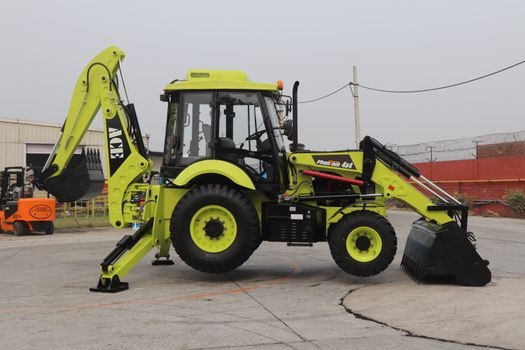
OEM and Indian Roads Congress (IRC) guidance converge on the same role: backhoe loaders are the most common single piece of equipment on a road project, used for light excavation, trenching, backfilling, material moving, light underground utility works, site clearance and loading [S4].
Beyond the loader and hoe ends, the multi-attachment interface is the real economic lever. Manufacturer guidance lists excavation, material loading, asphalt breaking, tree digging and small-scale demolition as in-scope tasks, with multiple optional attachments available for certain models [S3].
For paving-adjacent work, a single 70-100 HP machine can hand off spoil from its backhoe to its own front bucket in one pass - cutting one piece of support equipment (a wheel loader or skid steer) and one operator from a 4-5 person road crew.
Selection Criteria: Dig Depth, Hydraulic Flow, Lift and Loader-End Geometry
Four decision filters consistently drive correct 70+ HP sizing: (1) backhoe dig depth vs deepest required trench, (2) bucket breakout force vs ground conditions, (3) loader lift capacity vs aggregate-handling payload, (4) loader hinge-pin height vs receiving truck wall height [S1].
For subgrade prep and base-course work, the CASE 580N EP's 14' 11" dig depth and 11,317 lbf bucket force handle clay and dense aggregate without frequent repositioning [S1]. For trench-drain and culvert work in tight easements, the John Deere 310L EP or JCB 3CX Compact at 13,514 lb is easier to transport and lighter on soft subgrade [S1].
For projects that include a road roller compaction pass, the lighter 310L EP and 3CX reduce risk of subgrade rutting when working ahead of the roller on marginal soils. Operators moving between backhoe work and grader work also prefer the lighter-footprint units for the same reason.
Electric and Telematics Options Now in the Mix
On the 2026 product line, the CASE 580EV electric backhoe loader lists a 72.7 kWh battery and 19,947 lb (9,048 kg) operating weight, putting it at the upper end of the operating-weight band and suitable for indoor, tunnel or night-shift urban work where diesel exhaust is restricted [S6].
The John Deere 320 P-Tier backhoe loader features an advanced Pressure Compensated, Load Sensing (PCLS) hydraulic system for improved multi-functioning, smooth control, and fuel efficiency, along with a Lift Mode that increases lifting capacity by up to 15 percent and a Precision Mode that allows for reduced flow, ideal for precise tasks or new operators [S5].
OEM telematics is now standard on most new builds - Cat Product Link, for example, comes as standard on the 434 and supplies machine location and Service Meter Unit (SMU) hours, supporting fleet-level utilization tracking on multi-segment road contracts [S2].
Limitations and When to Skip the Backhoe Loader
The class is not a substitute for a dedicated excavator on deep utility work (over 15' trench depth), nor for a skid-steer loader on finish-grade work in confined footprints, nor for a backhoe loader on large-volume mass excavation where cycle-time matters more than versatility. [S1]
On haul-road construction with high daily yardage, a mid-size excavator + wheel loader combination typically beats a backhoe loader on cost-per-yard, even after the second-operator savings. The backhoe's value peaks on jobs that demand four to six different tasks per shift on a footprint that doesn't justify two machines.
Sourcing, Standards and Reference Specs
Cross-vendor spec data is most reliable in the OEM spec sheets (Teknox 434 brochure for Cat-equivalent 100 HP class [S2]) and aggregator tables that list net power per SAE J1349 / ISO 9249, operating weight with ROPS/FOPS cab, and bucket force in lbf or kN [S1][S2].
The IRC "Pocket Book for Road Construction Equipment" frames the backhoe as standard kit for any road project, citing the same scope - light excavation, trenching, backfilling, material moving, light underground utility works, site clearance and loading [S4]. For a 2026 road-equipment overview that includes backhoe loaders alongside small, mini, medium, large and mining excavators, see SANY's 12-Type road-construction guide [S3].
For compactive-support work behind a backhoe trencher, the 2026 spec map for urban road roller selection lines up the matching roller size classes; on landfill-access roads, the padfoot-drum 4-wheel-articulated spec map covers the heavier end. Selection criteria for related site vehicles are mirrored in the backhoe loader reference entry.
Trackable signals: monitor OEM announcements of Tier 5 emission packages and battery-electric 580EV derivatives through Q4 2026, and watch OEM telematics dashboards for utilization deltas between 70 HP and 100+ HP classes on multi-segment paving contracts.