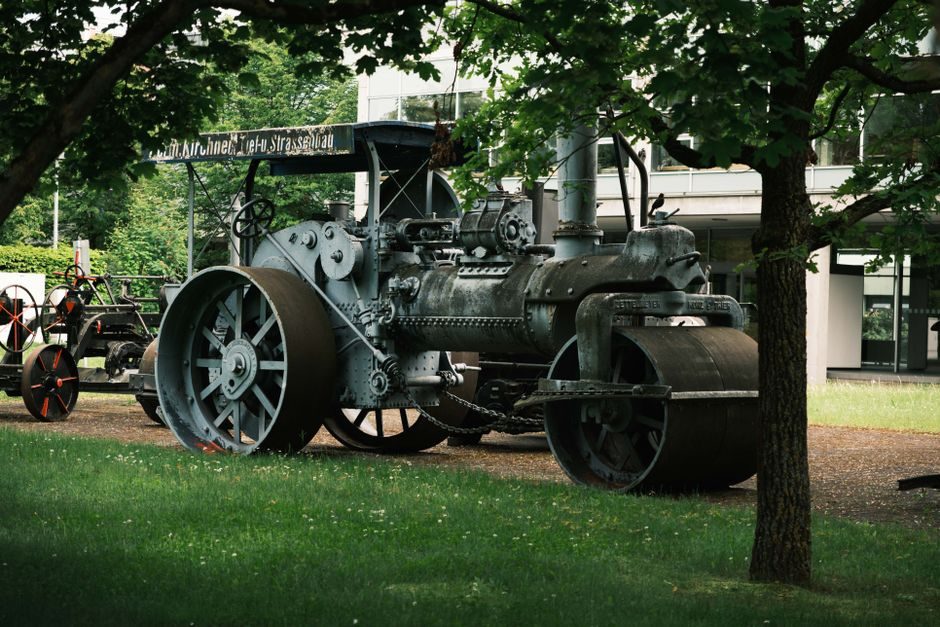
Road roller selection for urban infrastructure in 2026 is driven by a three-axis decision: drum configuration (single, tandem, pneumatic), operating weight class, and vibratory versus static compaction mode, with telematics-based intelligent compaction now standard on most new-builds above 10 t [S1][S2].
Public-engineering deployments in 2025 pulled more than 1,800 rollers into water-treatment facility expansion, 2,900 into rail corridor ballast work targeting 95% Proctor density, and 1,300 small units into public park pathway compaction, while urban drainage upgrades across 120 major cities lifted roller demand by 6% year-on-year [S7]. For context on the equipment class itself, the road roller encyclopedia entry covers the drum, frame, and vibration-system architecture that all of these specs hang off.
Single-Drum Soil Compactors for Sub-Base and Embankment Work
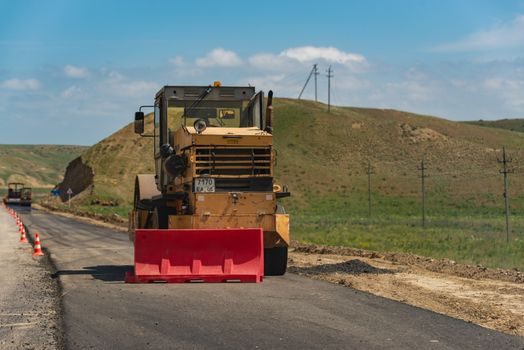
Single-drum vibratory soil compactors carry one smooth or padfoot drum at the front and driven tyres at the rear, making them the default pick for sub-base, embankment, and foundation preparation in urban road packages [S1]. A representative 10 t class unit such as the XCMG XS103J lists in the single-drum vibratory category, sitting in the weight band most city contracts call for on residential arterial sub-base lifts [S3].
Selection for urban sub-base work should key on three numbers: operating weight (8-12 t covers most city street reconstruction), drum width (typically 1.7-2.1 m for lane-width coverage), and nominal amplitude in the 1.5-2.0 mm range for granular fills [S3]. Padfoot drums are specified when the lift is clay-rich cohesive fill, while smooth drums win on well-graded granular sub-base and cement-treated layers [S1]. Vibration frequency around 28-32 Hz paired with dual-amplitude settings gives the operator a usable range across lift thicknesses of 200-400 mm without over-compacting the upper layer.
Tandem Rollers for Asphalt Wearing Course in City Streets
Tandem (double-drum) rollers apply two smooth drums front and rear with both often vibratory, and they are the machines specified for the asphalt wearing course on urban arterials, residential streets, and commercial parking decks [S1]. Operating weights in the 3-5 t range (mini tandem) cover footpaths, cycle lanes, and patchwork, while 8-14 t large tandem rollers handle full-width arterial lifts.
For wearing-course work the relevant variables are drum width (typically 1.2-1.7 m on mid-size units), static linear load (the kg-per-cm figure on the drum), and the option of dual amplitude/dual frequency so the operator can switch to high-frequency low-amplitude for thin-lift finish work. Asphalt density targets of 92-96% of Marshall density are normally written into the city spec, and vibratory tandem rollers hit that band in 3-5 passes when amplitude and frequency are correctly matched to layer thickness [S1]. The single-drum units from the sub-base stage cannot be substituted here because their drum-tyre weight distribution is wrong for finish rolling.
Pneumatic Tyre Rollers for Sealing and Surface Uniformity
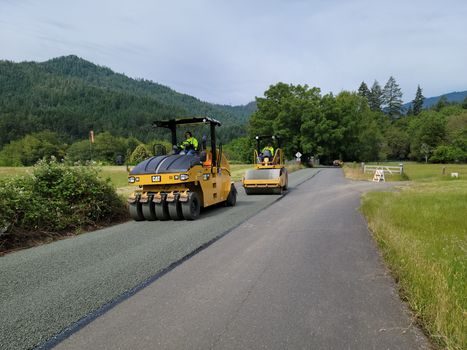
Pneumatic tyre rollers use a row of rubber tyres instead of a steel drum, producing a kneading action rather than direct impact, which makes them the third leg of a typical urban asphalt train: they are run between the breakdown tandem and the finish tandem to seal the mat and even out surface texture [S1]. Typical operating weights for city work sit in the 8-16 t band, with tyre pressure adjustable between 0.3-0.8 MPa so the operator can tune contact pressure to mix stiffness.
Pneumatic rollers are not a stand-alone solution for primary compaction on thick lifts, and they are the wrong choice for sub-base work because the contact stress is too low to densify granular fill. They earn their place on surface courses, chip-seal rolling, and where a city spec calls for a particular smoothness profile. For utilities trenches and patchwork, a small pneumatic roller (4-6 t) is often paired with a 1.5-3 t ride-on tandem to handle both the patch and the tie-in.
Intelligent Compaction and Telematics on 2026 Builds
Intelligent compaction (IC) systems integrate GPS, accelerometers on the drum, and an on-board display showing real-time compaction meter value (CMV) or machine drive power (MDP), letting the operator stop when the layer hits target stiffness rather than running a fixed pass count [S2]. On urban infrastructure projects this changes pass counts from a procedural 4-6 passes to a measured 2-4 passes on well-graded material, which contractor-side reporting puts at a 20-30% reduction in project timeline contribution from the compaction step [S4].
Three spec gates should be written into 2026 purchase orders or rental tenders: (1) IC-ready or IC-fitted from the factory, with documented CMV/MDP output; (2) GPS position logging at 1 Hz or better for as-built density mapping; (3) telematics export in a format the city pavement management system can ingest (CSV or API), so the data lands in the same asset record as the asphalt mix design and the layer-thickness log [S2][S4]. The wider bearing-related driveline on a 10-12 t single drum, including the tapered-roller-bearing sets in the drum-shaft housings, is the subsystem that takes the punishment from vibratory loading hour after hour.
Selection Criteria: A Side-by-Side Comparison

The three main urban-infrastructure roller classes line up against four decision criteria as follows, drawn from the 2026 supplier guides and city procurement practice [S1][S2][S5]:
Application fit: single-drum soil compactor wins on sub-base, embankment, and trench backfill; tandem roller wins on asphalt wearing course and thin-lift patching; pneumatic tyre roller wins on sealing, chip-seal, and inter-pass kneading.
Typical operating weight: 8-12 t for single-drum urban work, 3-14 t across the tandem class, 8-16 t for pneumatic — with 4-6 t mini-pneumatic units available for confined trench work [S1][S3].
Compaction mechanism: vibratory single-drum, vibratory tandem, or static pneumatic kneading — these are not interchangeable, and a city spec normally names all three because they run together as a train on a wearing-course shift [S1].
Data output in 2026: IC telematics is standard on most OEM builds above 10 t (CASE, XCMG, Hamm, Bomag), with CMV or MDP readouts and GPS mapping becoming the norm on new-build units rather than a costly retrofit [S2][S4][S5].
Project Size, Site Access, and Total Cost of Ownership
Project size and access drive the operating weight choice before any other variable: highway-class work pulls 12-26 t single-drum units (covered in our quarry road roller selection spec map), while urban street reconstruction with lane-by-lane traffic management typically caps at 10-12 t because of axle-load limits on adjacent structures and bridge decks [S1]. Mini rollers in the 1-3 t band are specified for footpath, cycle-path, and utility-trench reinstatement where a full-size unit cannot enter.
Total cost of ownership is shifting from purchase-price to operating-hour accounting in 2026: telematics-equipped rollers report fuel burn per cubic metre compacted, and contractors running IC report 20-30% fewer passes for equivalent density, which directly cuts fuel and operator-hour cost on the same lift [S4]. The drum bearing system — including the roller bearing cartridges at each drum-shaft end — is the maintenance hotspot on vibratory units, with inspection interval commonly set at 500 hours under continuous vibratory duty.
Limitations, Failure Modes, and Common Spec Mistakes
The most common spec mistake on urban infrastructure tenders is over-weighting a single drum roller in the 12-26 t class onto a city street package, where access, bridge-deck loading, and lane-closure rules generally cap the sensible single-drum size at 10-12 t. The second is using a soil-compactor (single-drum) for asphalt finish, which leaves a rough texture and density below 92% Marshall on the wearing course. The third is omitting IC data export requirements, which locks the city out of the as-built density record and forces manual coring to verify. [S2]
Failure modes to spec against: drum-shaft bearing failure under continuous high-amplitude vibration (write a 500-hour inspection gate), vibratory bearing overheating in prolonged static-vibration stalls (require auto-shutoff on prolonged zero-travel vibration), and tyre chain wear on pneumatic rollers when used on abrasive chip-seal aggregate. Each of these is a known failure pattern that the spec can head off with a 1-2 paragraph requirement, rather than discovering in year two of operation. For farm-track and field-prep work the use case is different and the spec band shifts; the road roller selection for agriculture article covers that adjacent segment.
Applicable Standards and Sourcing Signals
Compaction quality on urban infrastructure is normally written against a percentage of standard Proctor (ASTM D698) or modified Proctor (ASTM D1557) for soil layers, and 92-96% of Marshall density (ASTM D6926) for asphalt layers, with 95% Proctor cited as a common rail-corridor ballast target in 2025-2026 public works packages [S7]. Intelligent compaction measurement is referenced against ASTM D7698 for IC roller-based density measurement; specifiers should name the standard in the tender rather than the proprietary OEM name for the system.
Trackable signals over the next reporting window: (1) the publication of the next [S2]-style regional roller-compactor forecast with 2025-2026 base-year data, expected in early 2027; (2) any new city-level mandate requiring IC telematics on federally or municipally funded compaction work, which would shift the 2026 telematics uptake figure sharply; (3) updates to ASTM D7698 revision status from the IC working group, which would re-anchor the cited test method for any 2027 spec refresh. The concrete fiber selection for cleanroom slabs article on adjacent slab-spec work is a useful cross-reference where road-roller-compacted sub-base meets a fibre-reinforced slab on a data-center or industrial build.