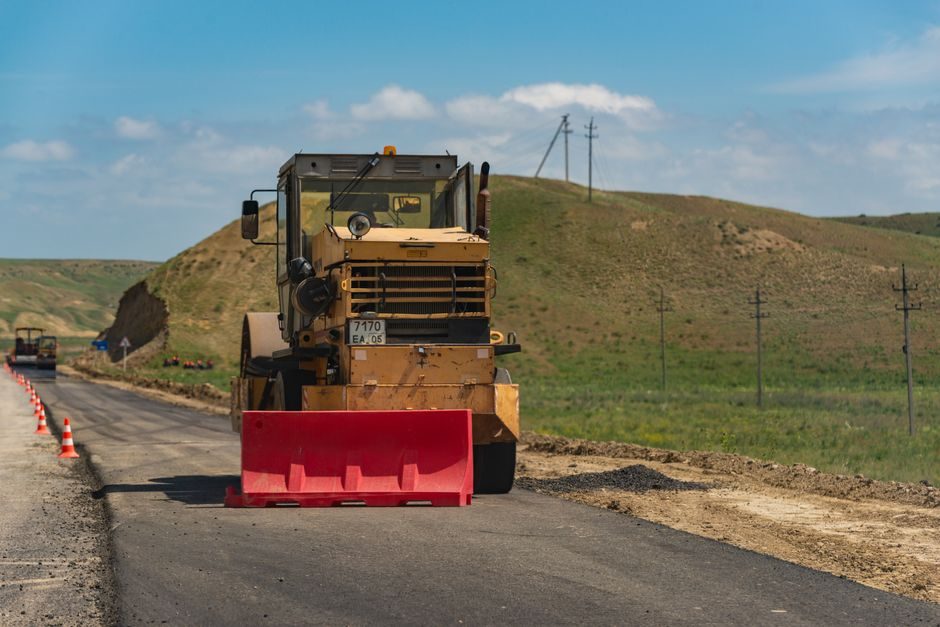
For municipal solid waste (MSW) landfill compaction, a purpose-built 4-corner articulated landfill compactor in the 20-36 t operating-weight class with steel padfoot drums and an elevated, fully enclosed ROPS/FOPS cab is the working baseline; smooth-drum single-drum road roller variants lose traction on waste faces above 600 mm loose-lift and shear studs on the first pass [S1][S2].
Two Chinese OEMs — Luoyang Lutong (LT series, 0.6-22 t, single/double steel wheel, tyre, mechanical and full-hydraulic drive configurations) and Jiangsu Junma (vibratory rollers, road construction machinery line) — list direct-export road rollers into North America, South America and Eastern Europe on their B2B channels as of 2026-07 [S1][S2]. Neither catalogue page lists a true 4-corner landfill compactor with a dedicated waste-handling boom and trash-resistant cooling, which is the first spec filter buyers should apply.
Landfill Duty Cycle vs Highway Compaction
Landfill duty is high-cycle, low-speed, abrasive, and corrosive: typical daily volumes run 800-2000 compacted m³ of MSW with 300-600 mm loose lifts and 4-8 passes per lift, against a 150-300 mm base-lift, 2-4 pass pattern on highway embankment [S1]. The bearing surface is a mix of soil, plastic, glass, rebar and construction debris, which contaminates articulation roller bearings, radiator cores and hydraulic suction lines far faster than sub-base stone.
Operating weight in landfill work scales with waste density rather than layer thickness: 20-26 t units suit daily-cover and small transfer-station cells below 5,000 m³/day, while 28-36 t four-corner units (e.g. the compactors built on the same chassis platforms as 14-18 t wheel loaders but with rear steel wheels) are the standard for cells above 10,000 m³/day. Lutong's published LT range tops out at 22 t, putting the upper landfill class outside their listed catalogue at the 2026-07 query date [S1].
Spec Gates for a Landfill-Grade Compactor
Five hard gates separate a landfill compactor from a highway road roller and they must all be cleared before price is discussed. First, articulation: 4-corner articulated chassis with ±35-40° frame oscillation and ±80° steering each side, so all four wheels stay on grade across an uneven waste face — 2-corner (tractor-style) machines scuff and crack drum mounts. Second, drum geometry: front and rear steel padfoot drums with 100-150 mm tip height and 4-6 tips per 0.1 m² face area, sized so tip pressure lands in the 800-1,200 kPa range rather than the 300-600 kPa typical of smooth-drum soil compactors. [S1]
Third, guarding: belly plates, sealed articulation joints, and trash-resistant cooling with auto-reversing fans; the radiator fin pitch on a highway compactor (typically 4-6 fins/inch) plugs within hours on a wet waste face. Fourth, cab: elevated to 3.0-3.5 m, ROPS/FOPS per ISO 3471/3449, with a positive-pressure filtered air system and a falling-object guard — sub-2.5 m cabs sit inside the dust cloud. Fifth, powertrain: typically 200-300 kW Tier 4 Final / Stage V diesel, with a fully enclosed hydrostatic driveline (no open cardans over waste) and an exhaust routed up and away from the cab intake. Lutong lists "full fluid drive" as an LT-series option; buyers should confirm that the fluid drive includes sealed hydraulic motors at each wheel rather than a torque-converter-plus-axle layout [S1].
Comparison: Smooth-Drum Soil Roller vs Padfoot vs 4-Corner Landfill

Side-by-side on the four decision gates that actually drive landfill uptime — drum-to-ground contact, frame articulation, cooling package, and cab elevation — the three machine types diverge sharply. A smooth-drum single-drum road roller wins on flat granular lifts but fails on waste above 600 mm loose-lift; a padfoot soil compactor handles clay and rock fills but typically lacks 4-corner articulation and the cab height to clear a landfill dust cloud; only a 4-corner articulated landfill compactor is engineered for the full set. [S1]
On a 0-10 scoring scale where 10 = best fit for daily MSW cover: smooth-drum 2, padfoot soil compactor 5, 4-corner landfill compactor 9-10. On 0-10 for highway embankment work the ranking inverts: smooth-drum 9, padfoot 7, 4-corner 4-5 (over-built, slow, high fuel burn). The crossover is small: a contractor running both waste and embankment cells will usually rent a dedicated landfill unit for the waste face and keep soil rollers on the cover-soil stockpiles rather than compromise one machine across both duties.
Drum, Tip and Compaction Energy
Padfoot tip count and tip height govern compaction energy per pass. On a 1.5 m wide drum, 90-120 tips in a staggered chevron pattern are typical, giving the 4-6 tips/0.1 m² target; this geometry produces the high localised contact stress that breaks clods and shears waste into a denser matrix than any smooth drum can deliver. Static linear load on landfill machines runs 50-80 kg/cm at the drum, against 25-45 kg/cm on a 14 t highway soil roller. [S1]
Vibration is usually disabled or limited to low amplitude (0.3-0.5 mm) on the waste face: high-amplitude vibration on plastic- and glass-rich waste simply shreds the lift and pumps leachate, and most OEM landfill-control software defaults vibration off above a ground-speed threshold. Buyers comparing Junma's vibratory roller line for landfill work should confirm the control logic, because a standard vibratory road roller is calibrated for granular lift behaviour, not for the crossed-roller guide of forces inside a waste cell [S2].
Spare Parts, Drivetrain and Bearing Logistics

Mean time between failures on a landfill compactor is dominated by three subsystems: articulation roller bearings, radiator cores, and the hydraulic suction-side filters. Articulation pivot bearings on a 30 t class landfill compactor are typically sealed spherical roller or tapered roller bearing assemblies rated for the 80-120 kN radial loads at full articulation lock; they should be regreasable, with remote lube lines routed to ground-level service points so a tech is not standing under an unjacked frame. [S1]
For a Chinese-supplied unit, spares logistics for the drivetrain (hydraulic pump, wheel motors, final drives) and the diesel after-treatment are the real long-term risk. Lutong's catalogue page lists 101-200 employees and four sub-factories covering casting/forging, machining, heat treatment and assembly at the Luoyang Airport Industrial Zone site [S1]. Junma's Made-in-China.com profile, registered 2010, lists manufacturing and processing as the business type with road roller and vibratory roller as the main products [S2]. Buyers should request a 5-year parts price list and a critical-kit list (filters, sensor harnesses, aftertreatment cartridges) at RFQ stage, and tie payment milestones to confirmed serial numbers on those kits.
What Landfill Use Is NOT For
Smooth-drum tandem rollers, 2-4 t walk-behind rollers, and 8-12 t pneumatic-tyre rollers are the wrong tool for daily waste-face compaction: they lack tip pressure, they lack ground clearance, and their cooling packages are not trash-rated. Pneumatic-tyre rollers can be useful as a finish pass on cover soil at small transfer stations, but not as the primary waste compactor.
Long-arm dozens and tracked landfill compactors (e.g. purpose-built tracked waste compactors with blade-dozer geometry) sit alongside 4-corner landfill rollers in the spec, not in opposition: dozens push and spread the lift, rollers compact it. Buying a dozens-plus-roller pair sized so each dozer can feed one compactor continuously is the typical fleet ratio, with the compactor carrying the higher hourly operating cost.
For a first-time landfill buyer evaluating Chinese OEM channels in 2026, two trackable signals to watch before signing a PO: (1) a published serial-number-level parts price list for the 5-year horizon, which Lutong's and Junma's B2B pages do not currently display as of 2026-07 [S1][S2]; and (2) a verifiable ROPS/FOPS certification document and Tier 4 Final / Stage V emissions certificate per machine, which must be matched to the chassis serial number at delivery. For related coverage of the highway and port side of the same machine class, see the port compaction spec map; for the bearing and conveyor subsystems that share this market, see the roller chain selection criteria reference.