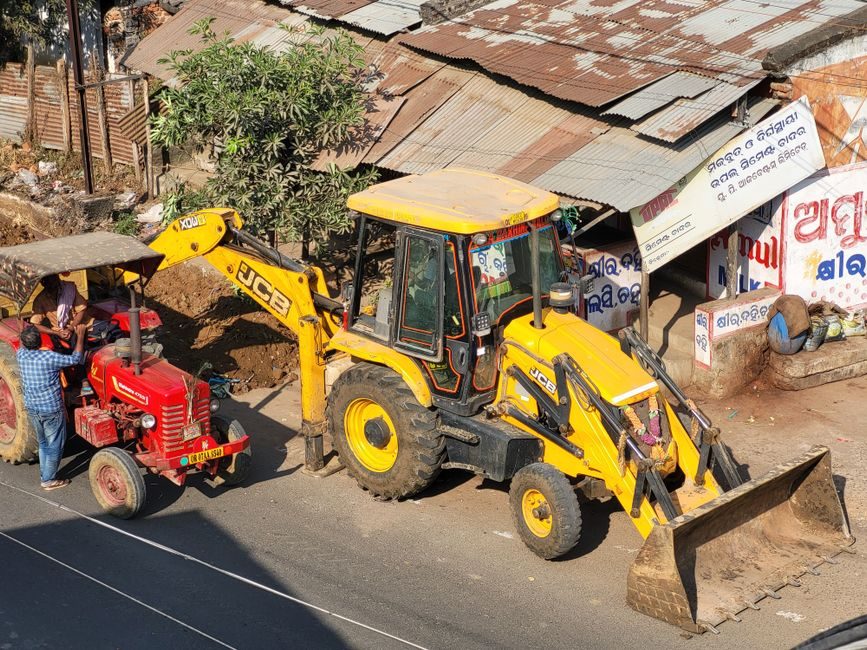
A backhoe loader is a single chassis carrying a front loader bucket and a rear excavator boom, and the global fleet still splits into two distinct frame formats — centre-pivot (sometimes called integral-frame) and side-shift — with the centre-pivot design holding the larger share of units shipped into municipal and rental fleets [S2].
Both formats combine a backhoe loader chassis with a tractor-style centre, so total operating weight generally falls between 5,800 kg on a compact side-shift build and around 10,000 kg on a centre-pivot production unit, with loader buckets rated from roughly 0.8 m³ to 1.5 m³ and backhoe buckets from 0.08 m³ to 0.30 m³ [S2].
Centre-Pivot vs Side-Shift Frame Format
Centre-pivot units carry the rear backhoe on a frame that pivots about the chassis centreline, which keeps the front and rear working envelopes almost symmetrical and gives the highest tearout forces in their weight class — at the cost of requiring the machine to be repositioned for trench work that runs along a wall or kerb [S2].
Side-shift machines mount the rear boom on a sliding carriage that traverses the full width of the rear frame, letting the operator dig close to existing structures without crabbing the whole unit; this format typically loses 200–400 kg of allowable operating weight to the carriage and adds ~150–250 mm to overall width, and the design dominates European municipal tenders where street-works are the dominant application [S2].
Production split between the two formats is fleet-dependent: rental houses in North America favour centre-pivot for parts commonality and higher resale value, while utility and telecom crews in the EU and UK specify side-shift so the backhoe can cut a trench parallel to a footway or curb without blocking the lane [S2].
Operating-Weight Classes and Dig-Depth Envelope
Manufacturer datasheets and dealer configurators group backhoe loaders into four operating-weight classes: compact (5,800–6,500 kg), standard (6,500–8,000 kg), mid-range (8,000–9,000 kg), and large (9,000–10,000 kg) [S2]. Each step up roughly adds 250–400 mm of maximum backhoe dig depth, with the compact class typically reaching 4.0–4.4 m and the large class pushing 5.5–6.0 m at the deepest 24-inch bucket pin.
Loader lift capacity at full height (to pivot pin) tracks operating weight closely, ranging from ~2,500 kg on a 6,000 kg compact unit to ~3,800 kg on a 9,500 kg mid-range chassis, which is the figure operators should check when palletising coping stones or kerb blocks [S2].
For comparison across the four classes on a single set of decision criteria, the typical envelope sits as follows: compact — 5,800–6,500 kg, 4.0–4.4 m dig depth, 0.8 m³ loader bucket, 0.08–0.10 m³ backhoe bucket; standard — 6,500–8,000 kg, 4.4–5.0 m, 1.0–1.2 m³, 0.10–0.18 m³; mid-range — 8,000–9,000 kg, 5.0–5.5 m, 1.2–1.3 m³, 0.18–0.24 m³; large — 9,000–10,000 kg, 5.5–6.0 m, 1.3–1.5 m³, 0.24–0.30 m³ [S2].
Drivetrain, Axle and Tyre Options
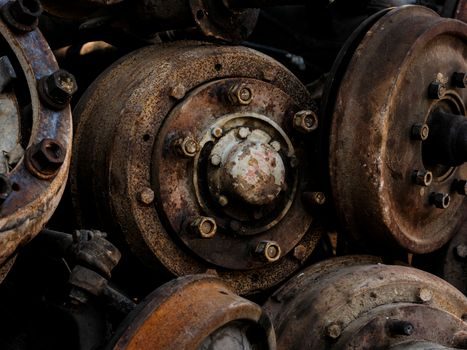
Two drivetrain layouts coexist: 4×2 (two-wheel drive, rear axle driven) used on cost-sensitive compact builds, and 4×4 (all-wheel drive with a centre-drive joint to the front axle) fitted as standard on most centre-pivot units in the standard class and above [S2]. 4WD adds roughly 250–350 kg to operating weight but is required to push a fully loaded loader bucket through soft ground without wheel-spin.
Tyre spec drives the difference between a road-legal site machine and a true off-road unit: 16.9×24 industrial-pattern rear tyres with 12×16.5 front wheels are the common municipal/road-build fit, while 17.5×25 or 19.5×24 agricultural-pattern rear tyres are specified where the unit has to cross soft shoulder or mud; the larger rear rims raise overall transport height by ~80–120 mm and require checking against local bridge-clearance signs [S2].
Engines on current production units run 55–82 kW (74–110 hp) at 2,200–2,400 rpm, with torque peaks in the 300–450 Nm band sized to keep both loader crowd and backhoe swing responsive under load [S2]. Emissions tier depends on the destination market and the build year, so fleet buyers should match engine certification to regional air-quality rules before accepting a unit at port.
Loader End: Bucket Geometry and Lift-Path Choices
The front loader is built around a parallel-lift linkage on premium models and a Z-bar (breakout) linkage on utility/rental models; parallel-lift keeps the bucket angle constant as the arms rise, which protects palletised loads and is the typical choice for material-handling yards, while the Z-bar geometry delivers higher breakout force at ground level and is preferred for excavating stock-piled aggregate [S2].
Return-to-dig and float-down are now baseline on production units, and ride-control accumulators (an optional nitrogen-charged accumulator on the loader lift cylinder) reduce bucket bounce at roading speeds above 25 km/h — worth specifying where machines are towed between sites on a daily basis [S2].
Quick-coupler interfaces on the loader end follow ISO 24410-style wedge couplers in most regions, while the backhoe end runs a 4-pin manual or hydraulic pin-grab coupler; mismatched couplers between machines in a mixed fleet are a recurring source of downtime and should be normalised at procurement [S2].
Backhoe End: Boom, Stick and Bucket Family
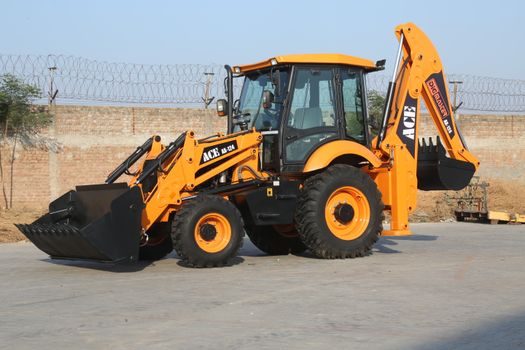
Backhoe booms come in three main profiles: standard (straight), extendable (telescopic stick adds 1.0–1.4 m of reach for deep utility work), and curved (better crowd force at depth) [S2]. The extendable stick variant typically extends dig depth from ~4.4 m to ~5.8 m on a standard-class chassis without moving up a weight class, and is the workhorse for sewer-lateral and water-main crews.
Bucket range on the backhoe covers 0.08 m³ trenching, 0.18 m³ utility, 0.24 m³ standard, and 0.30 m³ high-capacity, with width options from 300 mm (trenching) to 900 mm (grading) and pin-on teeth in HD or extreme-duty variants where ground contains shot rock or demolition debris [S2]. Fleet managers running mixed applications often keep a 600 mm utility bucket as the daily fit and rotate specialty buckets by site.
Hydraulic flow on the auxiliary circuits is typically 60–80 L/min at 200–230 bar on the rear circuit, and a hydraulic thumb (4-finger rigid or articulated) on the backhoe stick extends the unit into demolition and log-handling work that would otherwise need a dedicated excavator [S2].
Specialty Variants: Long-Reach, Loader-Less and Toolcarrier
Three specialty variants sit outside the standard fleet: long-reach backhoes (deep dig up to 7.0 m using a longer boom and stick combination, generally on large-class chassis); loader-less or backhoe-only units (chassis supplied without the front loader to cut transport height and tare weight for confined-site work); and toolcarrier configurations (front loader replaced by a hydraulic tool platform that can carry forks, brooms, or a 4-in-1 bucket) [S2].
Long-reach variants are common in India, the Middle East, and parts of Southeast Asia for canal cleaning and irrigation trenching, while loader-less builds dominate night-time road-works where the absence of a protruding front bucket reduces struck-by risk against passing traffic [S2]. Toolcarrier units are most prevalent in European municipal fleets where one chassis covers kerbing, snow clearing, and street-sweeping duties seasonally.
Specialty variants typically cost 8–15 % above the equivalent standard configuration and have lower residual values, so buyers should weigh that delta against the avoided cost of a second dedicated machine — a calculation that mirrors the broader Motor Grader TCO logic applied to similar mid-size iron on a 10-year service life.
Parts and Aftersales: Where the Real Cost Lives
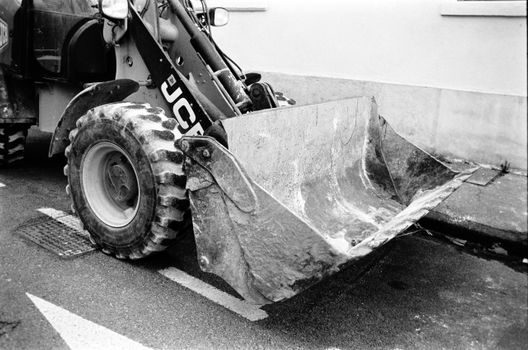
Independent backhoe parts distributors in regional hubs like Ipoh, Perak, supply wear items including absorbers, AC pumps, adapters, adjusters, air cleaners, air hoses, and alternators across mixed makes and models, keeping older fleets that are out of OEM warranty economically serviceable [S1].
Service intervals on a backhoe loader are 250 hours for engine oil and 500 hours for hydraulic filters on most current-production units, with the rear boom pins and the front loader pivot pins as the high-wear joints that drive the lifetime cost of ownership; these items track the same pin-and-bushing logic seen on Road Rollers and on motor graders, so a shared bushing-replacement toolset between machines in a fleet is a sensible investment [S1].
For sourcing decisions between a centre-pivot and a side-shift unit, the rule of thumb is simple: specify side-shift when the dominant work is trenching within 600 mm of a kerb, wall, or barrier; specify centre-pivot when the unit spends more hours on loader work, road maintenance, or stone handling than on trenching [S2].
For aftersales and parts planning, the next node to track is the revision of Tier 4 Final / Stage V emissions documentation on 2025 and later chassis, which is reshaping engine bay packaging and pushing new alternator and air-cleaner part numbers into the channel — distributors carrying the legacy part list will need a cross-reference update before the 2027 calendar year to keep older units in service [S1].
For component-level specifications, see wheel loader, and skid steer loader.