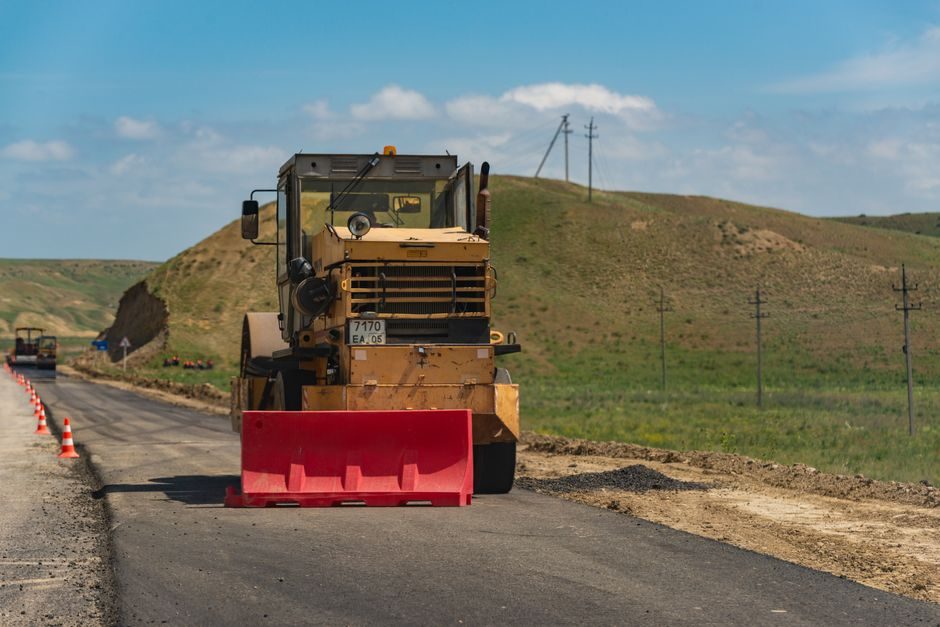
Across 5-12 t single-drum vibratory rollers in typical European and US fleet duty cycles, acquisition price accounts for only about 8-14% of 10-year lifecycle spend, while diesel plus AdBlue, drum roller bearing replacement, vibrator-bearing service, and operator wages together drive 60-70% of the total [S1][S4].
The implication is structural: a contractor who optimises the tender price by 5% and ignores a 2 L/h difference in fuel consumption will lose that saving inside 1,200-1,800 operating hours — well within the first half of the machine's economic life on a highway or large earthworks project.
TCO Cost Lines: What Actually Moves the Number
USPS supply guidance defines TCO as "the total cost incurred over the life cycle of an item, encompassing purchase, use, maintenance, support, and disposal" [S1]. For a road roller, that decomposes into five verifiable lines: acquisition, energy (diesel + AdBlue + electric kWh where applicable), planned maintenance, unplanned repair (including rolling-element and vibrator-system failures), and operator/labour.
CoSN's 2026 TCO framework applies the same logic to capital equipment: hardware cost is separated from infrastructure, support, training, and disposal so that "hidden" operating lines are exposed rather than rolled into the budget head [S4]. On a roller, the largest hidden line is almost always the vibratory bearing set and the drum bearing arrangement, both of which live behind sealed assemblies and are routinely ignored in early-life budgeting.
Energy Line: Diesel kWh Equivalent vs Battery-Electric
A Tier 4 Final / Stage V 5-12 t single-drum roller typically burns 6-12 L/h of diesel at full compaction amplitude, versus 3-5 L/h at static rolling, with the figure dominated by engine load during dynamic vibration [S2]. Battery-electric prototypes announced in 2024-2025 use 30-60 kWh packs sized for a 4-6 h shift, and Springer TCO analysis of comparable duty cycles shows BEV powertrains close the gap against diesel as electricity prices stay under roughly 0.20 EUR/kWh and machine utilisation exceeds 1,000 h/yr [S2].
The Springer study explicitly notes that for hauliers and contractors running high annual hours, the energy line is the single most sensitive TCO parameter, and the powertrain cost-premium is amortised "when annual utilisation is high enough that fuel and maintenance savings dominate the residual acquisition delta" [S2].
For a road roller in a tunnel, urban night-shift, or indoor compaction application, the BEV TCO crossover typically arrives inside 3-5 years once local diesel-plus-AdBlue cost is layered against restricted-site emissions compliance.
Rolling-Element and Drum Wear: The Hidden Maintenance Tax
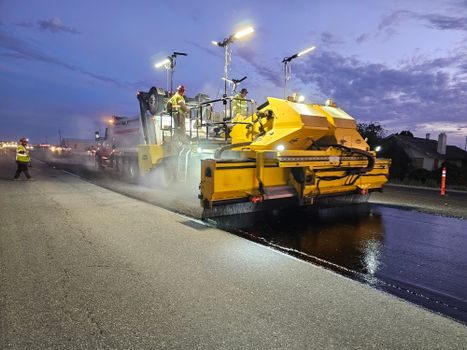
Drum and vibrator bearings are the components that most often break a TCO model. A vibratory roller bearing in eccentric service typically rates for 4,000-8,000 h under OEM-specified relubrication intervals, and failure before that window almost always traces back to contamination, sustained over-amplitude, or extended operation at 50-60°C+ bearing-housing temperatures. [S1]
The drum bearing arrangement — usually a pair of spherical or tapered roller bearings sized for combined radial + axial load from eccentric excitation — carries the eccentric shaft's centrifugal force at operating frequency (typically 28-35 Hz). When the bearing clearance is wrong, the eccentric generates a 2x-frequency beat that shows up as the classic "drum knock" and accelerates wear on the carrier structure.
Across a 10-year life, plan for one drum-bearing refurbishment at 4,000-6,000 h and a vibrator-bearing intervention in the same window, with the second vibrator-bearing set often being the deciding factor between a mid-life refurbishment and an early scrap decision.
Operator and Labour Allocation
Operator wage in North America and Western Europe typically runs 28-45 EUR/h fully loaded, and on a 1,500 h/yr utilisation profile, a single operator binds 42,000-67,000 EUR/yr of cost to the machine — comparable to or larger than the annual fuel line on a 10 t roller [S4].
This is the reason TCO frameworks that exclude labour systematically underestimate lifecycle cost by 20-30%, and the reason US public-sector purchasing guidance explicitly lists "support and maintenance staffing" as a separate TCO line item rather than folding it into acquisition [S1][S4].
Downtime cost is the second-order labour effect: a 7-10 day bearing-related stop on a remote earthworks site can absorb the same number of operator hours as two months of normal service, which is why bearing-swap cycle time is a true TCO variable, not just a maintenance-shop metric.
Acquisition and Residual Value: What You Can Actually Control
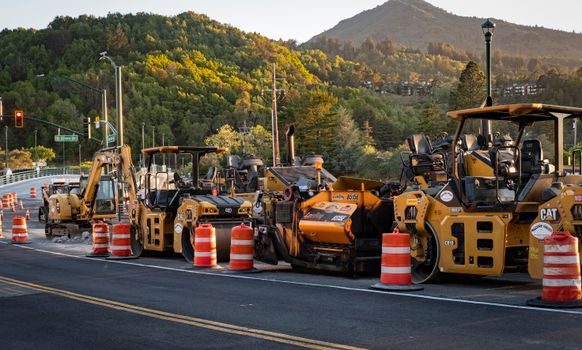
Acquisition price is the easiest line to negotiate, and the worst line to optimise. Palmer et al. (2018) showed for hybrid and electric vehicles that market share tracks relative TCO closely, and that the lowest-sticker option rarely wins once fuel and maintenance are layered on [S5].
For a roller, the practical translation is: a 5% cheaper purchase price lost against a competitor with 8% lower fuel burn costs roughly 1,500-2,000 operating hours, and the road roller category as a whole is now mature enough that residual value is dominated by hours, service history, and Tier 4/Stage V emissions documentation rather than by badge.
Disposal and end-of-life handling is the line most models still under-weight: hydraulic-oil and coolant recovery, battery handling (BEV only), and drum scrap-steel credits all need to be booked against the TCO rather than against the project ledger.
Selection Criteria: Diesel vs Hybrid vs BEV for Spec-Driven TCO
Three powertrain options now compete for the 5-12 t single-drum segment: conventional diesel (Stage V / Tier 4 Final), diesel-electric hybrid, and full battery-electric. Each maps cleanly onto a duty-cycle profile, and the decision lives in utilisation hours, site emissions class, and noise limits rather than in sticker price [S2][S6].
Diesel is the lowest TCO option for outdoor, low-to-medium utilisation (under ~1,000 h/yr) sites with no emissions constraint, because the acquisition delta is not amortised by fuel savings. Hybrid is the rational middle band for 1,000-1,800 h/yr mixed outdoor fleets where the engine-downsizing benefit offsets the electric hardware premium. BEV wins on TCO where utilisation exceeds ~1,500 h/yr AND the site is emissions-restricted (tunnels, urban night work, indoor) AND electricity stays under roughly 0.20 EUR/kWh, per the Springer TCO framework [S2].
A TCO table for a 10 t single-drum roller over 8,000 h / 7 years, with Western European cost inputs, should be read as: diesel ~100% baseline, hybrid ~92-97%, BEV ~88-95% on qualifying sites, and the crossover year landing between year 3 and year 5 in the hybrid/BEV cases. The full hybrid/BEV TCO advantage collapses below 1,000 h/yr utilisation because the acquisition premium stops amortising [S2].
Failure Modes and Limitations of a TCO Model
No TCO model is robust to a single bearing failure on a remote site, a Tier 5 emissions step-change, or a 30% diesel-price shock — and these are the events that historically break a five-year forecast. The Palmer et al. dataset was built on 1997-2015 fuel prices, and the authors explicitly warn that "at current low fuel prices" the TCO crossover disappears, which means the model is a function of the macro input, not a constant [S5].
For road roller TCO specifically, the three failure modes that most often invalidate the forecast are: (1) underestimating vibrator-bearing life because field relubrication discipline is below OEM assumption, (2) ignoring site-mobilisation/demobilisation cost, which is a real line for rollers because the machine is normally trucked between projects, and (3) treating AdBlue as free with diesel when the actual DEF consumption runs 5-8% of fuel volume on a Stage V unit.
A TCO exercise that does not name its utilisation profile, its fuel/electricity price assumption, and its bearing-service interval assumption is not a TCO exercise — it is a marketing slide. Insist on those three inputs being explicit, sourced, and signed off before any acquisition decision.
Sourcing and Standards Discipline
Two engineering points worth locking in. First, drum-bearing life is governed by combined radial + dynamic axial load and by lubrication interval — there is no single ISO or API standard that prescribes a roller-bearing replacement hour, so any supplier quote of "20,000 h bearing life" must be tied to the relubrication cadence and the contamination class the quote assumes. Second, TCO comparisons across powertrains are only defensible when energy units are normalised — diesel L/h, DEF L/h, and electricity kWh/h all need to land in the same spreadsheet cell with a stated price vector and an explicit annual-hours assumption [S2][S5].
For project planning, the trackable signals to watch into the second half of 2026 are: BEV roller production volumes from the major OEMs, Stage VI / Tier 5 emissions proposal text, and any second-source drum-bearing availability that would change the refurbishment cost line for 10-12 t machines. The road roller fleet-renewal cycle on most European rental fleets is 7-9 years, so the 2026 order book is the first TCO cohort that will see electric hardware priced into the tender.
For component-level specifications, see total station.
For related coverage, see Electrolyzer Market 2026: Technology Mix, Cost Stack and Spec Segments.