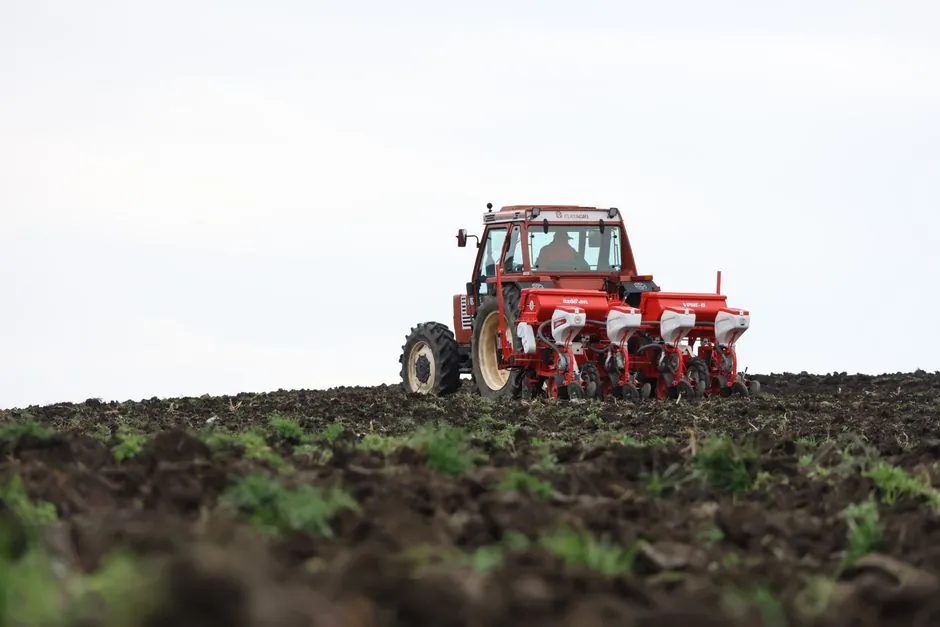
For tractors, combine harvesters, seeders, and rotary implements, the practical bearing family is the insert ball bearing (UC series) and its housed cousins UCP/UCF/UCFL, with deep-groove 62xx and 63xx series in non-housed positions, all running sealed-for-life with grease packed at the factory [S3].
On 2026-08-09 the agriculture-bearing category on Made-in-China.com lists 60 manufacturers and 180 stock SKUs, with UC305–UC312 insert bearings priced at US$0.50–2/piece (MOQ 100) and UCP204 cast-steel flange units at US$1–10/piece (MOQ 1) [S3]. Ball-bearing supply for ag use is concentrated in Shandong (Jinan, Qingdao) and Tianjin, with Tianjin Semri distributing SEMRI and TFN brands to more than 130 countries [S1].
Why insert ball bearings, not generic deep-groove
Insert ball bearings (UC-series) use a spherical outer race that mates with a pressed-steel or cast-iron housing, allowing static misalignment of roughly ±2° to absorb frame flex, PTO twist, and implement deflection on rough ground [S3]. The alternative, a precision deep-groove ball bearing with a 1:12 tapered bore on an adapter sleeve, offers higher speed and accuracy but costs more per unit and is harder to replace in the field, which is why UC-series dominates ag use cases where downtime matters more than rotational precision [S1]. For ag hubs and disc blades where a housed unit is impractical, the 62xx/63zz family (e.g. 626zz at US$0.10–0.80 per piece, MOQ 100) is the typical fallback [S2]. Mounted insert bearings also accept shaft tolerances of h6 to h8, the same range common in electric motors, simplifying the maintenance stock point for mixed fleets of tractors, augers, and motor-driven pumps [S4].
Loads, speeds, and the dust/moisture envelope
Ag bearings face three loads at once: radial (shaft weight + belt tension), axial (PTO thrust, hillside tilt, disc-blade reaction), and shock (rocks, root wads, wheel hop). Tapered roller bearings carry higher combined loads but are more sensitive to installation preload, so for low-to-medium load nodes (disc openers, idler pulleys, fertilizer-coulters, smaller mower decks) the radial load rating of a UC205/UC206 insert (roughly 14–19.5 kN dynamic, depending on maker) is typically enough [S3]. Continuous operating speed is bounded by seal friction: 2RS (rubber-contact) inserts usually cap at 3,000–4,500 rpm, while 2Z metal shields can run faster but lose dust protection, the wrong trade for soil-side and PTO-side positions. For environment severity, dust ingress is the primary killer; a 2RS contact seal on both faces plus a slinger or shield on the shaft side is the standard ag configuration, and grease is typically lithium-based or calcium-sulfonate with a polyurea thickener for water resistance in fertilizer or slurry service.
Material, seal, and grease options for ag conditions
Bearing rings and balls are case-hardened carbon-chromium steel (AISI 52100 / DIN 100Cr6) as standard; stainless (AISI 440C) appears only in corrosive fertilizer or manure-handling equipment, where 2–3× cost is justified by elimination of rust-induced pitting. Seals fall into four practical tiers: open (no seal, regreasable), 2Z metal shield (low friction, no dust protection), 2RS rubber contact (best dust/moisture, higher drag), and the triple-lip "agri-seal" molded cover used on premium UC-series for slurry or manure spreaders. Greases range from general-purpose lithium (NLGI 2, drop point ~190°C) to calcium-sulfonate (NLGI 2, water-resistant, drop point ~300°C); high-temperature polyurea greases are used in bearings close to engine manifolds or exhaust. For organic-dust service (grain augers, hay balers), food-grade NSF H1 grease is sometimes mandated to keep contamination out of the harvest stream, a spec gate detailed in the food-grade selection map for bearings. [S1]
Size series, common bore codes, and cross reference
The UC insert series is metric and follows a clean bore code: UC201 = 12 mm, UC202 = 15 mm, UC203 = 17 mm, UC204 = 20 mm, UC205 = 25 mm, UC206 = 30 mm, UC207 = 35 mm, UC208 = 40 mm, UC209 = 45 mm, UC210 = 50 mm, with UC305–UC312 stepping up the OD and load for heavier shafts (UC312 takes a 60 mm bore) [S3]. Housed equivalents add a letter for the housing shape: UCP = pillow block, UCF = 4-bolt flange, UCFL = 2-bolt flange, UCFC = round flange, UCPA = pressed-steel take-up. Inch-bore inserts use the same UC prefix with a "-12" or "-16" suffix (1/2 in and 1 in respectively) so UCP204-12 fits a 3/4 in shaft, a common ag PTO stub. When matching a worn unit, measure the bore with calipers and the OD across the spherical seat before ordering: OD values step in roughly 47, 52, 62, 72, 80, 85, 90, 100 mm across the UC2xx and UC3xx families.
Sealed vs regreasable: which ag stations need what
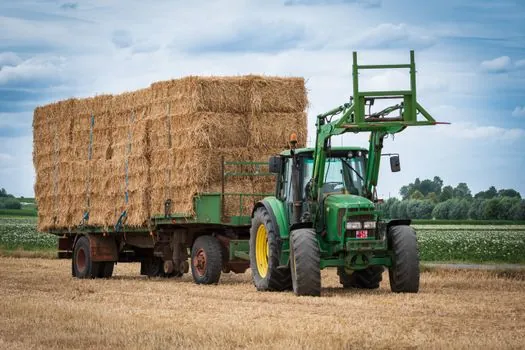
Sealed-for-life 2RS inserts suit inaccessible stations: disc-opener gauge wheels, seed-meter drives, idler pulleys inside belt guards, and combine header sprockets. Regreasable (open or shielded) inserts suit high-cycle or shock-loaded stations: primary tillage disc bearings, large mower spindles, and baler crank shafts, where a grease nipple lets the operator purge water and contaminants every 50–100 hours. A common ag failure mode is grease channeling in over-packed sealed bearings, where the grease cannot re-distribute and temperatures spike; a smaller fill (roughly 30–50% of internal free volume) plus a polyurea or calcium-sulfonate grease extends life. A practical rule: if the bearing sits within arm's reach of the operator platform and has a grease zerk route, regreasable; if it requires removing a guard or working under the implement, sealed. [S2]
Selection checklist before you order
Step 1, define the load: peak radial kN, peak axial kN, and shock severity. Step 2, define the environment: dust level, water exposure, chemical exposure (fertilizer, manure, lime), and temperature range. Step 3, pick the series: UC2xx for light/medium (up to ~20 mm shaft), UC3xx for medium/heavy, UCP/UCS for housed, deep-groove 62xx/63xx for non-housed high-speed. Step 4, pick the seal: 2RS for most ag, 2Z only if dust is filtered, agri-seal for slurry, open + zerk if regreasing is feasible. Step 5, pick the grease: lithium for general, calcium-sulfonate or polyurea for hot/wet, NSF H1 for harvest-stream contact. Step 6, source: Shandong and Tianjin suppliers dominate; confirm ABMA/ISO 15 dimensional conformance and request material certificates for 52100 rings. Step 7, install on a clean shaft with a sleeve, set screws tightened to maker torque, and lock with a face-mounted washer or eccentric collar to stop creep. [S2]
Comparison table: insert ball vs deep-groove vs tapered in ag service

Three options cover most ag bearing positions, each with a different trade-off. Insert ball bearings (UC/UCP series) carry moderate radial and light axial load, allow ±2° static misalignment, run sealed-for-life in stock form, and are field-replaceable without presses; typical ag use is disc openers, idler pulleys, and pillow-block shafts [S3]. Deep-groove ball bearings (62xx/63xx with 2RS) carry moderate radial and moderate axial load (in either direction), are intolerant of misalignment beyond a few minutes of arc, and need a press fit plus shouldered shaft; typical ag use is electric-motor shafts on pumps, fans, and small auger drives [S2]. Tapered roller bearings carry high radial and high axial load in one direction, are highly sensitive to preload, and need a press plus skilled setup; typical ag use is wheel hubs and final drives where load dominates over speed. For ag applications where downtime matters more than precision, insert ball bearings are the right default; the same logic appears in adjacent spec maps such as the material-handling ball-bearing selection guide and the broader ball-bearing encyclopedia entry for general envelope data.
Failure modes and field signals to watch
Four failure modes account for most ag bearing write-offs. Contamination ingress: 2RS lip cuts or hardens, dust grinds the race, premature spalling; field signal is grey-black grease leaking past the seal. Grease degradation: high temperature or water wash-out drops the base-oil viscosity, the bearing runs hot and the cage wears; field signal is brown, thin, or emulsified grease at the seal. Misalignment-induced edge loading: the inner race brinells on one side, vibration climbs, fatigue flaking starts; field signal is the bearing running noticeably louder at low speed. Shaft creep: a loose set-screw lets the inner race spin on the shaft, fretting corrosion and rapid wear; field signal is a polished, scored journal under the inner ring. A quick gauge: temperature at the housing above ~80°C steady state or 15°C above neighboring housings under the same load is the first numerical warning to pull and inspect. [S1]
Sourcing and supply signals in mid-2026
Ag-bearing supply is buyer-favorable in mid-2026: 60+ Chinese factories list agriculture-specific bearing lines with multi-SKU catalogues, MOQs from 1 to 1,000 pieces, and FOB unit prices between US$0.10 and US$30 depending on type and size [S2][S3]. Two structural signals to track through the rest of 2026 are the spread of agri-seal triple-lip inserts (premium pricing but rising on slurry and manure equipment) and the push by Shandong suppliers toward OEM/ODM custom bore codes for the major ag-OEMs replacing their legacy inch-series pillow blocks. Cixi Kent Bearing, a two-year-verified Zhejiang supplier, is one of the newer entrants marketing dedicated ag-machinery ball-bearing lines, indicating continued capacity build-out at the lower-priced end of the segment [S4]. For spec cross-checks, the ball bearing encyclopedia page lists the standard 62xx/63xx dimensional and load envelope behind most of the metric series referenced here, while adjacent ball bearing selection for material handling covers the heavier conveyor and roller-table side of the same component family.
Spec-level background on the components involved: ball screw, and ball spline.