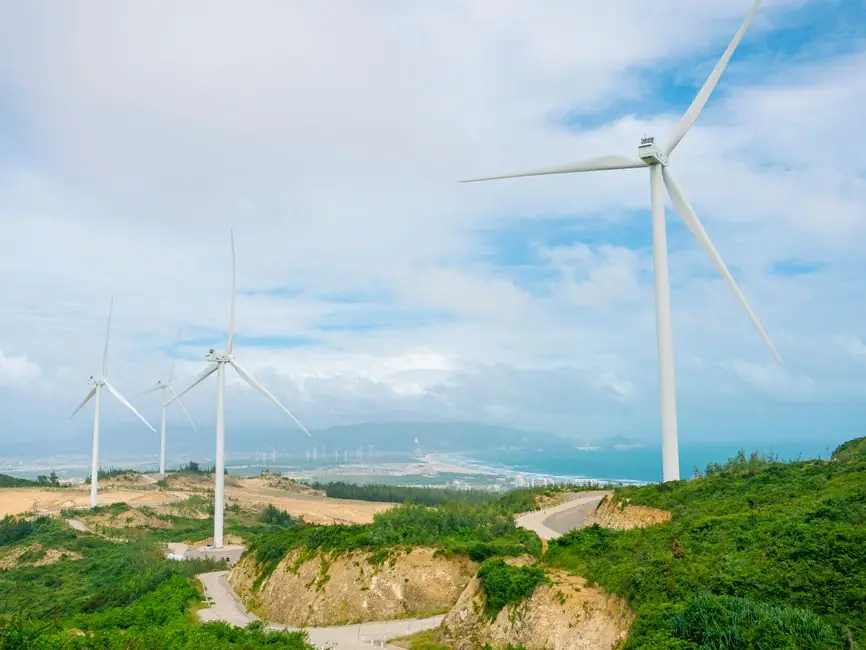
Wind turbine bearings span four functional classes: main shaft, gearbox, generator, and yaw/pitch slewing, with the rotor-side units taking the harshest combined axial-radial-moment loading and driving most of the spec discussion [S1][S4].
The supply chain remains dominated by Chinese ODMs offering 1,000-set monthly capacity for slewing rings and four-point contact ball bearings sized from 3.175 mm to 25.4 mm ball diameter, while global Tier-1 references continue to anchor the design baselines [S4][S5].
Load profile and bearing type mapping for turbine stages
A 3 MW onshore class unit imposes roughly 1.5-2.5 MN equivalent dynamic load on the main shaft bearing and 0.3-0.6 MN per planetary stage on the gearbox, which is why four-point contact ball bearings and double-row tapered roller bearings compete for the main-shaft slot while deep groove ball bearings stay restricted to generator and pitch-motor service [S4][S1].
Yaw and pitch drives overwhelmingly specify four-point contact ball slewing bearings or double-row different-diameter ball slewing bearings, with crossed roller variants reserved for nacelle applications requiring higher moment stiffness [S5]. For a side-by-side view of how the four main variants stack up on the criteria that matter, the table below distills the engineering tradeoffs: ball bearings in deep-groove geometry stay the cheapest, while slewing and four-point types trade cost for combined-load capacity.
Material, lubrication, and sealing gates for 20-year service
Through-hardened 100Cr6 / SUJ2 chrome steel remains the default ball and race material, with case-hardened 16MnCr5 or 20MnCr5 used for large ring gears to balance core toughness against surface fatigue resistance on rings above 1 m diameter [S4].
Grease life is the binding constraint: lithium-complex or polyurea base greases with PFPE fallback for offshore units must hit the re-lubrication interval that the OEM publishes, and the typical design target is a 17,500-hour L10 grease life matched to a 175,000-220,000 hour L10 bearing life under turbine ISO 281 load spectra [S4][S1]. For guidance on how a ball spline interfaces with the gearbox when the rotor uses an integrated drivetrain, refer to the related engineering note.
Sealing is where most field failures initiate: two-piece nitrile or fluoroelastomer contact seals plus an outer dust lip are now standard for onshore units, while offshore turbines specify labyrinth + sealed-for-life construction with epoxy or zinc-flake coating on exposed ring faces.
Supplier landscape: Tier-1 anchors, Chinese ODMs, and the ZWZ breakthrough
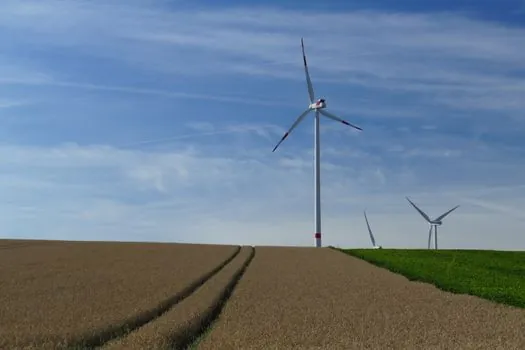
The historic wind-bearing oligopoly (SKF, FAG/Schaeffler, NSK, NTN, Timken) still holds the high-MW offshore and gearbox high-speed-shaft slots, but the 2022 milestone where ZWZ broke into domestic main-shaft bearing supply shifted where Chinese project owners can source [S3].
Today's sourcing channels split into three layers: global Tier-1s for critical LCC contracts, Chinese dedicated wind-bearing plants (Dalian United Wind Power Generation Bearing, UWE brand, TBB) for slewing and main-shaft rings, and trading platforms such as Made-in-China and DHgate for replacement-class deep groove ball bearings in the 3-25.4 mm ball range used in pitch and yaw motors [S1][S4][S5]. TBB Bearing, operating since 1998 with access to over 3,000 Chinese manufacturers, markets itself explicitly into the wind-power segment alongside automotive and agricultural lines [S1].
For a parallel decision frame on the rolling-element components upstream of the main shaft, the linear bearing RFQ for packaging retrofits walks through the same nine-line spec block approach that procurement teams can re-use for slewing-ring tenders, while the packaging-line ball bearing selection guide covers the same deep-groove and angular-contact families used in pitch motors.
Specification gates that actually block or release an order
Five gates consistently decide whether a wind bearing RFQ proceeds: (1) dynamic load rating C matching the site-specific wind class IEC 61400-1 load case, (2) L10 life above 175,000 hours, (3) raceway hardness 58-62 HRC with retained austenite controlled, (4) grease relube interval declared on the nameplate, and (5) surface finish below 0.2 micrometre Ra on the raceways [S4].
Beyond those, documentation gates (material certificates per EN 10204 3.1, ISO 9001 plus ISO 14001 for the plant, and IEC 61400-4 design verification for the bearing subassembly) carry equal weight with utility procurement and must be priced into the quote from day one [S4]. For OEM buyers comparing capacity in the slewing class, Dalian United Wind Power publishes a minimum order of 1 set with rated monthly output of 1,000 sets and accepts L/C and T/T settlement through ECVV [S5].
Failure modes, constraints, and what not to specify

White etching cracks, false brinelling at standstill, and axial cracking from ice-load spikes are the three dominant field-failure modes for wind ball bearings, and each one rules out a specific bearing family or material choice before the test program even starts [S4].
Specifying a deep groove ball bearing for the main shaft, or a four-point contact ball bearing for the gearbox high-speed stage, are the two most common errors seen in retrofit RFQs: the first fails by axial overload within a few thousand hours, the second by cage stress at DN above 1.5 million [S4]. For comparison, the same DN-constraint logic drives ball screw selection in machine-tool retrofits, where high-DN service demands a return-tube or end-deflector design rather than an external circulation block.
Lead time is the binding commercial constraint: large slewing rings above 2 m diameter carry 6-9 month lead times from Chinese ODMs and 9-14 months from Tier-1 suppliers, so any retrofit that aims for a single summer installation window must be ordered in the prior Q4 [S1][S5].
Standards, traceability, and the test data package
Wind ball bearings are governed by ISO 15 for boundary dimensions, ISO 76 for static load rating, ISO 281 for dynamic load rating and L10 life, and ISO 15243 for failure-mode classification, with IEC 61400-1 wind-class load cases feeding the input spectrum that drives the rating calculation [S4].
Material traceability to EN 10204 3.1/3.2 certificates, ISO 9001 quality system registration at the producing plant, and a documented PPAP-style first-article test report covering dimensional, material, hardness, and runout results are the minimum paperwork that utility-scale buyers now require, and the Chinese ODM tier has caught up on most of these [S1][S5].
Trackable signals for the next six months: (a) new offshore 15 MW+ prototypes will force main-shaft bearing diameters above 3.5 m, where only a handful of global foundries can pour the ring forging, and (b) any Chinese main-shaft bearing that wins a Type-C IEC 61400-4 verification for onshore 6 MW+ class will reshuffle the 2027 retrofit market.