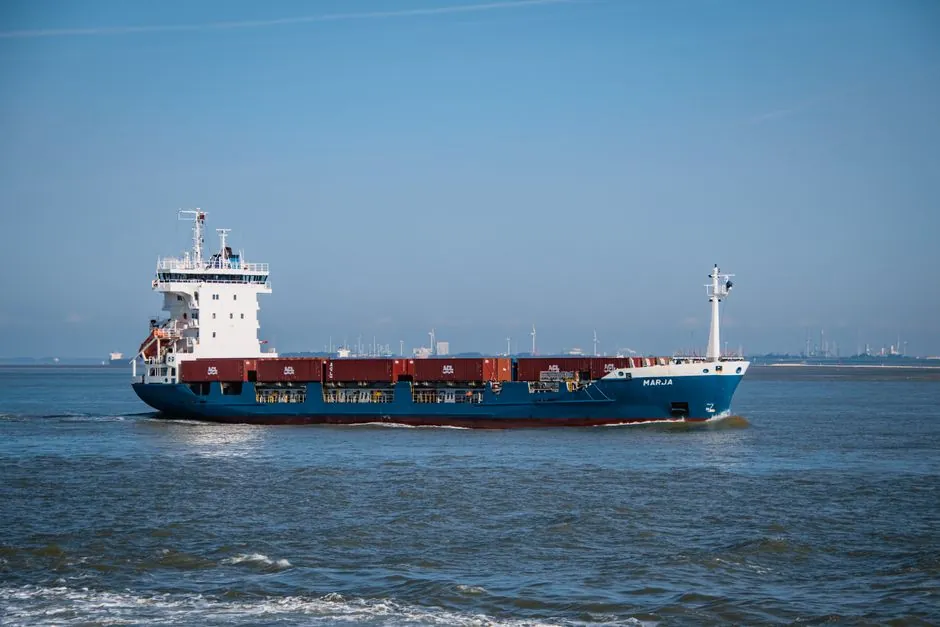
Three Chinese bearing lines now list marine-relevant variants: SEMRI (Tianjin, est. 2005, 130+ countries) covers deep groove, self-aligning, and ceramic ball families [S1]; HAXB (Jinan) covers ball, roller, ceramic, and stainless families with rotation speeds above 25,000 rpm on its high-speed motor range [S2]; Ningbo Jinpeng covers 3-60 mm bore 6000-6012 / 6200-6212 / 6300-6312 / 6400-6412 / 6800-6806 / 6900-6906 / 607-609 / 624-629 in RS, Z, ZZ, 2RS, NR variants [S3].
Material choice: chrome steel, stainless, ceramic
For above-deck, intermittently wetted service (winches, capstans, mast sheaves), 440C stainless races with 316 stainless or nylon cages are the default, while 304/316 stainless balls and races are reserved for low-load trim-tab and instrument pivots where L10 life above 5,000 hours is not required [S2][S4].
ASMI and FreeRun both list ceramic-hybrid ball lines alongside stainless lines, so procurement can hold two qualified part numbers per bore size [S4][S5]. A practical procurement rule from the Chinese supply base: if the unit ships with an RS/ZZ/2RS rubber seal and a nylon or 316 cage, it is the marine SKU; if it ships metal-shielded only (Z), it is a dry-deck or industrial SKU [S3].
Bore range, closure, and clearance gates
Standard marine bores cluster at 8-50 mm: Ningbo Jinpeng's marine-useful 6200 and 6300 series (20-65 mm OD) cover most small winch and pump motors, while the 6000 series (26 mm OD on the 6200) handles instrument and control linkages [S3]. HAXB's non-standard 608 injection-moulded pulley and galvanised 608 are typically specified for custom marine hardware, and the 626 carbon-steel bearing is the default for small electric-motor frames [S2].
Closure selection: 2RS (rubber seal both sides) is the marine default for radial loads under 70% of dynamic load rating, 2RZ (low-friction non-contact seal) is preferred for high-speed pump motors above 12,000 rpm where seal drag heat would push grease past 130 °C, and ZZ metal shields are only acceptable inside sealed gearboxes and motor housings [S1][S2]. Internal clearance must be C3 minimum for any bearing fitted to a shaft running through a hull penetration where ambient swing exceeds 20 °C; C4 is reserved for stern-gear auxiliaries where the shaft can reach 90-110 °C in tropical surface water [S2].
Class society approval and DNV-GL/ABS scope
For classed vessels, the bearing itself rarely carries a wheel-mark: approval is on the assembly (pump, motor, gearbox, winch). The bearing supplier provides material certificates, dimensional reports, and endurance test data to the assembler, who then submits the assembly to ABS, DNV, LR, BV, or CCS [S1][S2]. SEMRI documents a quality system that supports this certificate chain through "strict quality control" plus foreign-technology licensing for E and E1-type roller bearings, which is the same documentation pattern assemblers use to feed class society packets [S1].
For non-classed workboats, fishing fleet, and harbour craft, the gate is simpler: a recognised brand with traceable heat lot, 2RS seals, C3 clearance, and either stainless or ceramic-hybrid material is the procurement floor. The 440C variant remains the cost-optimised default; Si3N4 hybrid is specified only where L10 life above 40,000 hours is contractually required [S2][S4].
Application-to-bearing map
Selection logic by application: (a) main engine auxiliaries (sea-water pumps, lube-oil pumps) = 6204-6206 2RS C3, 440C races, nitrile seals; (b) deck machinery (winch, capstan, windlass) = 6206-6212 2RS C3 with 316 cage, or ceramic-hybrid at >5 kW continuous; (c) steering gear and rudder carrier = 6309-6312 2RS C4 with 316 or Si3N4; (d) ventilation and HVAC fans = 608-6203 ZZ or 2RZ, dry-deck application [S1][S2][S3]. Bearing selection for steel mills uses a similar C3/2RS gate but with higher-temperature grease; the marine version uses a salt-water-resistant EP2 polyurea or calcium-sulfonate grease instead related: [Ball Bearing Selection for Steel Mills: Load, Heat, and Contamination Gates].
Where the application is also cement-plant adjacent (e.g. port-side cement handling conveyors), the marine variant follows cement-plant spec plus seal upgrades, since the wash-down regime is the dominant failure mode rather than dust related: [Ball Bearing Selection for Cement Plants: 2026 Spec Map]. For wind-turbine marine installations (offshore substations, floating turbines), the wind-power spec map applies on top of the marine corrosion gate related: [Ball bearing selection for wind power: 2026 spec gates and supplier map].
Supplier landscape and lead-time signals
SEMRI exports to 130+ countries from Tianjin and lists CC, CA, MB, E, and E1-type roller and ball products aimed at replacement-brand sales channels [S1]. HAXB (Jinan Rockway) focuses on medium- and high-end ball and needle roller SKUs, with the brand positioned for OEM motor accounts rather than aftermarket [S2]. Ningbo Jinpeng operates as a GoldSupplier-listed trading-company-plus-manufacturer hybrid, with North America, South America, and Eastern Europe as primary export lanes, and is the practical choice for sub-1,000-piece orders of 6000-6900 series [S3].
The underlying component specifications are covered under ball bearing, ball screw, and ball spline.