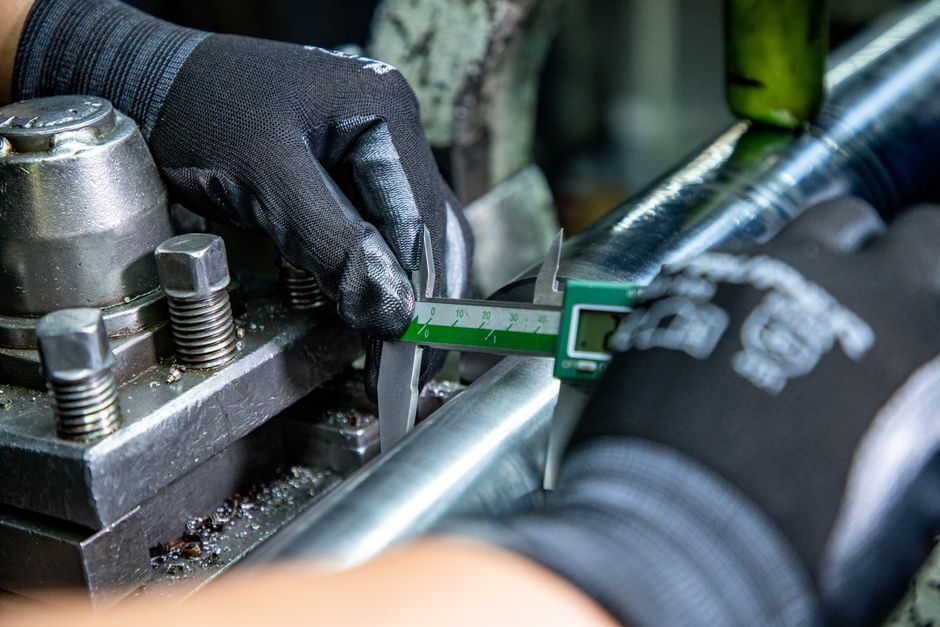
A complete ball screw build route runs from bar-stock preparation through thread forming (rolling for commercial grades, grinding for precision classes), heat treatment, nut machining, ball-track lapping or grinding, ball loading, and preload verification — the sequence that turns a 50-mm-diameter alloy-steel blank into a sub-5 µm/300 mm lead-accuracy actuator used in CNC machine tools, semiconductor steppers and surgical robots [S2].
The two product families most engineers meet are rolled ball screws and ground ball screws; the forming method, achievable lead accuracy, lot size and unit cost are the four variables that decide which route a given motion axis is built on. For a deeper primer on the part itself, see the ball screw encyclopedia entry, which covers geometry, load rating and the difference between internal and external ball returns.
Route Selection: Rolled vs Ground, and Where Each Fits
Rolled ball screws are produced by cold-forming a pre-hardened bar between profiled dies; the process is fast, material-efficient and suited to high-volume production of commercial-grade screws with typical lead accuracy in the 50 µm/300 mm range [S2]. Ground ball screws start from a soft-annealed blank, are rough-machined, then thread-ground on a precision grinder to reach precision-grade lead accuracy (commonly C0–C3, i.e. 4–12 µm/300 mm on smaller diameters) required by machine-tool and metrology axes [S2].
For motion engineers, the practical decision matrix is straightforward: rolled screws win on cost, lead time and minimum order quantity for transfer lines, general automation and replaceable axes; ground screws win on lead accuracy, rigidity and fatigue life for CNC feed drives, semiconductor handlers, and any axis where lost motion must stay below one encoder count. Steinmeyer's product line explicitly separates "Rolled Ball Screws" from "Precision Ball Screws" and "Ultra Thrust Ball Screws" along this forming-method and load-capacity axis [S2].
Process Map: Blank Prep, Thread Forming, Heat Treat, Finish Grinding
The first gate is metallurgy. Bearing-grade alloy steels such as 50CrMo4 (DIN 1.7228) and 100Cr6 (DIN 1.3505) are the typical bar choices because of their deep-hardening response and dimensional stability after quench-and-temper [S4]. The blank is saw-cut, normalised, and rough-turned to leave a controlled stock allowance — typically 1–3 mm on the OD — for heat treatment and final thread grinding.
Thread forming then branches: rolling dies impress the groove profile in one or two passes on a cold-roller for commercial product, or a thread grinder with a single-rib or multi-rib profile wheel removes material pass-by-pass on a precision lathe for ground product [S2]. After forming, the screw is induction-hardened or through-hardened to 58–62 HRC for the raceway, then tempered back to balance hardness against retained austenite and distortion; case depth is usually specified between 0.8 mm and 2.5 mm depending on root diameter and dynamic load rating.
Finish operations include centreless or between-centre grinding of the journal seats, OD finish grinding to the final diameter tolerance (typically g6 or h5 for bearing seats), and — for precision product — a stabilising sub-zero or temper pass to bring thermal growth below 1 µm/m/°C on the loaded length. The end result is a screw shaft whose lead error, straightness and surface finish meet the tolerance class stamped on its identification drawing.
Nut Build: Track Machining, Ball Return, Loading and Preload
Ball nuts are usually machined from low-carbon or case-hardening steel (e.g. 20CrMnTi), carburised to 58–62 HRC on the ball track, then either ground with a thread-following wheel or, more often, lapped with a master screw and abrasive media to refine the track profile to Ra ≤ 0.2 µm [S2]. Lapping is the slower route but the only practical way to match the nut raceway to a ground screw's actual lead map, which is what makes precision preload possible.
Ball return geometry is a defining sub-process. Internal returns (insert-tube or cap designs from makers like NSK-style deflectors) keep the nut envelope compact and are dominant on miniature and machine-tool nuts, while external returns (sheet-metal or button deflectors looped around the outside) carry higher loads because the return path doesn't steal ball space from the load zone [S2]. The choice is set early: it locks the nut OD, the end-cap design, and the wiper groove layout.
Loading and preload are the closing gates. Standard practice is to load the nut with one size of bearing ball, then measure the no-load running torque and the backlash under a defined reversing load. Dynatect's rebuild service explicitly states a target preload of "approximately 6% of dynamic rating" on a warranty reload — a useful reference number for any rebuild shop matching OEM feel [S3]. Steinmeyer's own engineering pages break preload into discrete classes (Z, Z1, Z2, Z3) keyed to the percentage of dynamic load carried at zero external load [S2].
Service, Reconditioning and Reverse Engineering
A ball screw is rarely a one-off consumable. Barnes Industries markets a full lifecycle stack — manufacturing, reconditioning, repair, emergency services and Acme lead-screw regrinding — running from a single Michigan facility since 1969 [S1]. Reconditioning typically means disassemble, clean, inspect the raceway for brinelling or spalling, replace the ball complement, swap wipers and seals, and reload to a target preload; the screw itself is reused if lead error and straightness are still inside spec.
When a screw has lost accuracy, the diagnostic chain almost always points at the screw, the thrust bearings on the journals, or both [S1]. Repair options then branch: a warranty reload with new balls, new seals and a documented smoothness / backlash / dead-band check (Dynatect gives a one-year warranty on a like-new reload) [S3]; a non-warranty "bridge" repair when full restoration isn't possible but a temporary fix is acceptable; or reverse engineering and build of a brand-new screw, with the rebuild bought in parallel so the machine stays in production while the replacement is cut [S3].
Chrome plating to restore grindable stock is possible but explicitly a niche repair path — Dynatect notes it is used "in very specific and unique applications" because most rebuilds don't need the extra material layer [S3]. For designers weighing whether to scrap or rebuild, the rule of thumb many shops apply is: if the raceway shows no brinelling, spalling or washboard and the screw is within tolerance, rebuild; if the lead error has drifted past the class limit, replace.
Selection Criteria and Quick Comparison
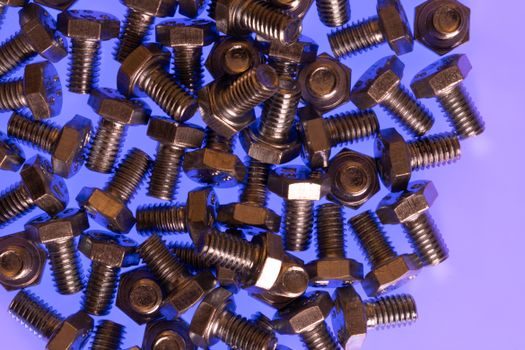
Putting the options side by side for an engineer who has to pick a process route or a service path: rolled vs ground is decided on lead accuracy and lot size; OEM-new vs rebuild is decided on remaining screw life and downtime cost; standard preload vs zero-backlash preloaded double-nut is decided on positioning repeatability and heat growth budget. For a benchmark on the underlying bearing component, the ball bearing reference covers the rolling-element basics that the ball screw inherits. [S1]
A related design question is whether a ball screw is the right pick at all, or whether a ball spline or roller screw is a better fit for combined linear-and-rotary motion or for higher static load. For very long travels where the screw is the dominant cost driver, or for high-cycle packaging axes, a rolled screw with internal return is usually the lowest-risk commercial answer; for tight-pitch positioning in metrology or semiconductor stages, a ground screw with ETA+ preload monitoring is the standard reference design [S2]. On the maintenance side, the same logic that drives pillow block bearing selection — match housing style, seal type and lubrication to the duty cycle — applies almost unchanged to the end-bearing supports that carry a ball screw's journals.
Process Variables That Decide Cost and Lead Time
Three variables dominate the commercial outcome. First, diameter and lead: standard commodity sizes (16, 20, 25, 32, 40 mm) ship in days from distributor stock, while specials over 63 mm or with non-standard leads move to weeks. Second, tolerance class: precision (C0–C3) requires thread grinding plus a stabilising stress-relief cycle, which adds both machine time and a real risk of distortion scrapping the part late in the route. Third, nut configuration: a flanged single nut with internal return is the cheapest to machine, a preloaded double nut with external return can add 30–60% to nut cost and double the assembly time. [S2]
Hardness verification, lead-error mapping over the full useful length, and a documented preload-vs-torque curve are the three QA artefacts that separate a commercial-grade product from a precision-grade one [S2]. For OEMs running a high-volume machine, those three documents are usually the gating items in the incoming-inspection plan; for a one-off retrofit, a simple no-load torque measurement at a fixed RPM is often enough to confirm the screw is healthy after installation.
Two trackable signals to watch in the next sourcing cycle: ISO 3408 tolerance-class revisions (the standard that defines precision, super-precision and ultra-precision grades for metric ball screws) and any tightening of backlash budgets below 1 µm in semiconductor and metrology builds, which usually pulls demand toward ground-and-lapped screws with active preload monitoring rather than commodity rolled product. Steinmeyer's published competence pages on thread grinding, ETA+ preload monitoring and the Guard Plus reproducibility kit are the public engineering artefacts to cross-check against any new vendor claim [S2].
For related coverage, see Baler Machine Selection Guide: Class, Ram Force and Throughput Mapping.