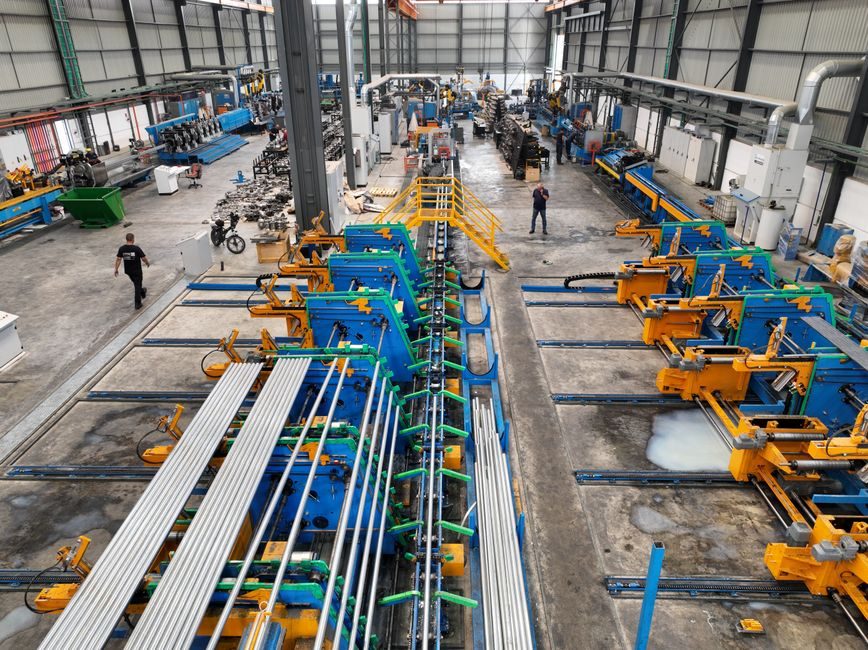
RV reducers — the cycloidal-pin gear speed reducers that drive industrial robot joints — require backlash below 1 arc-minute and torque density above 200 Nm per stage, which is why Wuhan Jinghua Speed Reducer Manufacturing registered as an ISO 9001-certified maker in 2015 and lists robotic RV reducers, speed gears and electric motors as core product lines at its Huangpi District, Hubei facility [S2].
Parallel-tier supplier Hengfengtai Precision Machinery, registered 2013 in Wenzhou, Zhejiang, holds ISO 14001 and OHSAS 18001 alongside its production-system certification, exporting a full reducer catalogue to the Made-in-China B2B channel for industrial equipment and metallurgy buyers [S6]. A Tianjin-based OEM/ODM shop also lists harmonic, planetary and worm RV reducer SKUs starting at US$ 50 per piece MOQ 1, signalling that the precision reducer segment is no longer a single-vendor lock-in for cobot and six-axis integrators.
What the 2026 Smart-Manufacturing Definition Locks In for Reducer Plants
Smart manufacturing in 2026 is defined as the integration of IoT, AI, big-data analytics and cloud computing across every layer of the factory, fusing physical machinery with networked sensors and software to predict, control and improve throughput in real time [S4]. For an RV reducer line that means a cycloidal-pin grinding cell, a heat-treatment carousel, and an end-of-line backlash station all have to stream data into the same MES rather than running on paper travellers.
SME's Smart Manufacturing Experience showcase, hosted at IMTS 2024 in Chicago, formalised the priority stack that downstream reducer vendors must satisfy to qualify for North-American OEM audits: additive manufacturing, automation and robotics, cybersecurity, AI/ML, data analytics, VR/AR/MR, and Industrial IoT from sensor to platform [S1]. NIST's June 25 2026 report on advanced-manufacturing knowledge, skills and abilities catalogued over 200 worker KSAs, putting workforce-readiness on the same compliance line as machine-tending cycle times [S1].
Criteria Comparison: Three Reducer Architecture Options for Cobot Joints
RV, harmonic and cycloidal reducers all reach the same general purpose — reduction ratios of 30:1 to 160:1 inside a robot joint — but they diverge on the four decision criteria that matter to a smart line: torque density, backlash, torsional stiffness and per-unit cost. The table below lines them up against the published OEM data on the Made-in-China channel and against the harmonic reducer process map covered in our related coverage of flexspline heat treatment. [S1]
RV reducers typically deliver 100–300 Nm nominal torque per stage with single-stage backlash under 1 arc-minute, making them the default for six-axis arm shoulder and elbow axes. Harmonic drives (also called strain-wave gears) hit 20–100 Nm with near-zero backlash but lower torsional stiffness and shorter life at peak torque. Planetary reducers sit at 30–150 Nm with 3–8 arc-minute backlash and the lowest cost, but cannot match RV torsional rigidity for high-acceleration moves. The Tianjin-based OEM/ODM shop's catalogue explicitly bundles harmonic, planetary and worm RV reducers in the same SKU family for joint designers who want to benchmark the three side by side.
Quality Gates and Process Map for RV Reducer Production
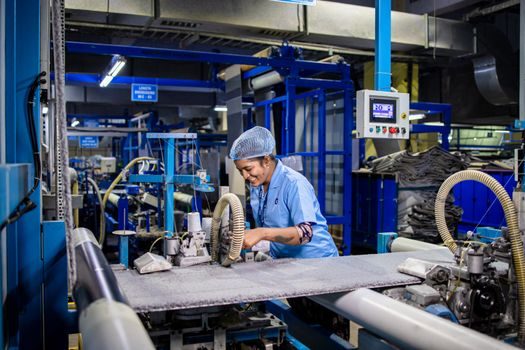
An RV reducer's quality gates run in this order: gear-blank forging or powder-metallurgy forming, rough and finish machining of the cycloidal disc, needle-bearing bore grinding, eccentric-shaft heat treatment, assembly with high-grade grease, and end-of-line backlash plus no-load running-in test. A 2026 process map on this site documents the inspection thresholds and gating logic that determine whether a reducer ships or returns to rework. [S2]
Wuhan Jinghua's robotic RV reducer product line is sold alongside standalone speed reducers, speed gears and reduction gearboxes from a single 2015-established manufacturing account, so the same ISO 9001 quality system has to govern both the cycloidal-disc machining tolerance band and the gear-tooth contact-pattern inspection [S2]. Hengfengtai layers ISO 14001 environmental management and OHSAS 18001 occupational health onto the same workflow, which is now the minimum paperwork set procurement teams demand when auditing Asian reducer suppliers for European end-customers [S6].
Automation Anchors: Where Cobots and Sensors Enter the Cell
Inside a smart reducer cell the 2026 anchor stack is: a cobot tending the grinding machine, a vision system on the cycloidal-disc profile, a torque-and-backlash end-of-line test rig, and an MES dashboard exposing OEE per shift. Rockwell Automation's 2026 industrial-automation brief explicitly frames the shift as moving from automation to autonomy, with 2026 investment trends targeting AI-driven optimisation at the machine level rather than just PLC-level sequencing [S5].
The 2026 cobot landscape covered in our cobots in smart manufacturing reference lays out cell-stack and safety-rated-stopped categories that decide whether a cobot can load an RV reducer into a grinding fixture without a physical cage. LiDAR-based safety scanners have become a common perimeter for those cells — see the LiDAR sensor spec stack for 2026 reference for cut-in distance and zone-set thresholds. End-of-line robotic palletising, in turn, follows the cell-layout rules in the palletiser selection guide, which compares robot, layer and cobot palletiser classes for the throughput a reducer plant needs at shipping.
Standards, Sourcing and the Limit of the Data
There is no single harmonised ISO or IEC standard that uniquely certifies an "RV reducer" as a component — conformity typically rides on the parent robot's ISO 10218 (industrial robot safety), ISO/TS 15066 (cobot collaborative operation) and the reducer supplier's own ISO 9001 quality system as published by Wuhan Jinghua and Hengfengtai [S2][S6]. Rockwell's 2026 industrial-automation positioning also calls out digital transformation as essential, but the report stops at strategic guidance rather than publishing a reducible per-plant adoption figure that can be cited as a percentage [S1][S5].
The published OEM/ODM shop data on Made-in-China spans US$ 50 to US$ 500 per piece for the harmonic/planetary/worm-RV family, but does not split the price band by reducer type, so a procurement engineer should treat the range as a coarse envelope rather than a calibrated benchmark. Watch the July 2026 IMTS preview cycle and any new SME Smart Manufacturing Experience event notice for 2027 dates — those are the next trackable signals on where the U.S. smart-manufacturing roadmap will pull the Asian reducer supply base [S1].