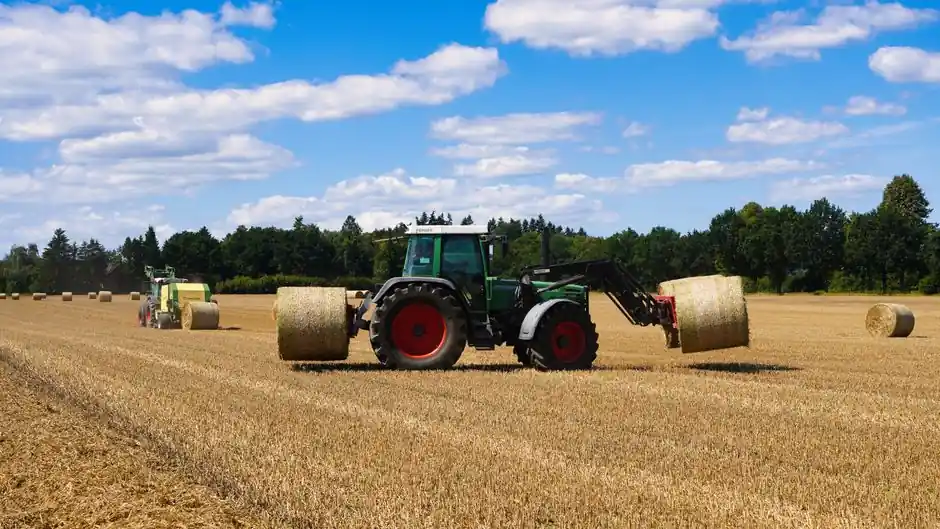
Ball screw selection for agriculture machinery is driven by four interlocking parameters: dynamic axial load (typically 1.5-3.0 kN for planter lift axes and sprayer booms), lead (5-20 mm for most field-speed applications), ISO 3408 accuracy grade (C7 for general farm equipment, C5 only for precision seeding), and a bellows or steel-scraper sealing system rated to IP54 or higher against dust and chemical ingress [S1][S2][S4].
Field machinery subjects a ball screw to vibration, dust, fertilizer corrosion, and seasonal thermal swings, so the spec map is more constrained than for general factory automation. In 2026 builds, OEM guidance from Helix Linear, MISUMI, and THK all converge on a diameter range of 16-32 mm for tractor three-point hitch actuators, implement depth wheels, and autonomous seeder Z-axes, with critical speed and column load more often governing the selection than raw load capacity [S7][S8][S9].
Diameter and Lead Pairing for Tractor-Mounted Actuators
For tractor three-point hitch positioning and implement depth cylinders, the working rule is motor speed (rpm) multiplied by lead must equal or exceed required linear speed, while the dynamic load rating Ca must exceed the calculated working thrust by at least 1.5x for dusty field duty [S1][S4]. Lead choices cluster in three bands: 5 mm and 10 mm for high-force, low-speed lift cylinders; 16 mm and 20 mm for sprayer boom fold and steering tilt; 25 mm and above for fast-positioning seed-meter gates that prioritize throughput over thrust [S3][S7]. Diameter selection follows: every 5 mm increase in nominal diameter roughly doubles the critical speed and column load capacity, so a 25 mm screw out-performs a 20 mm screw in both top speed and buckling resistance by approximately 2-2.5x for the same mounting class [S2][S9].
Accuracy Grade by Subsystem
ISO 3408 grade C7 (equivalent to Chinese GB/T 17587.3 P5 class) is the practical default for tillage and harvest lift axes, where positioning repeatability of about 50 micrometres per 300 mm is acceptable for hydraulic implement control [S1]. Grade C5 (P4 class) is reserved for precision planters that meter seed at spacings below 25 mm, where cumulative lead error directly translates to population drift across a 6 m toolbar. Grade C3 (P3) is rarely used in agriculture machinery because the cost premium outweighs the field-level gain; C10 rolled screws are common on rugged harvest conveyor drives where dust load is high and precision is forgiving [S5][S6][S9]. A standard rolled C7 screw costs roughly 30-50% of a ground C5 unit in 2026 sourcing data, which keeps the precision choice tightly linked to whether the application can detect a sub-50-micrometre error [S9].
Sealing, Lubrication, and Environmental Hardening
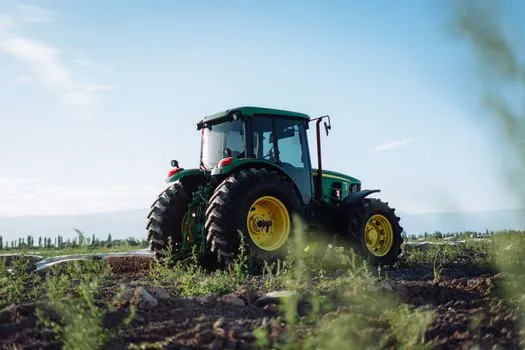
Dust and agrochemical ingress is the dominant field failure mode, not fatigue. OEM guidance recommends a double-lip wiper plus stainless steel scraper for tillage and harvest applications, with a bellows cover (expansion ratio approximately 1:8) added when the stroke exceeds 200 mm or the screw operates in slurry [S1][S3]. Protection class IP54 is the practical floor; IP65 with stainless end journals is specified for fertilizer spreader height-adjust axes where urea and ammonium nitrate attack standard chrome plating [S3]. Lubricant choice matters: standard lithium EP2 grease is adequate for seasonal service intervals of 200-400 hours, but autonomous machines running 800+ hours between service windows need food-grade or synthetic PAO grease with anti-washout additives [S4][S8].
Mounting Rigidity and Critical-Speed Envelope
Fixed-fixed end supports with bi-directional thrust bearings deliver the highest critical speed and column load rating, and are the recommended mounting for planter and drill drawbar actuators where stroke commonly runs 300-600 mm [S2]. Simple fixed-supported mounting is acceptable only when stroke stays below 200 mm, because screw length drives critical speed down roughly with the square of unsupported length: a 25 mm screw fixed at one end and supported at the other has a critical speed near 1500 rpm at 500 mm length, versus approximately 3500 rpm in a fixed-fixed arrangement [S2][S7]. For vertical lift cylinders on sprayer booms, fixed-free mounting is sometimes unavoidable, and the design then targets operation below 70% of the calculated critical speed to leave margin for field-induced vibration [S4][S9].
Comparison of Precision Classes for Field Duty
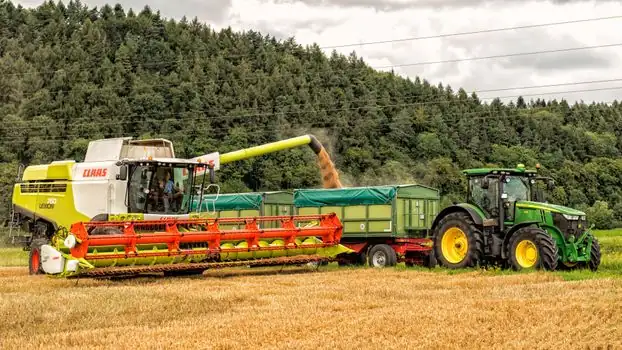
The three classes engineers actually specify for agriculture machinery line up against decision criteria as follows. Rolled C10: lowest cost, 100-200 micrometre repeatability, suitable for harvest conveyor and feed-pusher axes. Ground C7: mid cost, 50 micrometre repeatability, the workhorse for tillage depth control and three-point hitch positioning. Ground C5: 20 micrometre repeatability, reserved for precision planters and fertilizer rate controllers where lead error directly compounds into agronomic error across the toolbar width [S1][S5][S9]. Cost spread in 2026 sourcing: C5 ground typically runs 2-3x the price of a comparable C7 ground screw, and 4-5x a rolled C10 unit, so the rule is to pay for accuracy only where the implement can measure and act on it [S9].
Selection Workflow for Procurement
A repeatable 5-step workflow is the easiest way to lock a part number: (1) compute dynamic axial load from implement weight plus shock factor, target Ca at 1.5x; (2) pick lead from the linear-velocity requirement, motor speed known; (3) compute total length as stroke + nut length + safety margin + installation + connection + bellows allowance; (4) select accuracy grade C7 unless precision seeding is the use case; (5) specify sealing IP54 minimum, bellows for strokes above 200 mm, and stainless scrapers for fertilizer duty [S1][S2][S4]. For tractor and harvester builds this is closely analogous to the ball screw selection workflow used in mining crushers, where dust sealing and critical-speed margin dominate the same way they do in tilled-soil dust loads.
Who This Spec Fits and Where It Breaks
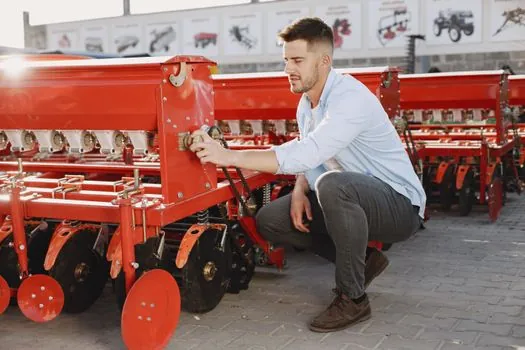
The 16-32 mm C7 ground screw with bellows cover fits tractor three-point hitches, planter down-force actuators, sprayer boom folds, and harvester feeder-house lifts. It does not fit sub-1 kN low-cost applications (where a polymer lead screw or rack-and-pinion is cheaper), nor does it fit autonomous high-speed gantries that need C3 ground accuracy and DN values above 100,000. Engine builders who already spec a construction lubricant map for adjacent drivetrain components will find the grease-side logic identical: match the service interval to the operating hours, not the calendar [S1][S4]. For equipment designers moving between farm and process-plant builds, the same ball screw fundamentals apply, but field machinery adds the dust, chemical, and thermal envelope that the standard catalog does not always show.
Track these signals over the next 6-12 months: ISO 3408 grade C7 supply lead times from regional distribution warehouses, the cost spread between rolled C10 and ground C5, and any new OEM guidance on C5 ground units below 16 mm diameter for compact autonomous seeders. A second node worth watching is adoption of food-grade synthetic grease in autonomous agriculture machines, which will signal a shift toward longer service intervals and a tighter spec on sealing at the wiper interface.
For component-level specifications, see construction machinery and equipment, and ball bearing.