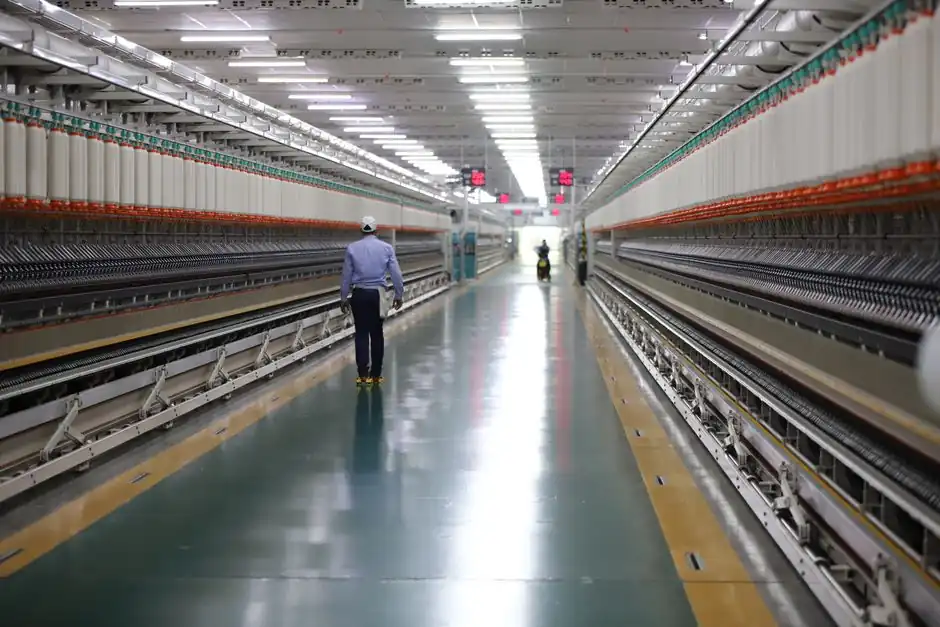
Profile linear guides such as the RGW20, RGH-series, and V-rail formats are routinely specified on weaving, knitting, and printing lines because they combine sub-millimetre positioning tolerance with sealed blocks that resist lint and humidity ingress [S3][S4].
Across spinning, weaving, dyeing, and finishing, the operating environment is unusually hostile: airborne fibre, sizing chemicals, dye-house steam, and three-shift duty cycles that push guide rails beyond the assumptions of generic factory automation [S1][S2].
Why Textile Mill Duty Cycle Breaks Generic Linear Guide Sizing
Textile machinery runs at high reciprocation rates, and the shuttle, rapier, or needle carrier in a weaving or knitting head can change direction several times per second, a duty profile that pushes standard linear guide life calculations toward their dynamic-load limits rather than their static ratings [S3].
Heavy-duty spinning frames impose sustained downward loads on drafting rollers, while the same rail also has to tolerate side loads from yarn tension variations, so a guide with a balanced four-row contact geometry (typical of RGH-class profile rails) usually out-performs a two-row light profile in this mixed-load service [S3].
CMMS data from textile plants shows that equipment classes unique to the industry, spinning frames, looms, and dyeing machines, are routinely missing from generic maintenance templates, which means the linear guides on those assets are also being inspected against the wrong interval grid [S1].
Self-Aligning Geometry Versus Fixed-Profile Rails in Mill Installations
Self-aligning linear guides compensate for base-frame flatness errors of typically several hundred microns, a common condition in textile mills where long machine beds are bolted onto cast-iron subframes that deflect under their own weight [S2].
The V-rail profile narrows the contact patch to two lines instead of the four rows used by a profile linear guide, so it tolerates misalignment better but trades some load capacity and rigidity for that forgiveness, which is why suppliers position V-rail as a fit for small to medium knitting, embroidery, and printing tables rather than heavy looms [S4].
For wide weaving machines and large calendering rolls, flat-rail heavy-duty profile guides remain the safer call because their larger cross-section and four-row ball path carry the bending moments generated by the fabric take-up tension without the carriage lifting off the rail [S4]. A related comparison of how rail profile choices interact with environment and load is laid out in Linear Guide Selection for Material Handling: Load, Accuracy, and Environment, which shares the same decision framework used here.
Contamination Gates: Lint, Humidity, and Dye-Chemical Attack

Lint and short fibre are the dominant contamination threat on a textile floor; a 20 mm-class guide such as the RGW20 has to be paired with felt wipers or metal scrapers on each end of the block, otherwise airborne fly becomes compacted into the ball path and accelerates brinelling [S3].
Dye-house and finishing zones add humidity above 80 percent RH plus exposure to weak acids, alkalis, and oxidising agents, so the rail and block need a black-chrome or low-friction zinc-flake coating rather than bare black oxide, and the end-cap seals need to be nitrile or fluoroelastomer rather than standard synthetic rubber [S3].
For mills that wash down equipment, IP54 sealing on the block is the practical minimum, and stainless steel end-cap screws should be substituted for the standard carbon-steel fasteners, otherwise the first annual shutdown typically returns a block with a frozen screw and corroded lube fitting [S3]. Similar environmental trade-offs show up in Linear Guide Selection for Agriculture Machinery: Sealing, Load, and Corrosion Gates, where dust load rather than lint is the dominant ingress driver.
Specification Comparison: RGW20, RGH-Series, and V-Rail on Textile Criteria
Side-by-side, the three families land at different points on the same selection matrix a textile maintenance engineer has to fill in: precision, dynamic load, speed rating, contamination tolerance, and multi-axis fit-out flexibility [S3][S4].
RGW20 / RGH20 profile rails: 20 mm rail width, four-row ball recirculation, balanced load capacity in all four directions, well suited to drafting rollers, narrow weaving heads, and printing carriages where repeatability matters more than absolute load [S3].
RGH45 profile rails: 45 mm rail width, same four-row geometry, dynamic load rating roughly 2-3x the RGH20 class depending on block length, the default pick for heavy spinning frames, wide looms, and any axis where the carriage sits on a long overhung arm [S3].
V-rail series: V-shaped two-line contact, self-aligning by design, lower load and rigidity, lowest cost per metre, and the easiest field retrofit on existing mill subframes that cannot be re-machined to the flatness a profile rail demands [S4].
Flat-rail heavy-duty series: highest dynamic and moment load capacity, best for thick-yarn looms and calendering lines, but they require machined reference edges and tighter base-frame flatness than V-rail, so retrofit cost is the trade-off [S4].
Where Self-Aligning Linear Guides Already Run in Textile Plants
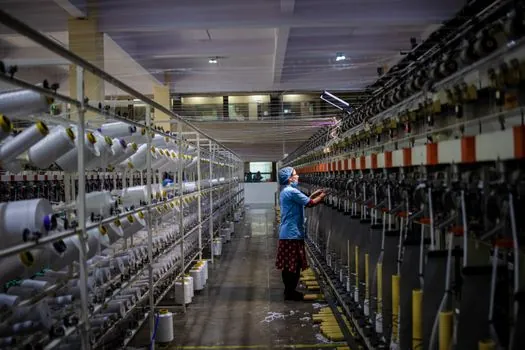
Rollon documents self-aligning linear guides operating in textile printing, finishing, and cutting-table service, where small alignment errors between long guide segments would otherwise print as visible banding in the pattern repeat [S2].
The same self-aligning behaviour is what lets a mill replace a worn section of rail without re-aligning the full machine bed, a meaningful maintenance gain given that three-shift handover and condition-based PM trigger logic are both still being rolled out across most mills' CMMS platforms [S1][S2].
The pattern matches a wider procurement trend covered in Linear Guide Rail Procurement: 2026 Spec Path and Supplier Map, where textile and packaging buyers are converging on the same shortlist of profile-rail sizes (15, 20, 25, 30, 45 mm) to consolidate spares across machine classes.
Selection Workflow That Survives a Mill Floor, Not a Vendor Demo
Start by mapping each machine class to a load-case: spinning frame drafting-roller carriages sit in the medium-load, high-cycle bucket, wide weaving rapier drives sit in the heavy-load, high-cycle bucket, and printing/finishing carriages sit in the light-load, very-high-cycle bucket where self-aligning geometry pays back fastest [S2][S3][S4].
Next, fix the contamination package before fixing the rail size: felt wipers, metal scrapers, IP54 block sealing, and a corrosion-resistant coating are non-negotiable in dye-house and finishing zones, and the supplier should be asked to confirm the seal material by part number rather than by generic datasheet line [S3].
Finally, lock the lubrication interval to runtime hours rather than calendar months, which means the CMMS for the mill has to support condition-based PM triggers rather than fixed-date scheduling, a feature that most generic CMMS templates still cannot do out of the box [S1]. Sourcing teams handling multi-mill rollouts can compare the supplier gate logic in Sourcing Linear Guide Rails from China: Spec Map and Supplier Gate for OEM Buyers against the same mill-side checklist above to keep the spec, not the brochure, in control.
Trackable signals for the next planning cycle: whether the mill's CMMS rollout reaches condition-based PM triggers on linear-guide assets by Q4, and whether the new RFP for sizing-zone guide rails specifies fluoroelastomer seals and zinc-flake coating by part number rather than by generic line item [S1][S3].
For component-level specifications, see crossed roller guide, and linear actuator.