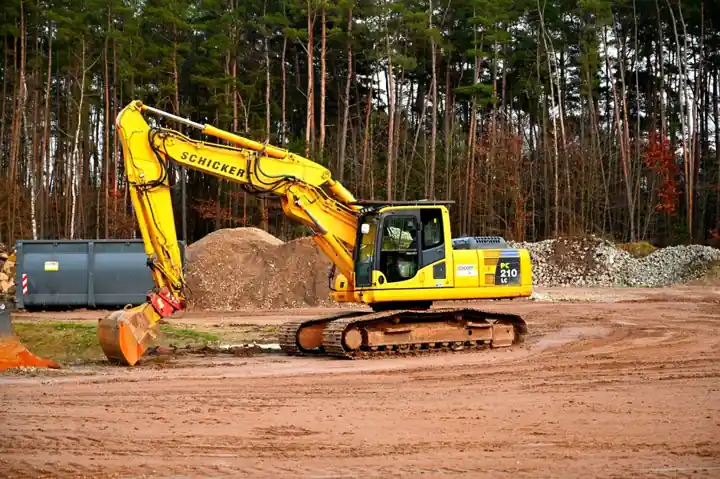
Construction equipment lubricant choice is driven by the component being lubricated: hydraulic pumps typically take ISO VG 32, 46, or 68 fluids; diesel engines use SAE 15W-40 heavy-duty oils; enclosed gear drives use extreme-pressure gear oils such as SAE 80W-90 or SAE 85W-140; and chassis pins, bushings, and bearings use NLGI 2 lithium-based greases [S4].
Operating environment matters as much as the component itself: construction machines run under heavy load, frequent shock loading, dust, water exposure, and wide ambient temperature swings, which is why lubricant selection directly affects drain interval, wear rate, and total cost of ownership [S4][S5]. The European construction sector alone accounts for 18 million direct jobs and roughly 9% of EU GDP, which puts fleet uptime decisions at a financial scale most procurement teams underestimate [S2].
Hydraulic Fluids: Viscosity, VI, and the Industry Specification Stack
Hydraulic systems on excavators, wheel loaders, and drilling rigs are the single largest lubricant volume on a construction site, and the wrong viscosity grade is the most common cause of premature pump wear [S1][S3]. Common industrial and mobile hydraulic grades are ISO VG 32, 46, and 68, selected so the fluid maintains an adequate film at operating temperature without starving suction at cold start [S4].
Viscosity index (VI) measures how much the oil thins as temperature rises; a higher VI means less viscosity change across the operating window, which is critical for machines that start at -20°C in winter and run at 80–90°C reservoir temperatures in summer [S2]. The three reference specifications buyers see on most data sheets are DIN 51524 (HL, HLP, HVLP grades covering anti-wear, anti-oxidation, and VI requirements), ISO 11158 (mineral-oil performance classification), and Denison HF-0 / HF-1 / HF-2 (hydraulic pump performance at high pressure) [S3]. HVLP grades add high-VI base oils for mobile equipment with wide temperature swings, while HL covers basic hydraulic applications and HLP adds anti-wear and anti-oxidation for industrial systems [S3].
Construction and mining hydraulic systems also generate substantial heat and run at sustained high load, so thermal and oxidative stability directly translate to longer drain intervals and lower unscheduled downtime [S1]. For a broader reference on lubricant families and base oil chemistry, the industrial lubricant encyclopedia entry covers viscosity, additive packages, and the difference between mineral, synthetic, and semi-synthetic stocks.
Engine Oils for Heavy-Duty Diesel: CK-4, FA-4, and Viscosity Reality
Construction diesel engines run at sustained high load in dust and heat, which is why most OEMs specify heavy-duty engine oils in the SAE 15W-40 grade, with the latest API CK-4 and FA-4 service categories used where emissions aftertreatment (DPF, SCR) is fitted [S5]. The 15W-40 multigrade balances cold-start flow at the "15W" winter rating with hot-viscosity protection at 100°C, which is the operating range a loaded earthmover sees during a shift.
Extreme conditions change the lubricant requirement: desert ambient temperatures above 45°C push sump temperatures past 110°C, while arctic sites at -30°C demand pour-point control so the oil flows on first start, and in both cases the additive package (detergent, dispersant, anti-wear, anti-oxidant) does the real work of protecting the engine [S5]. Buyers should confirm OEM approvals such as Caterpillar ECF-3, Cummins CES 20086, Detroit Diesel DFS 93K222, and ACEA E9 where applicable, because the API service category alone is not a sufficient warranty requirement.
For mobile equipment that doubles between site and road, drain intervals are typically shortened by 30–50% versus on-highway trucks because of dust ingestion, idling, and shock loading, so used-oil analysis programs (LubeWatch or equivalent) are the cheapest insurance against a catastrophic failure [S5].
Gear Oils, Axle Lubricants, and Grease: Final Drives and Pins

Final drives, axles, differentials, and transfer cases on construction equipment need extreme-pressure (EP) gear oils, with common grades SAE 80W-90, SAE 85W-140, and synthetic 75W-90 depending on the OEM and ambient temperature [S4]. Limited-slip differentials add an additional friction-modifier requirement that must be confirmed against the OEM specification, since a standard GL-5 gear oil in a clutch-type LSD will cause chatter and wear.
Grease selection is equally component-specific: pins and bushings on boom articulation, chassis, and bucket linkages typically use NLGI 2 lithium or lithium-complex grease with EP additives and MoS₂ (moly) for shock-loaded applications [S4][S6]. For slow-moving, heavily loaded pivot points, NLGI 1 or even NLGI 0 with a tackiness additive may be specified, but the equipment manual remains the primary reference and any deviation must be documented.
Specialty lubricants cover tasks the bulk hydraulic or engine oil does not: dry-film lubes and anti-seize compounds on threaded fasteners that see frequent removal, chain oils and wire-rope penetrants on cranes, silicone or PTFE dry lubes on plastic and rubber sliding surfaces, and food-grade or low-temperature greases on HVAC, generator, and weather-exposed linkages [S6]. The right specialty lubricant prevents the everyday jobsite failures (seized bolts, squeaking hinges, worn bearings) that consume technician hours.
Selection Criteria, Comparison Matrix, and Common Failure Modes
Specifying a lubricant requires five concurrent checks: the component (pump, engine, gear, pin), the required viscosity grade at operating temperature, the performance level (API CK-4, DIN 51524 HLP, API GL-5, NLGI 2), the OEM approval list, and the operating environment (load, temperature, dust, water) [S3][S4]. Skipping any one of these five checks is the most common route to a misapplication.
Comparing the main lubricant types against the same decision criteria, side by side, gives a procurement-grade view: hydraulic ISO VG 46 HLP fits mid-range mobile pumps at 10–80°C with moderate VI, while HVLP 46 raises VI for arctic-to-desert temperature spans; engine SAE 15W-40 CK-4 covers heavy-duty diesels with aftertreatment protection at a moderate cost premium; EP gear oil SAE 80W-90 GL-5 fits enclosed gear sets with shock load; and NLGI 2 lithium EP grease covers pins, bushings, and chassis points where re-greasing intervals are part of the maintenance schedule.
Typical failure modes line up directly with these categories: low-viscosity hydraulic oil causes pump wear and metallic sheen in the filter, high-viscosity cold-start oil causes cavitation and suction-line starvation, wrong gear oil additive in an LSD causes clutch chatter, wrong grease base (calcium vs lithium) causes incompatibility and softened NLGI consistency, and contaminated or mixed engine oil shortens drain interval and forms varnish on the turbo bearing. For broader context on how lubricant decisions fit alongside equipment selection, the automotive plant lubricant zone-by-zone spec map and the aluminum ladder spec map for steel construction sites sit in the same procurement workflow.
Standards, Sourcing, and What to Verify Before Order

The standards stack a B2B buyer should expect to see on a construction lubricant data sheet is specific: DIN 51524 (HLP / HVLP hydraulic grades), ISO 11158 (hydraulic fluid performance classification), Denison HF-0, HF-1, HF-2 (pump performance), API CK-4 / FA-4 (heavy-duty engine oil), API GL-5 (gear oil), and NLGI consistency grades for grease [S3][S4]. OEM approvals (Caterpillar, Komatsu, Volvo CE, JCB, Liebherr) are typically layered on top and must be confirmed line by line, not by category.
Sourcing discipline is straightforward: request the latest PDS (Product Data Sheet) and SDS (Safety Data Sheet) for each grade, confirm the manufacturing site and shelf life (typically 3–5 years for sealed mineral hydraulic oil, shorter for some synthetics), and verify the supplier can supply in the required pack sizes (20L pail, 200L drum, 1000L IBC, or bulk tanker) with consistent lead time. Buyers comparing private-label or bulk orders should also audit the additive package disclosure, since two oils meeting API CK-4 can use very different ZDDP, detergent, and dispersant chemistries that affect real-world performance.
Trackable signals to watch over the next procurement cycle: tightening of API CK-4 and FA-4 oil approvals as more Tier 4 Final and Stage V equipment enters fleets, increased demand for bio-based and readily biodegradable hydraulic fluids (HEES, HETG) on environmentally sensitive sites, and a slow shift from mineral 15W-40 to synthetic 10W-30 and 5W-30 engine oils as OEMs chase fuel-economy credits. The right lubricant today is the one that meets the spec sheet, holds up in the operating environment, and arrives on site when the machine is down.
Component reference pages worth checking: construction tools, and construction machinery and equipment.