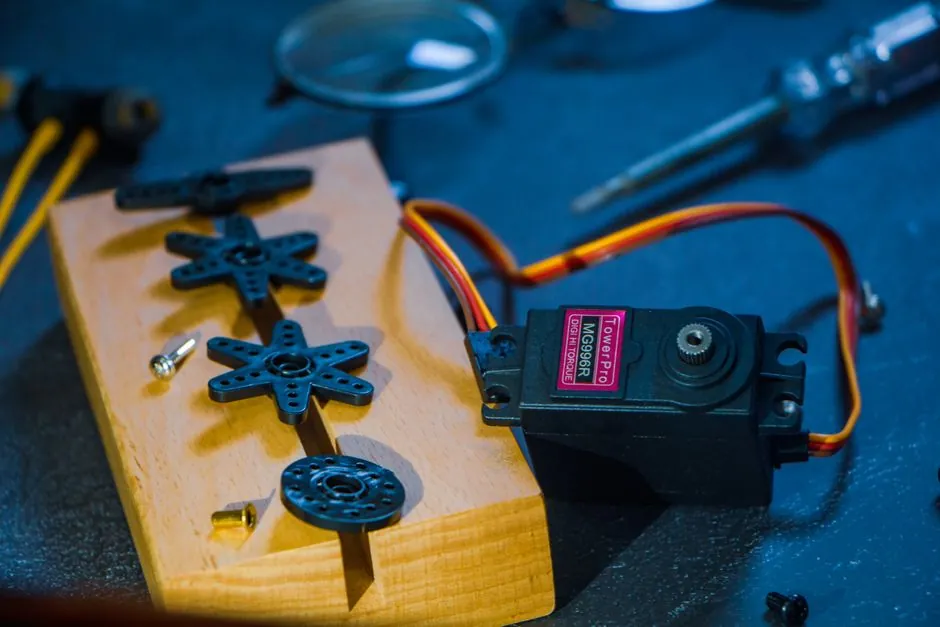
Linear motors can achieve much higher positioning accuracy and repeatability than ball screws, while the choice between them depends on application performance requirements and total cost of ownership [S1].
The decision depends on stroke, speed, acceleration, thrust, positional accuracy, duty cycle, maintenance exposure, and total cost of ownership.
Performance and positioning limits
Ball-screw actuators are mechanical drives that convert rotary motor motion into linear movement. Ball screws also suit applications requiring greater thrust density and rigidity than a belt drive [S4].
Linear motors remove the screw and nut from the force path, eliminating rolling-element contact between those components. Position feedback can come from a magnetic or optical linear scale measuring at the load rather than from a rotary motor encoder, which reduces errors caused by screw deflection, backlash, and lost motion [S1].
Accuracy and repeatability are separate acceptance criteria. Specify allowable positioning error over the full stroke, return-to-target repeatability after reversal, and positioning error under load and temperature. A motor-mounted rotary encoder cannot verify load position if compliance between the motor and load introduces displacement, so high-accuracy axes require error compensation or direct linear measurement [S1].
Decision matrix by application requirement
For a short-to-medium stroke where critical speed does not limit the axis, a ball screw is generally the stronger choice because its initial procurement cost is lower than a comparable linear-motor system [S5]. Ball screws can offer lower initial costs than linear motors, but their mechanical nature imposes an operational speed limit [S5].
For long travel combined with high speed or acceleration, a linear motor has the stronger performance case. Travel is then limited mainly by the support system, cable management, and feedback hardware rather than by screw critical speed [S1].
Against belts, preloaded ball screws offer better positioning accuracy because of their greater rigidity [S4]. Against a lead screw, a ball screw generally provides higher precision and repeatability, can use preload, and is suited to higher speed and high-duty-cycle work [S6][S9]. A lead screw remains reasonable where lower cost, quieter operation, and simpler mechanics matter more [S6].
Use this selection rule: specify a ball screw when the required stroke, speed, and acceleration remain inside its verified ratings and lower capital cost has priority. Specify a linear motor when cycle time, long travel, acceleration, direct load feedback, or avoidance of screw wear materially determines machine output or part quality [S1][S5].
Who each drive option suits
Ball screws suit short-to-medium strokes, high-thrust positioning, machine-tool feed axes, and machinery where a rotary servo motor and mechanical transmission fit an established architecture. A ball screw is not a good default for long travel with sustained high acceleration because rotational inertia, screw critical speed, and axial load capacity become more restrictive [S5].
Linear motors suit semiconductor handling, laser processing, high-speed sorting, packaging, assembly, and part-loading systems where travel length and acceleration are central requirements [S1][S5]. Independently driven linear-motor primaries can also operate on a shared secondary, allowing coordinated carriage motion in packaging equipment [S1].
Linear motors are not automatically the lower-cost choice. Their acquisition cost is higher, and the supporting system still requires properly sized bearings, cable management, a suitable scale, environmental sealing, and adequate electromagnetic compatibility with the surrounding controls [S1]. A machine with long idle periods and modest motion may retain a ball screw’s economical advantage.
Maintenance, wear, and ownership
A ball screw requires lubrication and incurs wear over its operating life; wear can eventually introduce backlash and reduce positional performance [S5]. Proper preloading, contamination control, lubrication, seals, and correct axial loading are therefore part of the actuator specification, not optional installation details.
A linear motor has no moving parts in the electromagnetic drive itself and requires no routine lubrication [S1]. Its support bearings can require periodic lubrication, although lubricated-for-life options are available. The remaining life limit is therefore concentrated in the bearings, seals, cable system, and feedback components rather than in a screw-and-nut contact pair [S1].
The ownership comparison must include maintenance labor, spare parts, lubrication, downtime, energy use, and lost production from degraded accuracy. Linear motors can provide lower total cost of ownership when applied correctly, especially where their higher utilization justifies the initial investment [S1]. For intermittent duty, low utilization, or modest cycle-time demand, compare that ownership benefit against the actuator purchase and integration cost before selecting the more complex drive.
Commissioning and acceptance criteria
Specify ball-screw performance with lead, screw diameter, screw length, rated load, critical speed, permitted speed, maximum acceleration, end supports, and nut preload. For long-travel axes, verify both critical-speed and buckling limits; the related ball screw buckling limits for long-travel axes reference provides a focused selection check. [S5]
For a linear motor, verify peak and continuous force, current or thermal limits, acceleration, velocity, stroke, scale resolution, cable routing, and magnetic-gap requirements. The cited linear-motor capability of up to 10 m/s and 10 g applies only when the other system components are sized for those conditions [S1].
Run acceptance tests at the actual payload and over the full usable stroke. Record positioning error after moves from both directions, repeatability after thermal stabilization, velocity error under load, and cable-force effects. Define a maintenance interval based on measured wear and lubrication condition rather than a generic service interval.
Final selection criteria
Choose a ball screw when the axis has limited stroke, substantial thrust, moderate dynamic demand, and a cost-sensitive integration. Its published repeatability of ±0.003 to ±0.05 mm covers a broad precision range, while preload and rigidity make it stronger than a belt drive for accurate positioning [S2][S4].
Choose a linear motor when the machine needs long travel, sustained speed, high acceleration, or direct load-position feedback. Its advantage is mechanical: eliminating screw wear and measuring position at the load can improve accuracy and reduce maintenance-related uncertainty [S1]. Confirm that the actuator is not being asked to compensate for undersized linear guide, bearings, scale, or structural members, since those components can become the limiting accuracy source.
The next procurement step is to enter stroke, payload, peak thrust, speed, acceleration, duty cycle, required accuracy, and maintenance exposure into a side-by-side actuator calculation. Reject any candidate whose verified rating leaves less than 10% margin against the governing requirement, then compare purchase price, commissioning effort, spares, and expected downtime over the planned service interval.