Ball valves for HVAC isolate refrigerant, hot-water, and chilled-water circuits with a quarter-turn, bubble-tight shutoff, and their typical HVAC working envelope sits between DN15 and DN150 with body ratings of PN16 to PN40 (1.0–1.6 MPa saturated steam) depending on body class [S1][S4].
Selection centres on three engineering decisions: fluid compatibility (water, glycol mixtures, refrigerant, natural gas, low-pressure steam), body and seat material, and whether the duty is isolation only or modulated flow [S5][S8].
Where a Ball Valve Fits vs Where It Doesn't
A ball valve is the default isolation device on refrigerant lines, boiler feed, heat-exchanger headers, and gas train up to about DN50 because it provides zero-leakage shutoff with a compact face-to-face and low torque at full differential pressure [S2][S4].
Engineers should reject ball valves for continuous throttling on hydronic circuits: an unported ball causes wire-draw and seat erosion at partial lift, and even V-ported trims do not match a globe pattern for stable Cv across the operating range [S3][S5].
For chilled-water mains at DN65 and above, a butterfly valve becomes the economical alternative because its wafer body halves the installed cost and weight at the same PN16 pressure class, with body materials of ductile iron or CF8M stainless and disc options in SS304, aluminum bronze, or EPDM-lined [S4].
Body, Ball, and Seat Material Selection
Brass CW617N (forged) and SS316 are the two most specified HVAC body alloys, and the choice is driven by fluid chemistry rather than temperature: CW617N handles potable hot water, chilled water, and standard glycol mixtures up to about 110°C; SS316 (CF8M) is required once chloride concentration in the water exceeds roughly 200 ppm, on geothermal loops, or on refrigerant suction where trace oils attack copper-zinc alloys [S4][S8].
For low-pressure saturated steam up to 180°C, PTFE (Teflon) seats remain serviceable and provide bubble-tight Class VI shutoff, but above that temperature, or on abrasive condensate, a metal-seated trunnion design with Stellite or 17-4PH ball hardfacing is the better engineering choice, with stainless or alloy bodies and API 607-style fire-safe construction as a baseline for steam [S5].
Three-way ball valves (L-port or T-port) are commonly used for mixing and diverting duty on heating/cooling changeover and on thermal-storage tanks, and the same material rules apply; the additional concern is that the common port must be sized for the combined flow so that Cv does not collapse when two circuits feed simultaneously [S8].
Port Geometry, Sizing, and Cv Discipline
For two-position isolation, Belimo's electronic-sizing guidance allows standard full-port or reduced-port ball valves to be specified at line size, with reduction permitted only when the valve is sized for a specific Cv at the design ΔP [S9].
Correct HVAC ball-valve sizing for energy efficiency requires evaluating the system curve against the valve characteristic: an oversized two-way ball on a variable-flow loop generates low ΔP, poor control resolution, and hunting at part load, while an undersized one wastes pump head and causes cavitation risk at the seat [S6]. The standard procedure is to target a valve authority of 0.3 to 0.5 at design flow, which keeps the valve's pressure drop at 30–50% of the circuit's available ΔP [S3][S6].
Actuation: Manual, Electric, and Pneumatic
Manual lever ball valves remain the lowest-cost option for equipment isolation behind an access panel, but any valve tied into a building automation system (BAS) needs an electric actuator with a 24 VAC/DC or 0–10 VDC control signal, end-switch feedback, and an IP54 minimum enclosure for plant-room service [S5].
Electric ball valves integrate directly with BMS schedules and enable remote shutoff on condensate overflow, freeze-stat, or smoke events, and the standard torque envelope for a DN25 brass two-way body sits at 3–5 Nm with a 50–90 second travel time at 60 Hz [S5].
Pneumatic ball actuators are reserved for hazardous-area HVAC rooms (e.g., boiler houses with natural gas) where the absence of electrical ignition sources is a hard requirement, and they cycle in under 1 second versus the 15–60 seconds of an equivalent electric unit, making them the better choice for safety-instrumented gas-train isolation [S5].
Connection Ends, Standards, and Codes

Threaded (BSPP/NPT) ends dominate the DN15–DN50 HVAC size range, with flanged ends (ANSI 150 / PN16) starting at DN50 and becoming mandatory at DN65 and above to handle assembly torque and to allow removal without rotating the pipe; solder-end copper-ball valves remain the residential/refrigeration default for up to 7/8" OD lines [S4].
For gas-train service, regulators and codes require AGA/CSA-certified ball valves with a tamper-proof lever and a clearly marked full-open position; for hydronic and steam service, the project specification should reference ASME B16.34 (valve design and testing) and, where fire exposure is possible, ISO 10497 fire-safe qualification for the soft-seated construction [S3][S4].
Pressure-temperature ratings follow the body class: a PN16 brass ball valve is typically rated to 1.6 MPa at 120°C but drops to 1.0 MPa at 180°C, while a Class 150 stainless ball holds 1.9 MPa at 38°C and 1.0 MPa at 200°C, and these de-rate curves must be cross-checked against the design operating point before order release [S3][S5].
Selection Matrix: Ball vs Butterfly vs Globe on HVAC Duty
On a chilled-water DN80 branch at 1.0 MPa and 7°C, a butterfly valve delivers the lowest installed cost (typically 40–60% of an equivalent flanged ball) at a comparable Cv and 0.3–0.5 bar ΔP, making it the correct economic choice above DN65 [S4].
On a refrigerant liquid line up to DN50, a full-port brass or stainless ball remains the only correct option because the line cannot tolerate the leakage path or pressure loss of a butterfly, and a globe valve would cost more in both body and actuator with no hydraulic benefit at on/off duty [S4].
For hydronic circuits that need accurate flow control (coil circuits, heat-exchanger bypass), a globe or characterised globe pattern delivers linear or equal-percentage characteristics that a ball cannot match, even with a V-port trim, and the design rule is: use ball for isolation, globe for modulation, butterfly for large-bore isolation and coarse balancing [S3][S5].
For an end-to-end decision matrix that maps bore, port type, body class, and seat material against slurry, steam, and chemical service, the ball valve selection guide for power generation applies the same logic on a different fluid envelope and is worth a side-by-side read.
Failure Modes and Field-Trackable Signals
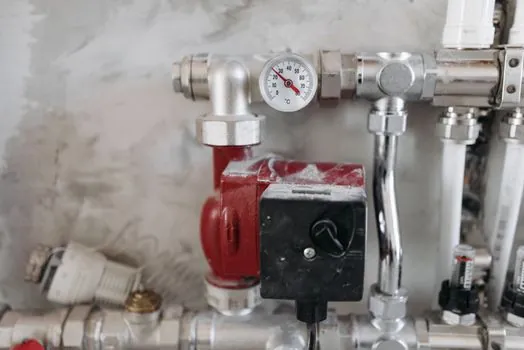
Track three signals during commissioning and the first heating season: (1) stem torque at the rated ΔP (a rise of more than 30% over the nameplate figure indicates scale or seat deformation, common on hard-water loops above 60°C); (2) handle-position leakage past the seat at full closed (any visible drip on a water-service ball at 1.0 MPa after 30 seconds indicates seat fatigue and a planned replacement); and (3) actuator current draw on electric units (a sustained rise above the inrush value points to seat debris or stem-packing over-torque) [S3][S5].
Steam-service and high-glycol (>40%) systems should be sampled annually for seat hardness and packing compression set, with PTFE replaced on a 5-year cycle and metal seats re-lapped every 3–5 years depending on cycle count, because soft seats lose resilience above 180°C and below -20°C in unheated plant rooms [S4][S5].
Specifying engineers should also verify the project's water-chemistry report against the selected seat and body: chloride above 200 ppm forces SS316, sulphite-treated boiler water above pH 9 attacks brass CW617N, and refrigerant oils are universally compatible with PTFE and PEEK seats but degrade EPDM and NBR, which is why the seat polymer must be confirmed alongside the body in every submittal [S4][S8].