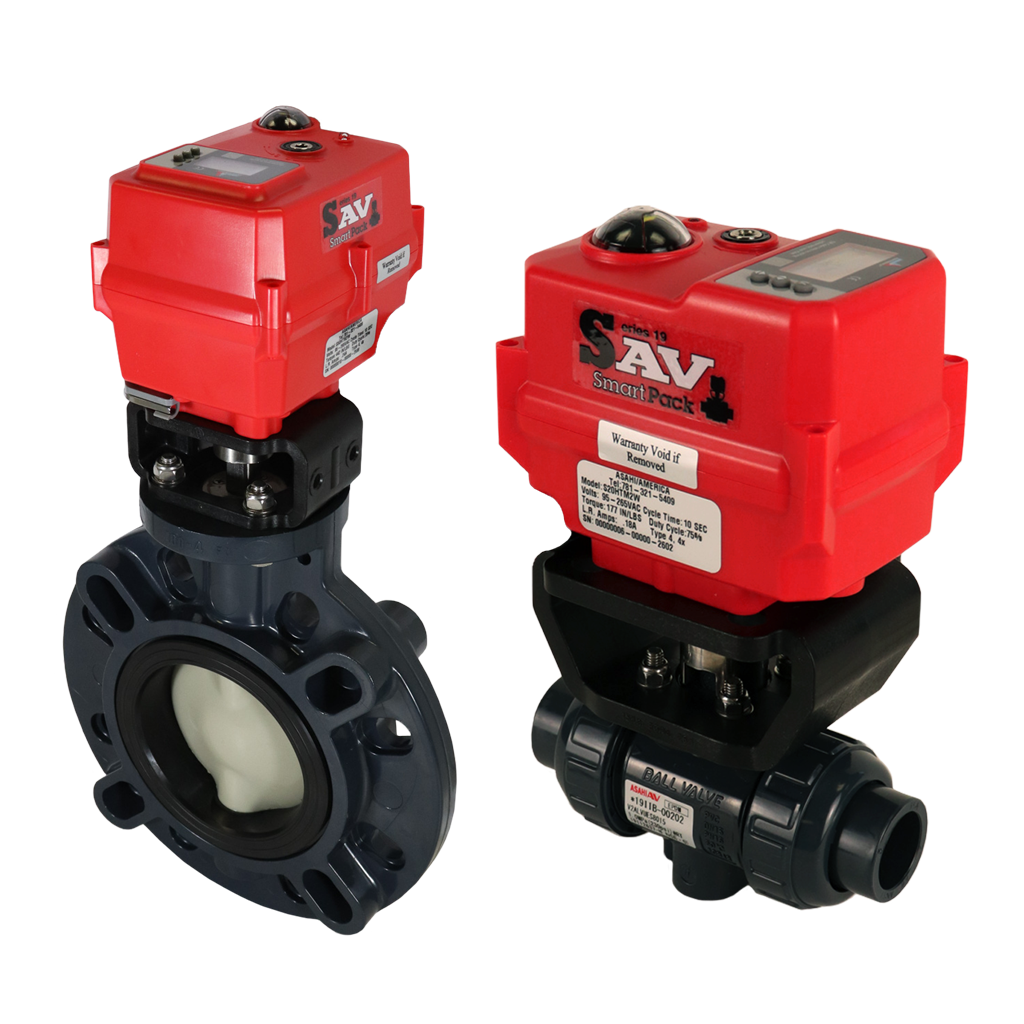
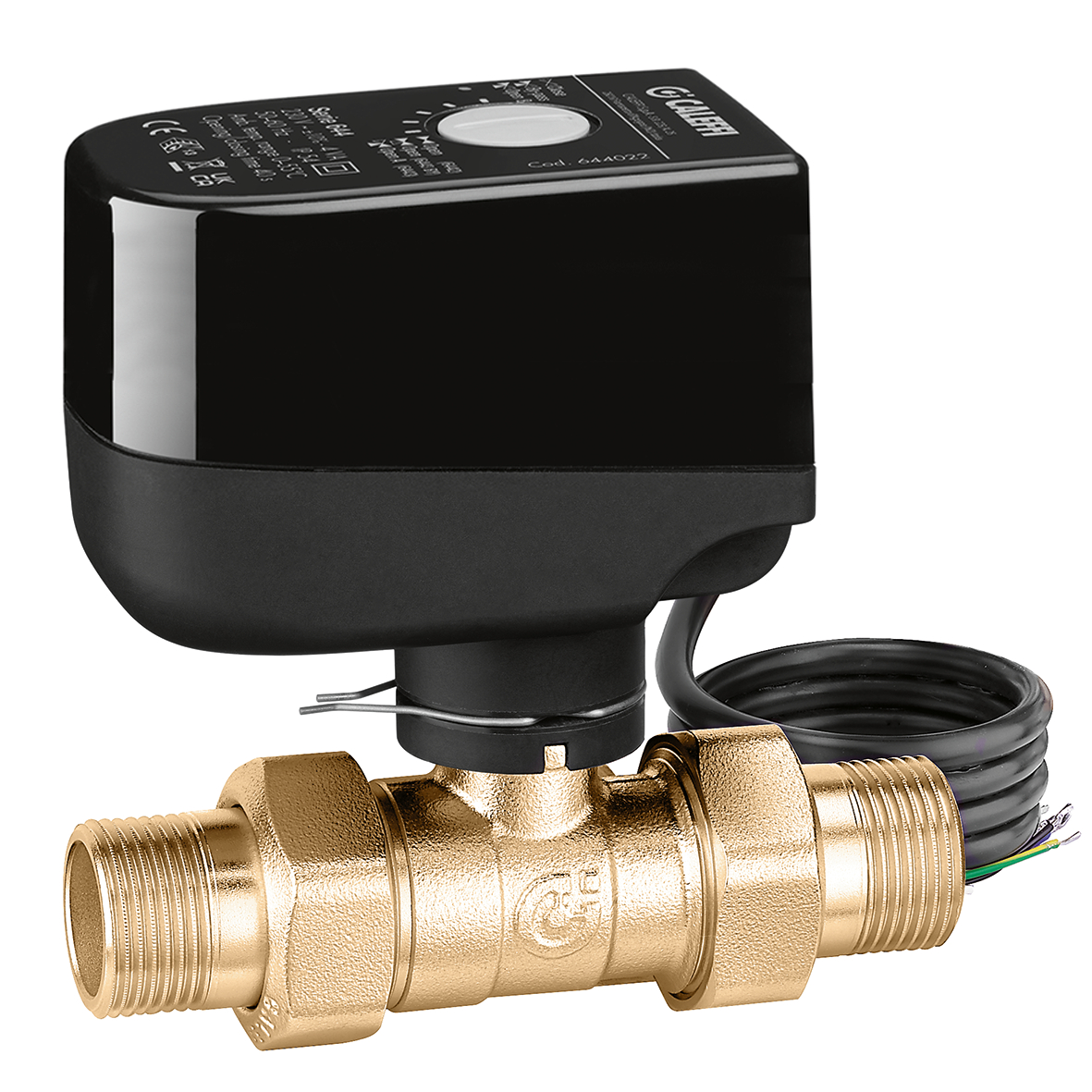
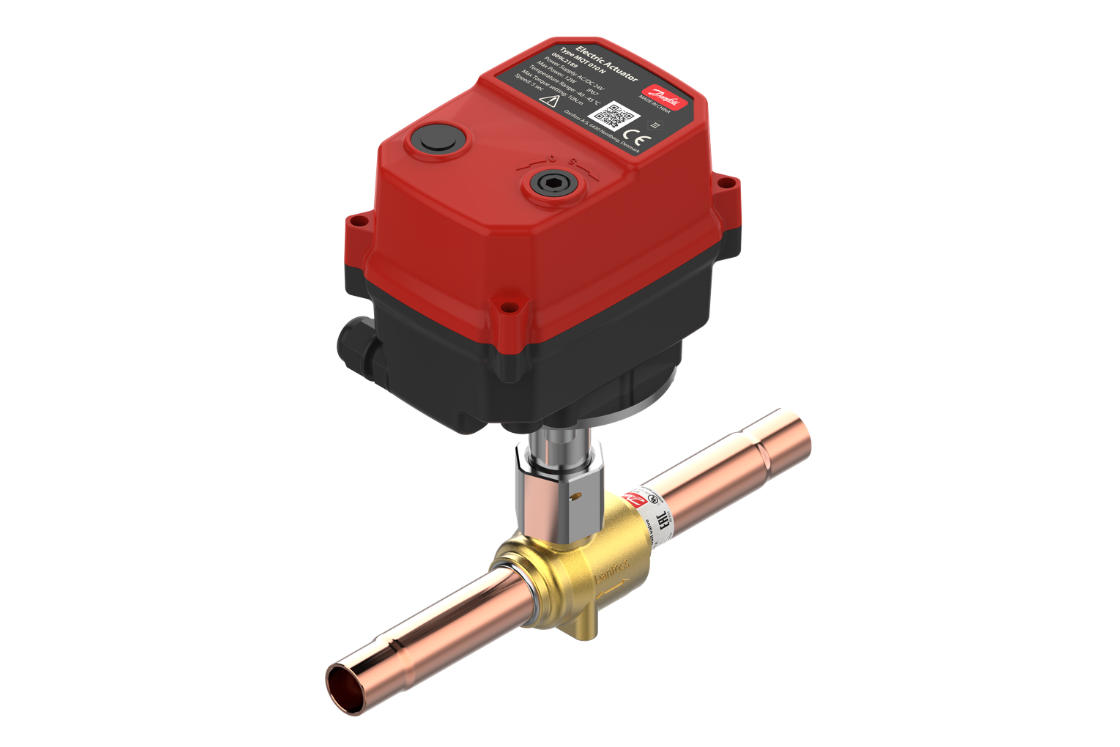
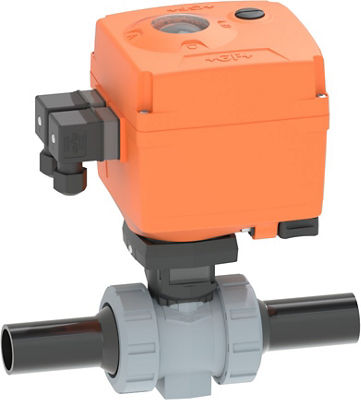
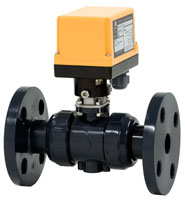
An electric ball valve is a quarter-turn ball valve coupled to an electric actuator that rotates the ball 90 degrees to open, close, or throttle flow on command from a control system. It removes the need for a compressed-air header, gives repeatable positioning, and integrates cleanly with PLC and DCS loops, which is why it has become the default automated isolation and control element in water treatment, HVAC, chemical dosing, and skid-mounted process equipment.
The assembly has two distinct halves with separate specifications: the valve itself (body, ball, seats, stem, governed by API 608, ISO 17292, and ASME B16.34) and the actuator (motor, gearbox, controls, governed by ISO 5211 mounting and IEC 60034 duty classes). Specifying an electric ball valve means specifying both, and confirming that the two mate correctly.
Photo: Ie edits, CC BY-SA 4.0, via Wikimedia Commons
This guide is aimed at industrial purchasing engineers and design engineers. It covers 6 chapters from what an electric ball valve is, through valve types, actuator and control modes, body and seat materials, key spec parameters, to selection decisions, with 7 selection FAQs and manufacturer references, helping you build a complete knowledge framework before a selection decision. Parameters reference API 6D, API 608, ISO 17292, ASME B16.34, ISO 5211, and the IEC 60034 and IEC 60079 series public standards.
Chapter 1 / 06
What is an Electric Ball Valve
An electric ball valve is an automated quarter-turn valve: a spherical closure member (the ball) with a bore through its center sits between two seats inside the body, and an electric actuator rotates the ball through 90 degrees. When the bore aligns with the pipeline the valve is fully open with low pressure drop; rotated 90 degrees, the solid face of the ball blocks the bore and the valve shuts off bubble-tight against a soft seat. The defining feature versus a manual ball valve is the prime mover: instead of a hand lever or gearbox, a motor and reduction gearbox driven by an electrical supply do the work, taking commands from a switch, a PLC discrete output, or an analog control loop.
Functionally the device splits into two engineered subassemblies with separate datasheets. The first is the valve: body and end connections, the ball, the seats, the stem, and the body seals, governed by valve standards such as API 608 and ISO 17292 for design and ASME B16.34 for pressure-temperature rating. The second is the electric actuator: an AC or DC motor, a worm or planetary gear train, limit and torque switches, position feedback, local controls, and the power and signal terminals, governed by the ISO 5211 mounting interface, the IEC 60034 motor duty classes, and, where relevant, the IEC 60079 explosion-protection series. A correctly specified electric ball valve is a correct pairing of these two halves, not a single monolithic part.
The ball valve principle is over a century old, but practical isolation valves became widespread after the development of polytetrafluoroethylene (PTFE) seats in the mid-twentieth century, which gave the hard metal ball a soft, low-friction, chemically inert sealing surface and made tight shutoff at low torque achievable. Electric actuation matured in parallel: as solid-state motor controls, limit switching, and later microprocessor positioners became reliable and affordable, motorizing a quarter-turn valve became routine rather than exotic. Today an electric ball valve can be a 24 VDC plastic-bodied unit on a DN15 dosing line or a three-phase, trunnion-mounted, Class 600 steel valve on a transmission pipeline.
The reason engineers reach for ball valves so often is the combination of three traits: tight shutoff, low flow resistance when open, and fast quarter-turn operation. A full-bore ball valve has essentially the same inside diameter as the pipe, so its flow resistance and pressure loss are very low, close to a straight pipe section. The same quarter-turn that makes it fast, however, also makes a standard ball valve a poor throttling device: most of the flow change happens in a narrow band of the rotation, so for true modulating control a characterized V-port or segmented ball is used instead of a plain round bore. This distinction between isolation duty and control duty runs through every chapter that follows.
Four engineering questions decide whether an electric ball valve is the right choice and which one to buy: what is the service (media, pressure, temperature), is the duty isolation (on-off) or throttling (modulating), what does the site demand of the actuator (power available, area classification, fail-safe behavior), and what is the total cost of ownership including stroke frequency and serviceability. The chapters below work through each in turn.
Chapter 2 / 06
Ball Valve Types and Construction
Before choosing an actuator, fix the valve. Ball valves are classified two ways that matter for actuation: by how the ball is supported (floating versus trunnion-mounted), and by how the body is assembled (one-piece, two-piece, three-piece, or top-entry). A third axis, port size (full bore versus reduced bore), sets the flow capacity. The table below summarizes the two support types, which most directly affect the operating torque the actuator must overcome.
Construction
Ball Support
Typical Size / Class Range
Operating Torque Behavior
Floating ball
Held by the two seats only
Up to ~DN150 (6 in), Class 600
Rises with size and line pressure
Trunnion-mounted
Fixed on upper and lower shafts
Class 600+, up to NPS 60 (API 6D)
Low and stable, spring-loaded seats
Floating ball valves hold the ball captive between the two seats with no separate support shaft. Line pressure pushes the ball downstream against the seat, energizing the seal. This is mechanically simple and economical and dominates small and medium sizes, but as diameter and pressure rise the seat contact load (and therefore the torque needed to break the ball loose) grows quickly, which is why floating designs taper off around DN150 (6 inch) and Class 600. For electric actuation this matters because the actuator must be sized for the worst-case break-to-open torque, and floating-valve torque is sensitive to differential pressure.
Trunnion-mounted ball valves fix the ball on upper and lower stems (trunnions) so it cannot move axially under pressure; instead, spring-energized seats are pushed against the ball. The result is lower and far more stable operating torque, which is why trunnion construction is standard for large-bore, high-pressure pipeline service, scaling under API 6D up to NPS 60. Because their torque is predictable and they are often remote, trunnion valves are frequent candidates for electric actuation. Two governing standards apply by application: API 608 (also aligned with ISO 17292) for general-industry metal ball valves up to about NPS 24 and through Class 600, and API 6D for pipeline valves up to NPS 60 and through Class 2500.
Body assembly determines serviceability. A one-piece body is leak-tight and cheap but not field-repairable. A two-piece body unbolts into two halves for seat replacement but must be removed from the line. A three-piece body lets the center section (with ball and seats) drop out while the end caps stay welded or bolted in the pipe, the preferred choice for valves that need periodic seat service without disturbing the piping. A top-entry body allows inline maintenance through the bonnet, common on large pipeline trunnion valves.
Port size sets flow capacity. A full-bore (full-port) ball has a bore equal to the nominal pipe diameter, giving minimal pressure drop and allowing pipeline pigging; it is the default for isolation duty. A reduced-bore (standard-port) ball has a bore one size smaller, which lowers cost, weight, and torque at the price of higher pressure drop. For control duty neither plain bore is ideal: a V-port ball (with a 30, 60, or 90 degree V notch) or a segmented (characterized) ball gives a more usable, near-equal-percentage flow characteristic for modulating loops.
Chapter 3 / 06
Electric Actuators and Control Modes
The actuator is what makes the valve electric, and it is specified independently of the valve. An electric part-turn actuator contains a motor, a reduction gearbox (usually worm gearing, which is self-locking so the valve holds position without power), limit switches to stop travel at the open and closed ends, a torque switch to protect against jams, and, depending on grade, position feedback and a local control station. The two most consequential choices are the control mode (on-off versus modulating) and the duty rating, because they must match how often and how the valve will actually move. The table below compares the mainstream control modes.
Control Mode
Command Signal
Typical Duty Rating
Ball / Trim
Typical Use
On-off (open-close)
Discrete (relay, PLC DO)
S2-15 min / S4 class A-B
Full or reduced bore
Isolation, batch shutoff
3-point floating
Open / close pulse contacts
S4 class B-C
Full bore or V-port
Slow level / temperature
Modulating (positioning)
4-20 mA or 0-10 V
S4-25% / class C
V-port or segmented
Continuous flow control
On-off (open-close) actuators drive the ball fully open or fully closed and nothing in between. Because they move only occasionally, they carry an intermittent-duty rating under IEC 60034, such as S2-15 minutes (rated to run continuously for 15 minutes then rest) or short-time S4 with a modest starts-per-hour count, which AUMA describes as class A and B. This is the lowest-cost and most common automation for isolation valves: a relay or PLC discrete output sends the open or close command, and limit switches stop the travel.
Three-point floating control sits between on-off and modulating. The controller sends separate open and close pulse contacts, nudging the valve toward the demanded position without a continuous analog reference. It suits slow loops (large tank level, building temperature) where exact positioning is not critical, and uses a mid-grade duty rating because it cycles more than pure on-off but less than a true modulating loop.
Modulating (positioning) actuators hold the ball at any angle in proportion to a continuous 4-20 mA or 0-10 V command. They include a positioner that compares the command to the actual position fed back by a potentiometer or encoder, and they carry a continuous-positioning duty such as S4-25 percent or AUMA class C, because the motor may reverse hundreds of times per hour. Critically, a modulating actuator on a plain round-bore ball still controls poorly, because the ball's flow characteristic is nearly on-off; usable throttling requires a V-port or segmented ball as covered in Chapter 2. Modulating units cost the most and should be specified only where the loop genuinely throttles.
Three further actuator attributes apply across all modes. Power supply ranges from 24 VAC/VDC for small process and HVAC valves, through 110/230 VAC single phase, to 400 VAC three phase for large pipeline actuators; AUMA part-turn actuators, for example, reach torque ratings into the hundreds and over a thousand newton-metres on three-phase supply. Travel time for 90 degrees is commonly in the range of 5 to 30 seconds depending on gearing and size; faster strokes need larger motors. Fail-safe behavior is the actuator's response to power loss: a plain electric actuator simply holds last position (the self-locking worm gear keeps it there), so where a defined safe state is required you must add a spring-return module, or a battery or super-capacitor backup that drives the valve to a preset position on power failure. Every electric actuator should also have a declutchable manual handwheel or override for commissioning and power-out operation.
Chapter 4 / 06
Body, Ball, and Seat Materials
Material selection runs in two layers: the body and ball (which set the pressure-temperature envelope and bulk corrosion resistance) and the seat and seals (which set the sealing performance, friction, and the real temperature ceiling). For most electric ball valves the seat is the limiting component, so it deserves the closest attention. The table below maps common seat materials to their service envelope.
Seat Material
Temperature Range
Strengths
Limitations
Virgin PTFE
-29 to +200 °C
Low friction, broad chemical resistance, tight seal
Cold flow under sustained load, limited wear life
Reinforced PTFE (15% GF)
-29 to +200 °C
Better cold-flow and wear resistance than virgin PTFE
Slightly higher friction, glass attacks some media
PEEK
up to +260 °C
High strength, high pressure, dimensional stability
Higher torque, higher cost
Metal (hard overlay)
+400 °C and beyond
Abrasion, high temperature, fire-safe
Higher torque, small allowable leakage
Body and ball materials follow standard valve practice. Cast carbon steel ASTM A216 WCB and forged A105 are the workhorses for general service, rated by ASME B16.34 up to about +425 degrees Celsius. Austenitic stainless steel CF8M (cast 316) or 316/316L (forged) is used for corrosive and clean process media. For aggressive duty, nickel alloys such as Hastelloy and duplex stainless extend the corrosion envelope. The ball is typically the same grade as the body or a harder grade, often chrome-plated or hard-coated to resist seat wear; in abrasive service a tungsten-carbide or chromium-carbide overlay is applied.
Virgin PTFE is the default soft seat: it is chemically near-universal, low in friction (so it keeps torque and therefore actuator size down), and seals bubble-tight. Its weaknesses are cold flow (it slowly deforms under sustained seat load, which can raise break-to-open torque after a long idle period, a real consideration for electric actuator sizing) and a continuous limit around +200 degrees Celsius. Reinforced PTFE, commonly 15 percent glass-filled (RPTFE), keeps PTFE's chemistry while resisting cold flow and wear better, at the cost of slightly higher friction; glass fill should be avoided with hydrofluoric acid and strong caustics that attack glass.
PEEK is a high-performance thermoplastic seat for higher temperature (to about +260 degrees Celsius) and higher pressure than PTFE allows, with excellent dimensional stability; it raises operating torque and cost and is specified where PTFE cannot survive but a full metal seat is not yet warranted. Metal seats with a hard overlay (tungsten carbide or chromium carbide) are used above the polymer limit, in abrasive slurry, and where a fire-safe rating is needed; they reach +400 degrees Celsius and beyond but demand a stronger actuator and accept a small specified leakage rate rather than bubble-tight shutoff.
The table below is a quick first-pass lookup tying media and temperature to a seat choice. Treat it as a starting point only: always confirm against the valve maker corrosion chart and the actual concentration, temperature, and cycling of your service before committing.
Service Condition
Recommended Seat
Body / Ball
Water, air, light hydrocarbons ≤+200 °C
Virgin PTFE or RPTFE
WCB or CF8M / 316
General chemical, mild cycling ≤+200 °C
RPTFE (15% GF)
CF8M / 316L
Hot process or higher pressure to +260 °C
PEEK
316 or nickel alloy
Steam, hot oil, fire-safe >+260 °C
Metal (hard overlay)
WCB / 316 hard-faced
Abrasive slurry, particulate
Metal (carbide overlay)
Hard-coated ball
Chapter 5 / 06
Key Specification Parameters
An electric ball valve datasheet carries two parameter blocks, one for the valve and one for the actuator. The valve block centers on pressure class, port and connection, and torque; the actuator block centers on power, control, duty, mounting, and enclosure. Below are the parameters that actually drive a selection decision.
Pressure class and rating is the valve's pressure-temperature envelope, set by ASME B16.34 for Class-designated valves (or EN 1092-1 for PN-designated valves, as ISO 17292 allows). The rating is not a single number: it derates as temperature rises. For cast carbon steel WCB at -29 to +38 degrees Celsius the maximum working pressures are approximately 19.6 bar for Class 150, 51.1 bar for Class 300, and 102 bar for Class 600; the same Class 300 valve falls to a lower pressure as the line heats toward the +425 degrees Celsius carbon-steel limit. Always read the rating at your actual operating temperature, not at ambient.
ASME Class
WCB max working pressure at +38 °C
Approx. PN equivalent
Class 150
19.6 bar (285 psi)
PN 20
Class 300
51.1 bar (740 psi)
PN 50
Class 600
102 bar (1,480 psi)
PN 100
Port size and flow coefficient (Cv or Kv) describe capacity. Full-bore valves have the highest Cv and lowest pressure drop; reduced-bore valves trade capacity for lower cost and torque. For control valves the published Cv at each opening angle, together with the inherent characteristic (a V-port approximates equal-percentage), defines how the loop will behave. Operating torque is the single most important number for actuator sizing: the break-to-open torque (BTO) at maximum differential pressure, taken from the specific valve datasheet, drives everything in Chapter 6.
End connections set how the valve joins the pipe: threaded (NPT, BSP, G), socket-weld or butt-weld, wafer, tri-clamp for sanitary service, or flanged (ASME B16.5 raised-face, or PN flanges to EN 1092-1). Leakage class and fire-safe rating matter for isolation: soft-seated ball valves typically achieve tight shutoff (ISO 5208 rate A, often described as bubble-tight), while metal seats accept a defined leakage; fire-safe designs to API 607 or API 6FA maintain a secondary metal seal if the soft seat burns away.
Actuator parameters form the second block. Rated torque must exceed the factored valve BTO. Power supply is 24 VAC/VDC, 110/230 VAC single phase, or 400 VAC three phase. Control mode is on-off, 3-point, or modulating (4-20 mA / 0-10 V) per Chapter 3. Duty rating per IEC 60034 (S2 or S4 with a percentage) must match the stroke frequency. Mounting is the ISO 5211 flange code (F03 through F12 and larger, where the number is the bolt pitch-circle diameter code in millimetres, for example F07 is a 70 mm circle) plus the stem-drive size. Enclosure is the IP rating (commonly IP67 for outdoor and washdown, IP68 for submersion) and, separately, the hazardous-area certification (ATEX, IECEx, NEPSI, FM/CSA) where the area is classified. Ambient temperature for the actuator electronics is commonly -20 to +70 degrees Celsius, independent of the valve's process-temperature rating.
The list below summarizes the actuator output and feedback options that recur on datasheets:
On-off command: dry contact or PLC discrete output, with open and closed limit-switch feedback.
Modulating command: 4-20 mA or 0-10 V, with a 4-20 mA position-feedback transmitter.
Fieldbus / digital: Modbus RTU, PROFIBUS DP, or in larger ranges PROFINET and EtherNet/IP for status and remote configuration.
Fail-safe option: spring-return module or battery / super-capacitor backup driving to a preset position on power loss.
Manual override: declutchable handwheel for commissioning and power-out operation.
Chapter 6 / 06
Selection Decision Factors
Translate the previous five chapters into a model with the decision sequence below. The most common selection failures are torque undersizing and a control-mode mismatch (buying a modulating actuator on a round-bore ball, or an on-off actuator for a throttling loop), so treat steps 1 through 4 as non-negotiable. These eight steps double as an RFQ template.
Service definition: media, maximum and minimum temperature, maximum operating and design pressure, and any solids or corrosion concerns. This fixes the body, ball, and seat materials per Chapter 4 and the pressure class per ASME B16.34.
Duty: isolation or throttling: decide on-off versus modulating up front. Isolation duty takes a full or reduced-bore ball and an on-off actuator; throttling duty takes a V-port or segmented ball and a modulating actuator. Do not motorize a round-bore ball for a control loop.
Valve construction and size: floating for small-to-medium, trunnion for large-bore and high-pressure; select port size (full or reduced bore) for the required Cv; choose body assembly (two-piece, three-piece, top-entry) for the serviceability you need.
Actuator torque sizing: take the valve break-to-open torque at maximum differential pressure from the valve datasheet, apply a safety factor of 1.25 to 1.5 for clean service or 2.0 or more for sticky, infrequently cycled, or spring-return duty, and confirm the actuator rated torque exceeds it. Verify the ISO 5211 flange code and stem-drive dimension both match.
Power and control interface: confirm the available supply (24 VAC/VDC, 110/230 VAC, or 400 VAC three phase), the command signal (discrete, 3-point, or 4-20 mA / 0-10 V), and the feedback and fieldbus the control system expects.
Duty rating and stroke frequency: match the IEC 60034 duty class (S2 / S4 with percentage) to how often the valve will actually move; a modulating loop needs class C / S4-25 percent, an occasional isolation valve needs only S2.
Enclosure and area classification: specify the IP rating (IP67 outdoor or washdown, IP68 submerged) and, where the area is classified, the explosion-protection certification (ATEX / IECEx Ex d, NEPSI, or FM/CSA) with the correct gas group and temperature class. An IP rating alone does not cover a hazardous zone.
Fail-safe and total cost of ownership: decide the required action on power loss (hold, spring-return, or battery backup) and add it. Then weigh purchase price against installation, commissioning, spare seats, and downtime: a marginally cheaper undersized actuator that stalls after the seats relax onto the ball costs more in nuisance trips than the saving.
A frequently overlooked dimension is serviceability and sourcing. Because most ISO 5211 ball valves are supplied bare-stem and paired with a separately specified actuator, you can mix valve and actuator brands as long as the mounting kit matches, but you also inherit two spare-parts chains. Established valve makers include Emerson (Vanessa, KTM), Flowserve, Cameron, KITZ, Velan, Bray, and Swagelok for instrument-scale valves; established actuator makers include Rotork (IQ and part-turn ranges), AUMA (SA/SQ and modulating SQR), Emerson Bettis, Flowserve Limitorque, and Belimo for smaller HVAC and process duty. Confirm local spare-seat and actuator-board availability, declutchable manual override, and firmware or positioner support before committing to a large fleet of identical units.
FAQ
What is the difference between an electric ball valve and a pneumatic ball valve?
Both automate a quarter-turn ball valve, but the prime mover differs. An electric ball valve uses a motor-gearbox actuator driven by an electrical supply (typically 24 VAC/VDC, 110/230 VAC single phase, or 400 VAC three phase). A pneumatic ball valve uses a rack-and-pinion or scotch-yoke cylinder driven by compressed air at 4 to 8 bar. Electric actuators need no air infrastructure, give precise modulating positioning, and draw power only while moving, but they stroke slower (commonly 5 to 30 seconds per 90 degrees) and need a battery, capacitor, or spring module to fail to a safe position. Pneumatic actuators are faster, inherently fail-safe with a spring return, and preferred in hazardous areas, but require a clean dry air header. Choose electric where air is unavailable, throttling accuracy matters, or stroke frequency is low.
What is the difference between an on-off and a modulating electric ball valve?
An on-off (open-close) electric ball valve drives the ball fully open or fully closed and is governed by an intermittent duty rating such as IEC 60034 S2-15 min or S4 class A and B, because it only strokes occasionally. A modulating (positioning) electric ball valve holds the ball at any intermediate angle in proportion to a 4-20 mA or 0-10 V command, so it carries a continuous-positioning duty such as S4-25 percent or AUMA class C, a built-in positioner, and a feedback potentiometer or encoder. Modulating units need a characterized V-port or segmented ball to give usable flow resolution, since a standard full-bore ball is nearly on-off in its flow curve. Specify on-off for isolation and batch service; specify modulating only where the loop actually throttles.
What is the difference between a floating ball valve and a trunnion-mounted ball valve?
In a floating ball valve the ball is held only by the two seats; line pressure pushes the ball against the downstream seat to create the seal, which is simple and economical but raises seat load and operating torque as size and pressure climb. Floating designs dominate up to roughly DN150 (6 inch) and Class 600. In a trunnion-mounted ball valve the ball is fixed on upper and lower shafts (trunnions), and spring-energized seats are pushed against the ball, so the ball does not move under pressure. This lowers and stabilizes torque, which is why trunnion construction is standard for large-bore, high-pressure pipeline valves (Class 600 and above, up to NPS 60 under API 6D). Larger torque-stable trunnion valves are common candidates for electric actuation.
How do I size the electric actuator torque for a ball valve?
Start from the valve break-to-open torque (BTO) at maximum differential pressure, found in the valve maker datasheet, not a generic table, because seat material, line pressure, and dry or lubricated service change it substantially. Apply a safety factor: 1.25 to 1.5 for clean service, and 2.0 or more for sticky, slurry, infrequently cycled, or fail-safe duty where the actuator must also compress a spring. Confirm the actuator rated torque exceeds the factored BTO, and that its ISO 5211 mounting flange (for example F05, F07, F10) and stem coupling match the valve. Undersizing causes stall and nuisance trips after the seats relax onto the ball during idle periods; oversizing wastes cost and can over-stress the stem.
What IP and explosion-protection rating do I need outdoors or in a hazardous area?
For outdoor, washdown, or wet locations choose an actuator enclosure rated at least IP67 (NEMA 4X), which resists dust ingress and temporary immersion; submerged or buried duty needs IP68 with a defined depth and time. For potentially explosive atmospheres the enclosure rating is separate and mandatory: ATEX or IECEx Ex db (flameproof) or Ex d under the IEC 60079 series in Europe and most of the world, with NEPSI in China and FM or CSA Class I Division 1 or 2 in North America. The gas group (IIA, IIB, IIC) and temperature class (T1 to T6) must cover the site hazard. An IP67 weather rating alone does not make an actuator suitable for a classified zone.
What is the maximum temperature for a soft-seated electric ball valve?
It is set by the seat polymer, not the body. Virgin PTFE seats run about -29 to +200 degrees Celsius continuously; reinforced PTFE (15 percent glass-filled RPTFE) covers a similar window with better cold-flow and wear resistance; PEEK seats extend to roughly +260 degrees Celsius and tolerate higher pressure. Above that, a metal-seated ball valve with a hard overlay (for example tungsten carbide or chromium carbide) is required, reaching +400 degrees Celsius and beyond, at the cost of higher torque and a small allowable leakage. Note also that the electric actuator has its own ambient limit, commonly -20 to +70 degrees Celsius, so for hot lines mount the actuator on an extended bonnet or stem extension to keep its electronics within range.
Which manufacturers make electric ball valves and electric actuators?
For the valve body, established makers include Emerson (Vanessa and KTM brands), Flowserve, Cameron (SLB), KITZ, Velan, Bray, and Swagelok for instrument-scale valves. For the electric actuator, widely specified industrial brands include Rotork (IQ multi-turn and the part-turn quarter-turn ranges), AUMA (SA/SQ open-close and SQR modulating part-turn), Emerson Bettis, Flowserve Limitorque, and for HVAC and smaller process duty, Belimo (torque roughly 5 to 90 Nm). Many ISO 5211 ball valves are supplied as bare-stem valves and paired with a separately specified actuator, so the valve and actuator can come from different manufacturers as long as the mounting kit matches.
Electric Ball Valve Manufacturers
Source-backed product routes. Open a company dossier for procurement scope and cited evidence.