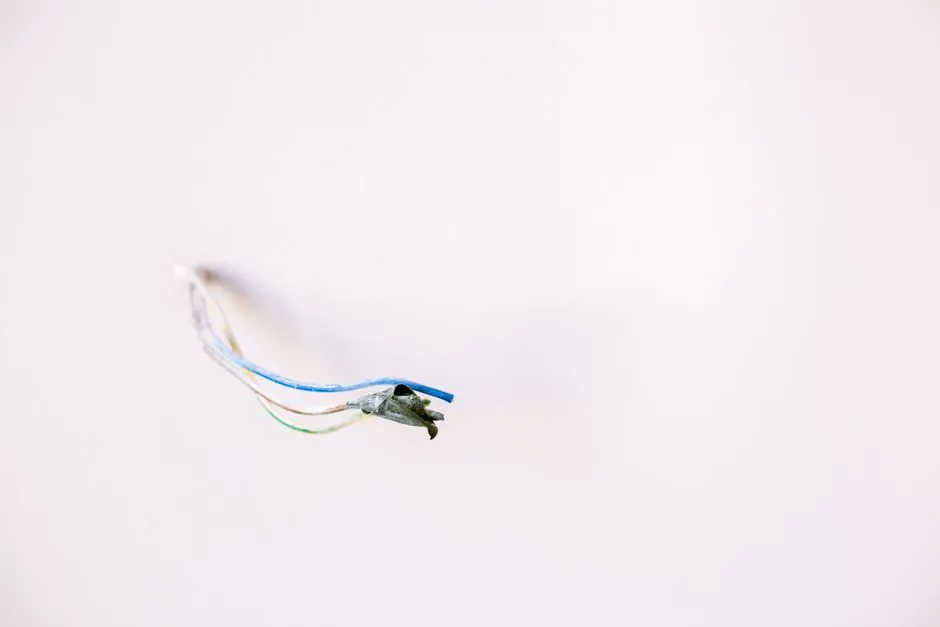
A bare copper (BC) drain wire is the uninsulated stranded conductor that runs longitudinally in direct contact with the metallic face of an aluminum or copper foil shield, sized most commonly between 18 AWG and 22 AWG [S8]. The "BC" stamp on a cable spec sheet means the drain is left uncoated, the default for control and instrumentation cables such as Southwire SPEC 85026 [S4].
Functionally, the drain wire is not a signal conductor and not a safety ground; it terminates the shield by completing the Faraday cage around the insulated pairs, giving induced shield currents a low-impedance return path to the equipment ground bar at one end of the run [S2][S3]. That single distinction, shield-termination aid versus protective earth, drives every spec choice that follows.
What the BC Designation Actually Means on a Spec Sheet
BC means the drain wire is supplied as bare, uncoated copper, usually class B stranded per ASTM B8 to match the main power conductors of the same cable [S4]. Southwire's 600 V FR-XLPE shielded control cable lists "Drain Wire: Bare copper drain wire. Tinned copper drain wire available upon request" as a standard line item, confirming BC as the default [S4].
The base material matters because the drain sits in direct, sustained contact with the aluminum side of a foil shield, two dissimilar metals separated only by the cable's rated temperature (90°C continuous, 130°C emergency, 250°C short-circuit per SPEC 85026) [S4]. In a dry, sealed jacket that combination is benign; where moisture ingress is possible, specifying tinned copper drain is the standard mitigation, discussed below in the comparison section [S2].
Electrical Function: Why a Drain Wire, Not a Ground Wire
The drain wire's job is to create a low-resistance connection to the cable's metallic shield so the shield can be bonded to ground at the termination [S1][S3]. Without it, terminating a delicate aluminum/polyester foil is impractical; a drain gives the installer a single, solderable or crimpable conductor to attach instead of trying to pigtail the fragile foil edge [S3].
The drain is grounded at one end only, a single-point bond, so that no closed loop exists for 50/60 Hz mains current to circulate on the shield [S2]. This keeps the drain out of the fault-current path: a drain wire "doesn't have the size or strength to replace a standard ground wire in an electrical installation" [S2]. Engineers reading a cable print should therefore never count the BC drain toward the equipment-grounding conductor required by NEC 250 or the protective-earth cross-section in IEC 60364.
Sizing, Stranding, and AWG Range
Drain-wire gauges cluster in a narrow band: 18 AWG to 22 AWG bare copper is the most common range for signal- and instrumentation-level foil-shielded cables [S8]. Larger 16 AWG and 14 AWG drains appear in multi-conductor control cables such as Southwire's 16 AWG 2-conductor through 12 AWG 4-conductor SPEC 85026 builds, where the main conductors themselves are that size and the drain scales to keep the shield termination mechanically consistent [S4].
Stranding almost always follows the main conductor: 7-strand class B compressed bare copper per ASTM B3 and ASTM B8 on Southwire's 16 AWG and 12 AWG control cables, 19-strand on the 12 AWG 12-conductor build [S4]. The strand count matters at the connector, because a fine-strand drain crimps more reliably into a backshell than a solid of the same cross-section, and the higher strand count also flexes with the cable without work-hardening at the termination [S6].
BC vs Tinned Copper Drain: A Side-by-Side Decision
The spec question that comes up on every shielded cable purchase order is whether to accept the standard BC drain or pay the upcharge for tinned copper. The decision is driven by four criteria, drawn from the sources: [S2]
(1) Galvanic compatibility with the shield. Bare copper against aluminum foil in a wet environment is a galvanic couple. Tinned copper "prevents interactions between the copper conductors and the aluminum shield from occurring," and is the standard fix where heat and moisture could otherwise drive corrosion that shortens cable life [S1][S2].
(2) Termination environment. Indoor, controlled-climate panels, conduit, and tray installs are BC territory because the jacket keeps the shield and drain dry. Outdoor, direct-burial, chemical-plant, and marine runs default to tinned because jacket breaches are not a question of if but when [S2][S4].
(3) Specification precedent. Southwire and most US control-cable OEMs list BC as the default with tinned as the optional variant, a pricing signal that tinned is the special-order item [S4].
(4) Resistance budget. Tinned copper carries a marginally higher DC resistance per kilofoot than bare copper of the same AWG, but the drain is not a current-carrying conductor in normal operation, so the difference is functionally irrelevant for shield-termination duty [S4].
The take-away: specify BC for dry, indoor, NEC Article 501/502 Class I-III Division 2 tray and conduit runs (which is exactly the application envelope of Southwire's 600 V TC-ER control cable) [S4]; specify tinned for any run where the jacket is the only thing keeping moisture away from the shield [S2]. For a deeper look at how that cable design interacts with broader control-panel grounding, see this 200 A arc welder duty cycle walkthrough, which uses the same one-point bonding logic at a much higher current scale.
How the BC Drain Interfaces with the Rest of the Shield System
The drain is the terminating pigtail for whichever shield the cable uses. With foil (aluminum/polyester tape), the drain lies along the inside of the tape, in continuous contact along the whole cable length, and that 100% foil coverage is what makes foil shielding the right pick for low-frequency and high-frequency EMI alike [S3]. The drain is then soldered or crimped to the connector backshell at one end of the run [S3].
With a braided shield (woven copper, typically 70-95% coverage depending on weave density), a drain is optional because the braid itself is mechanically robust enough to terminate directly to a connector, and braid coverage is chosen to trade off against flexibility and flex life [S3]. Many cables use both: an overall braid for mechanical strength and an inner foil with BC drain for 100% EMI coverage, a common pattern in pro-audio, broadcast, and industrial signal cables [S1][S3].
The BC drain is also the failure point most likely to be miswired in the field. The two most common installation errors are grounding both ends (creating a 50/60 Hz ground loop on the shield) and treating the drain as a safety ground (using it as the equipment bonding conductor) [S2]. Both errors are prevented by the same rule, called out by the ODU engineering brief: the drain is bonded at one end only and exists solely to terminate the shield [S3].
Applicable Standards and Where the BC Drain Fits
There is no single standard that governs the drain wire itself as a component; the requirements cascade from the cable specification. Southwire SPEC 85026 cross-references ASTM B3 (soft or annealed copper wire), ASTM B8 (concentric-lay-stranded copper conductors), UL 44, UL 1277, UL 1685 FT4, ICEA S-58-679, ICEA S-73-532, ICEA S-95-658 (NEMA WC70), IEEE 1202 / FT4, and VW-1, with NEC Articles 501, 502, and 336.10 governing the Class I-III Div 2 and exposed-run (TC-ER) installation rules [S4].
The single most-cited operating envelope for these cables is 90°C continuous, 130°C emergency overload, 250°C short-circuit, three numbers that bound both the conductor insulation and the bare-copper drain in the same thermal cycle [S4]. Engineers writing a cable spec for a copper material procurement should copy those limits verbatim; they are the only drain-wire temperature numbers that are not vendor invention in the source set.
Selection Checklist for a BC Drain on the Next PO
Use BC as the default unless one of three conditions is met: the run is outdoor, direct-burial, or in a corrosive atmosphere; the cable sits in a tray or conduit that has previously seen water ingress; or the spec writer wants to eliminate the bare-copper/aluminum galvanic couple as a future failure mode [S1][S2][S4]. In all three cases order tinned copper drain, which the same vendors stock against the same part numbers [S4].
Size the drain to roughly match the main conductor AWG on multi-conductor control cable, or to 18-22 AWG on signal and instrumentation cable [S4][S8]. Verify the cable is built to a published spec sheet that names both the drain material and the applicable UL/ICEA/ASTM standards, because generic "drain wire" callouts without an AWG or material are a red flag for offshore builds that skip the tinned option entirely [S1][S4].
Trackable signal to watch on the next sourcing cycle: whether more US control-cable vendors add tinned-copper drain to the default line (rather than as a special order) as direct-burial and Class I Div 2 work continues to migrate to TC-ER-rated constructions under NEC 336.10 [S4]. A second signal is any movement on harmonising the BC/tinned callout across ICEA S-73-532 and UL 1277 so the spec writer does not have to reconcile two vocabularies on the same datasheet.
Spec-level background on the components involved: shielded cable, and cable wire.